
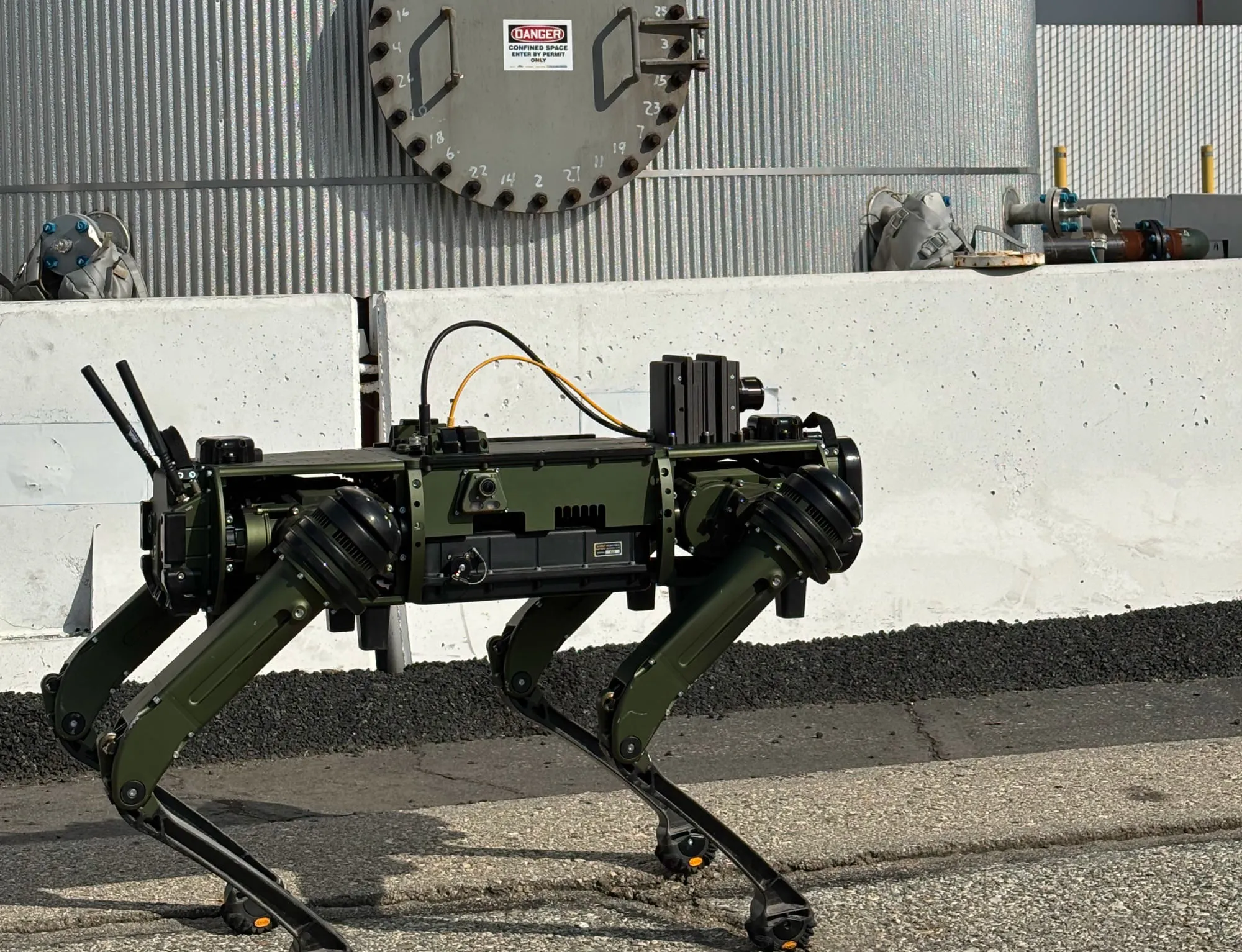
The Chemical Facility Anti-Terrorism Standards (CFATS) program, administered by TSA's Chemical Security Inspection Division, requires high-risk chemical facilities to implement physical security measures commensurate with their assigned risk tier. For the highest-consequence sites, those requirements include documented perimeter patrol, surveillance, and access-control programs that most facilities meet today through contract guard services. Rising labor costs, chronic staffing shortages, and the difficulty of proving continuous coverage are pushing chemical operators across the Gulf Coast to look at autonomous ground robots as a way to strengthen compliance while controlling spend. This guide explains what CFATS asks of physical security, how autonomous patrol fits, and what a real deployment looks like.
What CFATS Requires for Physical Security
A CFATS Site Security Plan (SSP) must address a defined set of security measures: perimeter security and access control, patrol and inspection protocols, detection and surveillance capability, and the ability to respond to an incident. The exact measures scale with tier and are negotiated between the facility and TSA through the SSP approval process. Across every tier, though, one theme is constant — the program has to be documented and auditable. Patrol rounds must be logged, access events must be recorded, and inspectors must be able to verify that the plan on paper is actually being executed in the field.
This is precisely where traditional guard programs struggle. A guard walking a route with a clipboard produces logs of uneven quality and completeness. When a section of the perimeter gets skipped — which happens in every human patrol program during bad weather, short-staffed shifts, or fatigue late in a night rotation — the gap rarely announces itself. It simply becomes a hole in the record that a CFATS auditor may later question. Manual logs are also slow to compile and easy to dispute, which turns audit preparation into a scramble.
How Autonomous Ground Robots Close the Gap
Autonomous quadruped robots are built to run the same route the same way, on schedule, and to prove it. The Ghost Robotics Vision 60 is a rugged, all-terrain unmanned ground vehicle designed for outdoor perimeter security. It handles mud, gravel, ice, and Gulf Coast heat — the real conditions around a Texas or Louisiana chemical plant — and it produces GPS-tracked, timestamped patrol logs for every mission it runs. The record does not depend on a guard's diligence or documentation habits. Every route is captured with precise location data, timing, and sensor evidence of completion, which is exactly the kind of defensible audit trail CFATS documentation is meant to demonstrate.
For sites that want layered coverage rather than a single platform, Asylon combines a ground robot (DroneDog) with an aerial drone (Guardian) and 24/7 human monitoring from a remote security operations center. That pairing lets a facility watch the fence line from the ground and cover large open areas, tank farms, or rail sidings from the air, while trained operators verify alarms and coordinate response. A Vision 60 excels at repeatable, terrain-heavy perimeter loops; the Asylon system layers aerial reach and staffed oversight on top. Both approaches are described in more depth on our security and surveillance solutions page.
What robotic patrol adds to an SSP
- Consistent coverage. A robot runs the full route every time, day or night, without the coverage gaps that come from staffing and fatigue.
- Objective documentation. Timestamped, geolocated logs and captured imagery give inspectors a verifiable record instead of a handwritten one.
- Faster incident awareness. Thermal and visual sensors flag intrusions, hot spots, or open gates in real time rather than at the end of a round.
- Safer human roles. Guards move from repetitive night walks in a hazardous environment to monitoring and response — a meaningful benefit given that warehousing and industrial settings carry above-average injury rates per BLS data.
Building the Compliance and ROI Case
Physical security is one of the few line items on a chemical facility budget that grows every year and returns nothing measurable in good times. Autonomous patrol changes that math on two fronts. First, it hardens the compliance posture — the SSP is easier to prove, audit prep shrinks, and the documentation record is stronger than anything a clipboard produces. Second, it reshapes the cost structure. Under a Robotics-as-a-Service (RaaS) model, the robot, software, and support are an operating expense rather than a capital purchase, so a facility avoids a large up-front outlay and pays a predictable monthly fee. Typical payback on Actel deployments runs in the range of ten to twenty-two months, and a site can go from a signed proposal to a live system in roughly three months.
We encourage security and operations leaders to model this out before committing. Our ROI calculators let you compare the fully loaded cost of guard coverage against a robotic patrol program for your specific site, and our robot comparison tool helps you weigh the Vision 60 against an integrated Asylon deployment. Because Actel is a full-lifecycle integrator, the number you model should reflect the whole engagement — assessment, solution design, deployment, systems integration, operator training, and ongoing optimization — not just hardware.
Implementing Robotic Security at a CFATS Site
CFATS facilities considering robotic security should notify their TSA Chemical Security Inspector early and discuss how the autonomous patrol program fits within the approved SSP. In most cases the robot supplements, rather than replaces, the human security elements the plan requires — its documentation then becomes a core part of the ongoing compliance record. A typical Actel engagement starts with an on-site assessment to map the perimeter, terrain, patrol routes, charging or docking locations, and network conditions. From there we design the patrol program, integrate alerts and data into the facility's existing security operations, train the on-site team, and tune routes and schedules after go-live.
Deployment also means attention to the standards that govern how these systems operate safely around people and other equipment — including ANSI/RIA R15.08 for autonomous mobile robots and ISO 3691-4 for automated industrial vehicles. Actel handles that engineering and integration work as part of the project so your security and EHS teams are not left to interpret it alone. Facilities that also run automation inside the building can extend the same integrator relationship to autonomous inspection with Boston Dynamics Spot or to warehouse inventory and fulfillment systems, keeping one accountable partner across the site.
The Takeaway
CFATS does not tell you to buy a robot — but it does demand a documented, auditable, continuously executed physical security program, and that is exactly what human patrol programs find hardest to prove. Autonomous ground robots like the Ghost Robotics Vision 60, or an integrated Asylon ground-and-air system, deliver consistent coverage and objective records while turning a growing labor cost into a predictable operating expense. For chemical operators across Texas, Louisiana, and Oklahoma, that combination strengthens compliance and the balance sheet at the same time. Learn more about our services, read our related overview of robotics on the Gulf Coast, and when you are ready, contact Actel Robotics for a free facility assessment tailored to your CFATS requirements.