Autonomous Warehouse
Inventory Management
Autonomous warehouse inventory management is the use of AI-powered drones to scan barcodes and pallet locations in distribution centers without human operators. Using platforms like the Corvus One™ drone, facilities reach 99%+ inventory accuracy within 90 days while scanning roughly 250 slots per hour — with no Wi-Fi, GPS, or facility modifications. It is deployed across 3PLs, cold storage operators, and enterprise retailers.
Replace manual cycle counting with AI-powered autonomous drones. Daily full-facility scans, 99%+ accuracy within 90 days, direct WMS integration — with zero changes to your facility infrastructure.
Manual Inventory Management Is Broken
Manual cycle counting typically dedicates 2–4 full-time associates to counting, pulls forklifts off productive work, and still leaves accuracy gaps between annual physical inventories.
Most distribution centers operate at 85–95% inventory accuracy on any given day. That 5–15% gap drives failed picks, emergency replenishment, shrinkage, and customer service failures — all from a process that consumes 2–4 FTEs doing nothing but walking aisles with a scanner.
Annual physical inventories require teams of 8–130 people, days of operational disruption, and external auditors — for a snapshot of inventory that starts degrading the moment counting ends. There is a better way.
Autonomous Drones Replace Manual Counting — Entirely
Corvus One scans hundreds of pallet positions per flight with no Wi-Fi or GPS and syncs a discrepancy report to your WMS before the next shift.
Autonomous AI drones fly your warehouse aisles every day, scan every barcode, and upload a complete discrepancy report to your WMS before the next shift begins. No pilots. No scanners. No disruption to operations.
Full-Facility Cycle Counts
Every location counted every day. Discrepancies caught the day they occur — not weeks or months later. Your WMS becomes genuinely trustworthy.
Inventory Accuracy in 90 Days
From a typical 85–95% baseline to 99%+ within 90 days of go-live. Documented across enterprise warehouse deployments.
Infrastructure Changes Required
No WiFi, no GPS, no reflectors, no racking modification. A power drop and ethernet connection at each cradle location. That's it.
From Cradle to WMS — Fully Autonomous
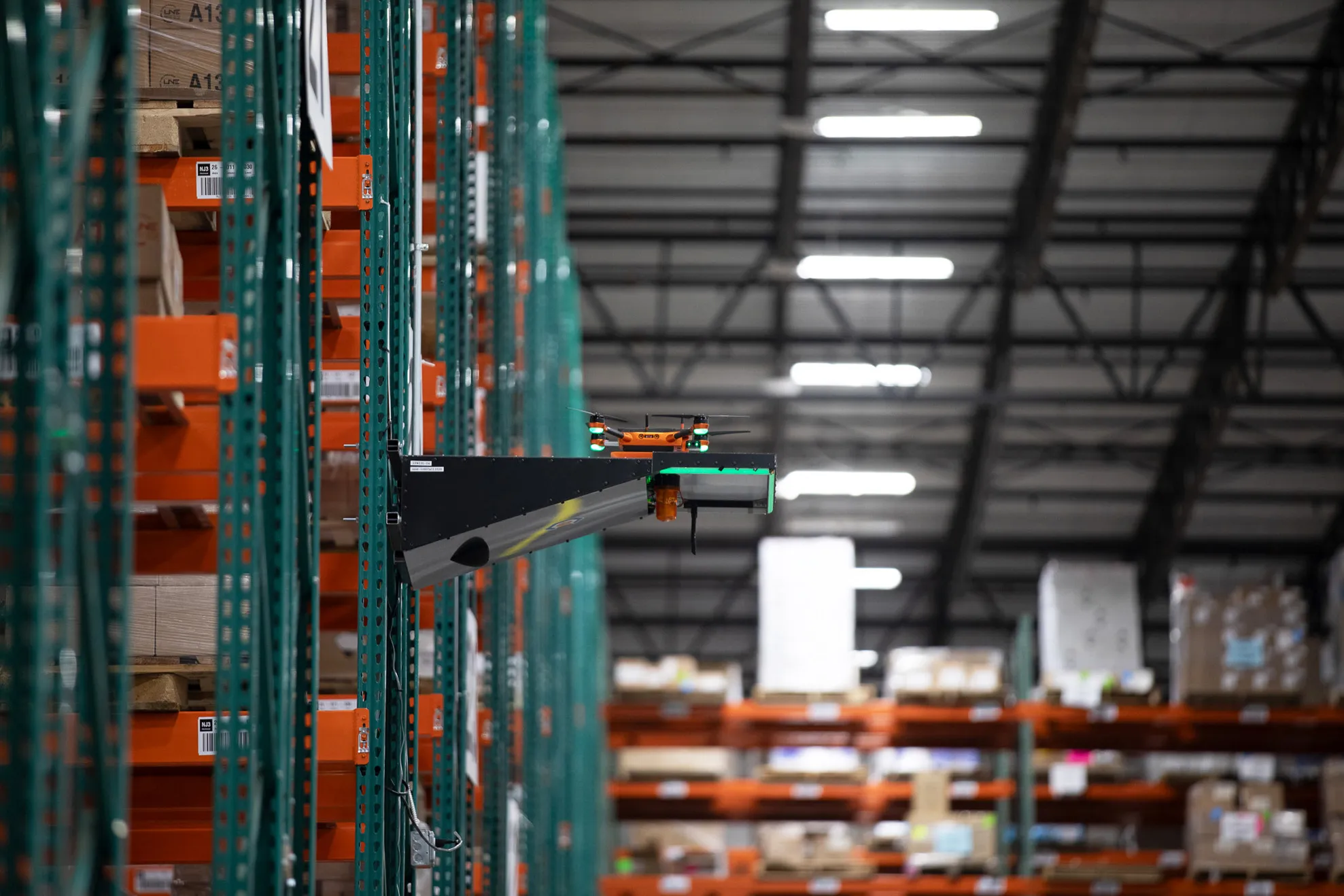
Autonomously launches on a programmed schedule — day, night, or lights-out. No human needed to start, supervise, or land the mission.
14-camera array scans every pallet face, reads every barcode, captures timestamped photos linked to WMS location addresses. Forklifts and staff work normally around it.
Monitors battery level, returns to cradle autonomously, recharges, and relaunches for the next aisle. No human battery swap. Ever.
the Corvus One platform uploads all scan data to your WMS — SAP, Manhattan, Blue Yonder, Oracle, and others. Supervisors review discrepancies and approve adjustments. No manual data entry.
Built for These Operations
Distribution Centers
High-velocity DC operations with 50,000+ locations, multiple SKUs, and daily order fulfillment requirements where accuracy failures directly drive customer service costs.
Cold Chain & Frozen
Cold storage and frozen warehouse operators where human counting in sub-zero environments is slow, expensive, and creates safety exposure. Cold Chain variant operates to -20°F.
3PL Operators
Third-party logistics providers with multi-client accuracy SLAs who need daily verification across all client inventory without dedicating headcount to each client's counting needs.
Retail Distribution
Retailers and grocery DCs where inventory inaccuracy drives out-of-stock conditions and failed replenishment — the accuracy gap that costs sales every day.
Pharmaceutical & Healthcare
FDA-regulated supply chain operations requiring documented inventory accuracy with full audit trail — every count timestamped, location-tagged, and photo-documented.
MRO Storerooms
Maintenance, repair, and operations storerooms at industrial facilities where parts availability directly affects uptime — and where inaccurate inventory drives emergency procurement.
Payback in 10–22 Months.
5-Year ROI of $1.5M+.
Delivered on a Robotics-as-a-Service model — an operating expense, not a capital project — with typical payback in 10–22 months.
The ROI case for autonomous inventory management extends well beyond direct labor savings. When you model the full cost of manual inventory — including MHE diversion, annual PI events, shrinkage from infrequent counts, and failed pick cost — the total is typically 3–5× what operations teams estimate.
Most mid-size distribution centers achieve payback in 10–22 months. The subscription model means no CapEx — your ROI starts from month one with no capital appropriation required.
130 People → 8 People for Annual Physical Inventory
From Assessment to Go-Live
in About 90 Days
Dedicated Warehouse Inventory Sites
Explore our autonomous inventory solutions and local service areas:
Warehouse Automation Guides
Go deeper on warehouse automation, inventory automation, and the scanning technologies behind it:
Warehouse Inventory Automation — Frequently Asked Questions
What is autonomous warehouse inventory management?
It is the use of AI-powered drones to scan barcodes and pallet locations in a distribution center without human operators. Platforms like the Corvus One fly the aisles on a schedule and report discrepancies to your WMS, replacing slow, hazardous manual cycle counting.
How accurate are inventory drones?
Facilities typically reach 99%+ inventory accuracy within about 90 days of deployment, and hold it with near-continuous counting rather than an annual physical inventory that is stale the day it finishes.
Do inventory drones need Wi-Fi, GPS, or facility changes?
No. The Corvus One localizes with onboard computer vision, so it flies without Wi-Fi, without GPS, and without rails, beacons, or other infrastructure changes to your building.
How much faster is drone counting than manual cycle counts?
Autonomous drone counting is roughly 20× faster than manual cycle counting — scanning on the order of 250 slots per hour, including the high, hazardous top-rack locations, and it can run lights-out.
What is the payback period for inventory drones?
Under a Robotics-as-a-Service model, deployments typically reach payback in about 10 to 22 months. Model your own numbers with our ROI calculators, or see typical ranges in the ROI Benchmark.
