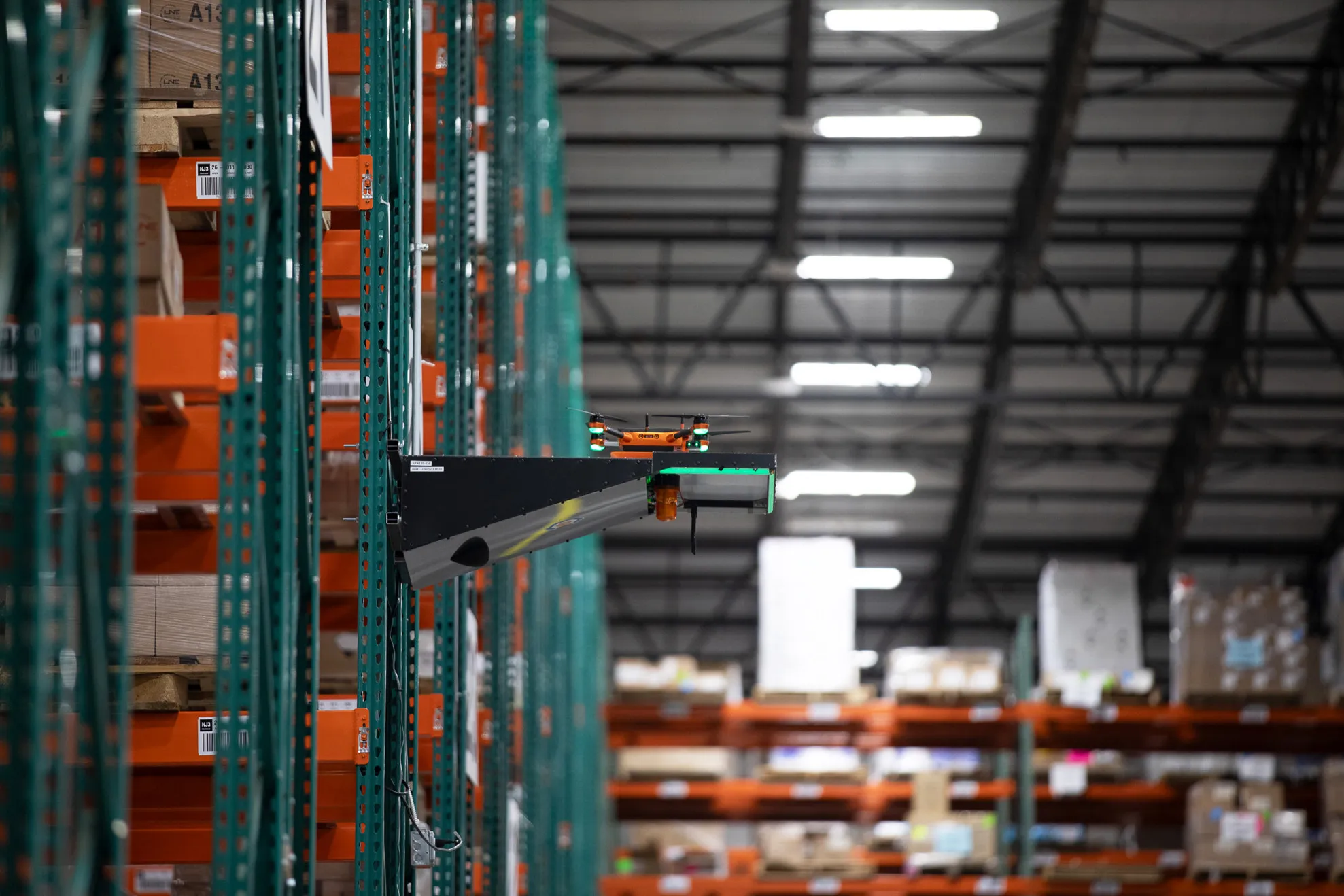
When GNC approached Corvus Robotics about automating their inventory counting process across two distribution centers in Indiana and Arizona, the scale of what they were trying to replace was staggering. GNC was dedicating entire teams to manual cycle counting — associates walking aisles, scanning labels by hand, logging discrepancies into a WMS that was perpetually out of date. The Indianapolis facility ran 24/7 without meaningful downtime, making it nearly impossible to allocate counting labor without disrupting order fulfillment. Full physical inventories required external auditing teams and days of effort. The process was expensive, slow, and still delivered results that degraded by the hour.
Bill Monk, VP of Distribution at GNC, put it simply: "I like the Corvus Robotics drones because they are out of sight, out of mind. They're doing things that there's really not a lot of value to an individual on, but to the business, it's priceless."
What Manual PI Really Costs
The GNC case study is representative of a pattern we see across large distribution centers. Annual physical inventories — the event that most facilities rely on as their source of inventory truth — are enormously expensive when you account for the full cost. One customer with a computer component manufacturing operation described their most recent PI: over 130 people working around the clock, with multiple forklift teams diverting from productive operations to assist counting crews at elevated levels. That event cost hundreds of thousands of dollars in direct labor, lost throughput, and organizational disruption — for a snapshot of inventory that began degrading the moment it was completed.
The math on manual cycle counting isn't much better. At the typical distribution center, maintaining a reasonable cycle count frequency requires 2-4 dedicated FTEs — associates whose full-time job is walking aisles with a scanner, a clipboard, and a WMS connection. Add in the material handling equipment hours required to reach elevated positions, and the fully-loaded cost of manual inventory management routinely exceeds $150,000-$250,000 per year at mid-size facilities.
What that investment buys is not comprehensive inventory accuracy. It buys a rotating sample of your inventory — not the whole facility, not every day, and not with the consistency that good operational decisions require. The average distribution center operates at 85-92% inventory accuracy on any given day. The gap between what the WMS records and what is physically on the shelf is the source of failed picks, mis-shipments, emergency replenishment, and the customer service cost that follows each fulfillment failure.
What Changed with Corvus One
GNC deployed Corvus One across 40,000 locations at their Indiana and Arizona distribution centers. The drone system operates throughout the day during active business hours — flying alongside associates and forklifts at walking speed, triggering neither distraction nor safety concern. Every pallet position is scanned. Every barcode is read. Every discrepancy is categorized and uploaded to the WMS before the next shift begins.
The transformation in how GNC manages inventory is not incremental — it is categorical. The facility that previously required an external audit team and days of disruption for a physical inventory can now run a full scan overnight, every night, and have a complete discrepancy report waiting for the operations team when they arrive for first shift. The 2-4 FTEs who spent their days counting are now working in picking and fulfillment — higher-value work that actually moves product to customers.
The accuracy improvement is the headline number. GNC and comparable Corvus deployments consistently achieve 99%+ inventory accuracy within 3 months of go-live — up from baselines of 83-92%. But the operational benefit goes beyond accuracy. Cycle count frequency — the number of times each location is scanned per year — increases from 2-4 times annually to daily coverage. Discrepancies are caught on the day they occur, not weeks or months later. The inventory record in the WMS becomes genuinely trustworthy.
One operations director at a Fortune 500 construction goods company put it in terms that capture the operational transformation precisely: "We use Corvus every day. We trust it as our system of record more than our WMS."
The Physical Inventory That Used to Require 130 People
One computer component manufacturer with a massive distribution footprint described their most recent PI in terms that illustrate what autonomous drone inventory changes for large-scale annual events. Previously, 130+ people working around the clock — with all the coordination, overtime cost, and operational disruption that implies. This year, the same facility used the drones to scan overnight, then applied 8 associates and 4 scissor lifts to work through the exceptions. Total time: 3 hours.
That is the difference between a drone inventory program and a manual one. Not a 10% improvement. Not a "better process." A complete replacement of the economics of inventory management — at a cost that most distribution center operators recover in less than two years through labor savings alone.
What Does Deployment Actually Look Like?
The Corvus One deployment process through Actel Robotics is designed to minimize disruption and front-loaded cost. The system operates on a Robotics-as-a-Service (RaaS) monthly subscription model — no large capital expenditure, no owned hardware. The subscription covers the drones, the Corvus Cradle charging stations, the AIMS software platform, all maintenance, battery replacements, and ongoing support.
From signed agreement to go-live is approximately 3 months. Actel Robotics manages the full process from our Sugar Land, Texas headquarters: facility assessment, WMS integration, power and ethernet coordination with your facilities team, Corvus engineer onsite installation (1-2 weeks), test flights, and go-live on the AIMS dashboard. Your team receives training on the AIMS platform and a dedicated customer success contact for the life of the contract.
For facilities that want to evaluate drone inventory before committing to a subscription, Actel Robotics also offers a one-time physical inventory scan service — a single full-facility scan by a Corvus One drone, managed by an Actel deployment engineer, delivering a complete discrepancy report. No subscription required.
Is Corvus One Right for Your Facility?
Corvus One is purpose-built for facilities with racked pallet storage in aisles as narrow as 50 inches. It handles standard and high-bay configurations, ambient and frozen environments (the Cold Chain variant operates to -20°F), and active and lights-out operational windows. If your facility has:
- Racked pallet storage with 200+ locations
- Active cycle counting labor (even 1 FTE) or annual PI events
- Inventory accuracy challenges affecting fulfillment or planning
- A WMS system (SAP, Manhattan, Blue Yonder, Oracle, or others)
— then a Corvus One deployment almost certainly has a compelling ROI case. Use our free Drone ROI Calculator to model your facility's specific savings, or contact Actel Robotics for a facility assessment. We serve the Greater Houston area, Louisiana, and Oklahoma from our Sugar Land headquarters — and can be on-site for an initial evaluation within days.