Warehouse inventory management has a fundamental problem that no amount of manual labor has ever fully solved: inventory inaccuracy is expensive, persistent, and remarkably resistant to traditional solutions. U.S. retailers alone lose an estimated $224 billion annually to inventory distortion — shrinkage, misplacement, and inaccuracy. The average warehouse conducts physical inventory twice per year. For many, that's twice per year when they discover what went wrong in the preceding six months.
Autonomous drone systems are changing this calculus entirely. And the numbers from real deployments — not marketing projections — are compelling enough to demand attention from any distribution center or logistics operation managing more than 50,000 square feet of racked storage.
"Typically, warehouses will do inventory twice a year — we change that to once a week or faster." — Mohammed Kabir, Co-founder & CTO, Corvus Robotics (MIT)
The Scale of the Problem
Manual cycle counting is one of the most labor-intensive, error-prone, and operationally disruptive tasks in a warehouse. A team of 2-4 FTEs typically required for ongoing cycle counts costs $100,000–$180,000 in annual fully-loaded labor — before accounting for the material handling equipment (MHE) pulled off productive work to support counting operations, or the cost of the disruptions counting creates for put-away and pick operations.
Beyond labor, inaccurate inventory creates cascading downstream problems: failed picks, mis-shipments, customer service issues, premium freight charges to cover stockouts, and write-offs on damaged or expired inventory that sat in the wrong location. When you model the full cost of inventory inaccuracy, most facilities are carrying a $300,000–$800,000 annual problem they've normalized as the cost of doing business.
How Corvus One Actually Works
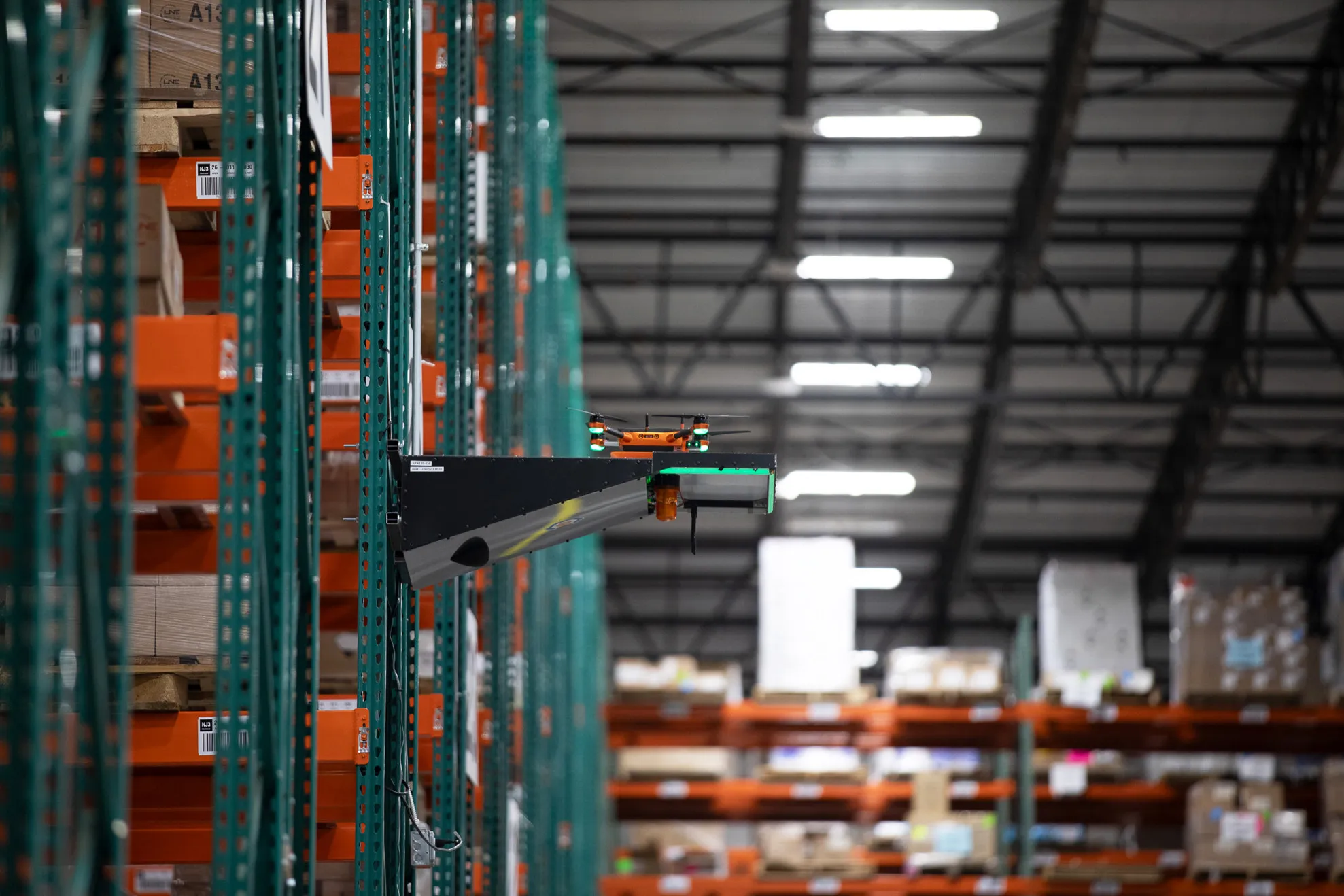
The Corvus One system deploys fully autonomous drones — no pilot, no remote operator — from a dock installed at the end of product racks. Setup requires no infrastructure modifications: no reflectors, stickers, beacons, or facility markings. The dock serves as a charging and data transfer station; drones return autonomously when battery is low.
Each Corvus One drone is equipped with 14 cameras and runs a custom AI-based navigation stack built specifically for warehouse environments. Unlike systems that rely on AprilTags or fixed markers for localization, Corvus uses learning-based vision autonomy — the same approach that makes GPS-denied navigation reliable in repetitive aisle environments where traditional computer vision algorithms lose their way.
The operational specs that matter for planning:
- 200–400 pallet positions scanned per 20-minute flight
- Minimum aisle width of 50 inches — including very narrow aisle (VNA) environments
- Operates at temperatures down to -20°F (fully rated for cold storage and freezer environments)
- Works in lights-out conditions — complete darkness, no disruption to operations
- Reads any barcode symbology in any orientation on pallet front faces
- Counts pallets and cases, performs volumetric analysis of slot storage capacity
- Real-time WMS sync — discrepancies auto-categorized with suggested resolution
The LAPP USA Case Study: 134,000 Sq Ft, 60% Labor Cut
LAPP USA — a global cable and connection technology distributor — deployed Corvus One at its 134,000 square foot warehouse. The results at 30 days were measurable and documented:
- Full inventory counts increased from 2–3 per year to 26+ per year (13× improvement)
- 60% reduction in inventory labor costs
- Weekend overtime for inventory counting was eliminated entirely
- Error detection accelerated from quarterly discovery to same-day flagging
- Supply chain planning confidence improved through accurate real-time data
The LAPP case is instructive because it shows what happens when a mid-size distribution operation modernizes — not a Fortune 500 facility with dozens of supporting technology investments. The ROI was driven entirely by labor reallocation and accuracy improvement, without any facility modification.
The GNC Deployment: 450,000 Sq Ft and Removing the Human Bottleneck
GNC's distribution center covers 450,000 square feet — a facility that previously required teams navigating with material handling equipment to conduct audits. The human cost was not just the direct count labor; it was the MHE pulled from productive operations, the disruption to active picking zones, and the scheduling complexity of coordinating count windows.
After Corvus deployment, GNC Vice President of Distribution Bill Monk described the experience: the drone system does things that have real business value but no value to an individual worker — precisely the profile of a task that humans will always deprioritize and a machine will always execute consistently.
"The drones are out of sight and out of mind. They're doing things that there's really not a lot of value to an individual, but to the business it's priceless." — Bill Monk, VP of Distribution, GNC
Cold Storage and Frozen Environments: The Special Case
Cold chain warehousing presents the most extreme version of the manual inventory problem. Workers in -20°F freezer environments face PHY limits on time in the zone, high injury risk, and stringent PPE requirements. Traditional cycle counting in frozen environments is expensive, dangerous, and consistently executed at a lower frequency than ambient operations.
Corvus One operates at -20°F without any infrastructure modification. The latest generation system runs lights-out frozen operations — nightly autonomous inventory sweeps with next-morning discrepancy reporting before the first shift begins. For cold chain operators, this is arguably the highest ROI deployment scenario, because the baseline cost of manual counting is so elevated and the accuracy gaps so significant.
What Drives ROI in Your Facility
The ROI calculation for drone inventory is straightforward, but the inputs vary significantly by operation. The key drivers are:
- Racked square footage and pallet positions: Larger facilities reach payback faster because the drone's throughput becomes proportionally more valuable vs. human labor
- Current FTE count dedicated to inventory: Each FTE represents $45,000–$70,000 in annual fully-loaded cost available for reallocation
- MHE cost allocation: The hidden cost — pulling forklifts and pickers off productive work has measurable throughput impact
- Temperature environment: Frozen/refrigerated environments carry a premium on both the drone system and the savings, because baseline manual costs are highest
- Current inventory accuracy rate: Lower accuracy = more recoverable value from improvement
- Write-off history: Drone accuracy improvement of 3–5 percentage points translates directly to write-off reduction
For a 100,000 sq ft ambient warehouse with 2 FTEs dedicated to counting and 85% baseline inventory accuracy, the typical payback period is 14–22 months. For a 200,000 sq ft frozen facility with 4 FTEs and 80% accuracy, payback can be under 10 months.
Use Our Free Drone ROI Calculator →The Market Trajectory
The drone-based warehouse inventory market was valued at over $1.2 billion in 2024 and is projected to reach nearly $10 billion by 2033 — a CAGR exceeding 20%. Corvus has raised $18M in Series A and seed funding and counts companies across the Fortune 500 in its pipeline. The technology is past early adoption; it is in mainstream deployment.
For distribution center operators who haven't yet evaluated autonomous inventory, the question is no longer whether the technology works. The documented case studies — across ambient, refrigerated, and frozen environments; across facility sizes from 100,000 to 450,000 square feet; across 3PL, manufacturing, and retail verticals — demonstrate that it does. The question is what the delay is costing.
Actel Robotics is an authorized Corvus Robotics systems integrator serving the Houston, TX region and beyond. We handle procurement, deployment, WMS integration, and ongoing support for Corvus One deployments of all scales.