
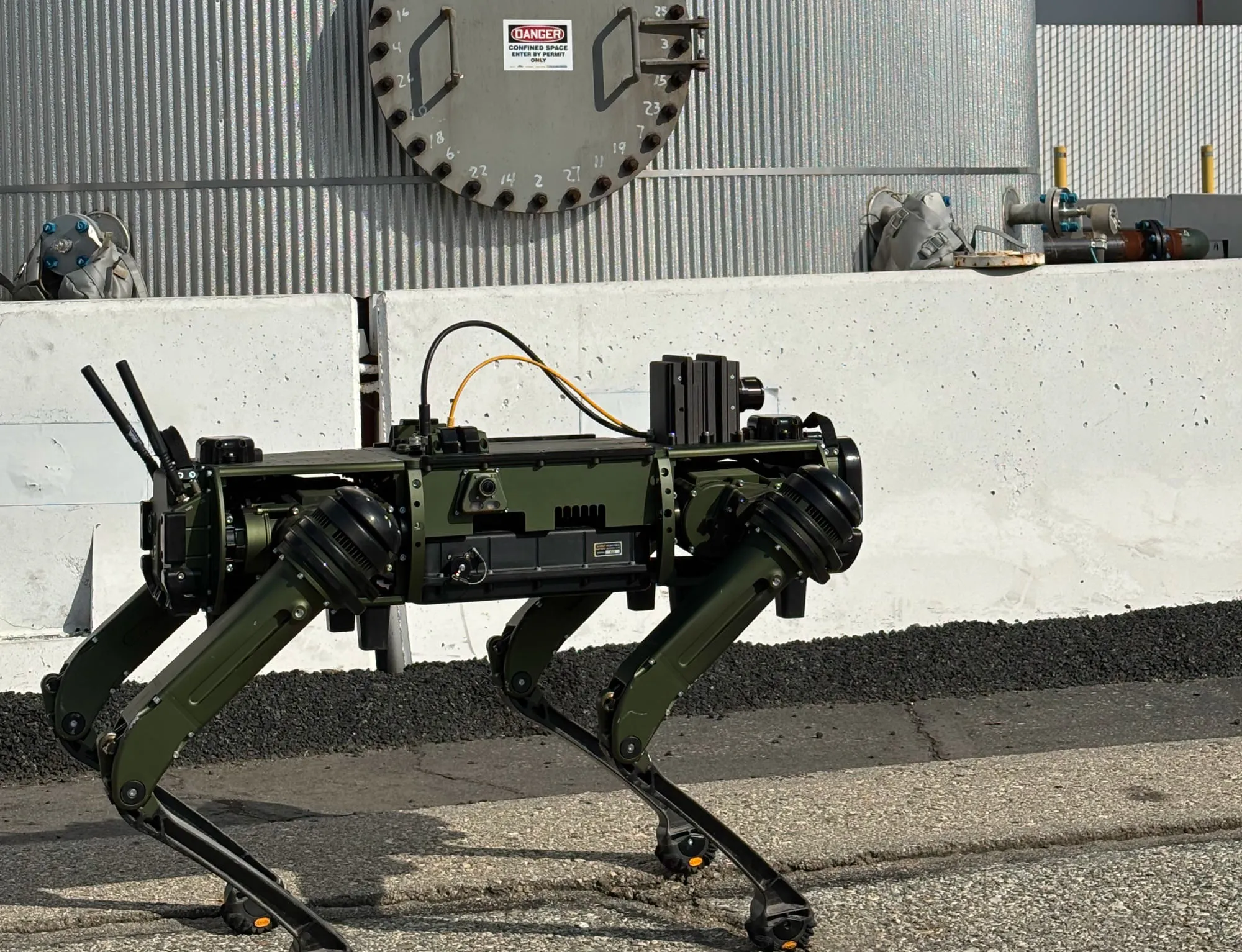
Physical security at industrial and commercial facilities has always run into the same wall: patrol coverage is only as consistent as the people walking the route. Guards get tired, coverage gaps open between rounds, and documentation varies from shift to shift and from one contractor to the next. Along the Greater Houston and Gulf Coast industrial corridor — where sprawling distribution yards, refineries, and chemical plants sit alongside busy freight arteries — that variability translates directly into risk and cost. Autonomous ground robots built for outdoor perimeter duty are changing that calculus, and the Ghost Robotics Vision 60 is at the center of the shift.
This post covers how the Vision 60 works on patrol, how it fits into an integrated ground-plus-aerial program, what buyers should weigh, and how the economics pencil out for a Texas facility.
Why Robotic Patrol Beats Adding More Cameras
The comparison that matters is not robot versus human guard — it is a moving patrol versus a wall of fixed cameras. Both are pitched as ways to extend coverage, but they do fundamentally different things. A fixed camera watches one point and records what crosses its field of view. It is a passive, after-the-fact record. A patrolling robot changes the nature of security from documentation to active deterrence: it is visible, it moves, and it is unpredictable to anyone studying your site for weak spots. It signals that the facility is actively monitored rather than merely recorded.
The Vision 60 is a rugged, all-terrain quadruped unmanned ground vehicle purpose-built for the outdoors. Unlike wheeled robots that stall on gravel, curbs, or drainage grates, a legged platform walks uneven perimeters, climbs stairs and berms, and keeps its footing in mud, ice, and standing water. That matters on the Gulf Coast, where facilities contend with unpaved laydown yards, flooding, and punishing summer heat. The Vision 60 is engineered to keep patrolling through conditions that ground a lot of other hardware.
How the Vision 60 Works on Patrol
Once deployed, the robot follows configured patrol routes autonomously on whatever schedule the site requires — day, night, or continuous lights-out rounds that a human crew could never sustain. Every patrol is logged with timestamped video and route data, producing a consistent, auditable record that does not depend on which guard was on duty.
When the robot encounters an anomaly — motion in a restricted zone, an open gate, a person where no one should be — it can pause, capture the scene from multiple angles including thermal imaging, and push an immediate alert to the monitoring team. That same visual-and-thermal sensing is why the class of quadruped is also trusted for demanding robotic inspection work.
What a Vision 60 patrol program delivers
- Consistent coverage — the same route walked the same way every round, unaffected by fatigue, turnover, or call-outs
- Complete documentation — every patrol timestamped and recorded, giving compliance and insurance teams a defensible audit trail
- All-terrain, all-weather operation — legged mobility across gravel, mud, ice, stairs, and Gulf Coast heat
- Active deterrence — a visible, mobile presence that changes the risk calculation for anyone surveilling the site
- Lights-out capability — round-the-clock patrol without the cost of overnight staffing
The Integrated Model: Ground, Air, and a 24/7 RSOC
The most capable deployments in the Houston corridor are not single-robot programs — they are integrated systems. Through Asylon, the ground robot (marketed as DroneDog and built on the Vision 60 platform) is paired with the Guardian aerial drone and managed from a Robotic Security Operations Center (RSOC) staffed by human security professionals 24/7.
The workflow is straightforward. When the ground robot flags a potential intrusion, the aerial Guardian can launch from its automated dock, reach the location quickly, and provide an overhead view that confirms or clears the alert. An RSOC operator then makes the call: escalate to law enforcement, dispatch a response team, or stand down. This human-in-the-loop design keeps every security judgment with a trained professional — the robots gather information, the people decide what to do with it. For large-footprint sites such as refineries, ports, and regional distribution centers, that layered coverage spans perimeters that would otherwise demand a substantial standing guard force.
Buyer Considerations for Houston and the Gulf Coast
Robotic security is not a drop-in gadget; it is a program. A few factors deserve early attention when scoping a deployment.
Environment and terrain
Map your perimeter honestly. Unpaved yards, ramps, retention ponds, and heat load all favor a legged platform over wheeled alternatives. Route design still needs to account for docking, charging, and safe navigation around active vehicle and forklift traffic.
What robotics does not replace
Autonomous patrol handles the most labor-intensive, lowest-consistency part of a security program — walking the route and documenting it. It does not replace access control and badging, human response to confirmed incidents, or emergency coordination. The strongest programs redeploy people from routine rounds toward the judgment-heavy work where they add the most value, using the robot's records as the backbone for metrics, reporting, and investigations.
Safety and standards
Any autonomous system operating around people and equipment should be deployed with recognized safety practices in mind. The same rigor that governs mobile robots in warehouse settings — standards such as ANSI/RIA R15.08 for autonomous mobile robots — informs how patrol routes, speeds, and hand-off zones are designed on a live site.
Security-plus-inspection dual use
If your facility also needs routine equipment rounds, consider a combined program. Boston Dynamics Spot handles autonomous, repeatable visual, thermal, and acoustic inspection on the same kind of terrain, so security and inspection can be planned as one integrated robotics initiative rather than two disconnected projects.
The Economics: RaaS and Payback
The reason robotic patrol is spreading is not novelty — it is the cost structure. Actel Robotics offers these systems on a Robotics-as-a-Service (RaaS) basis, which turns a large capital purchase into a predictable operating expense. There is no fleet of hardware to buy outright, and software, updates, and support are bundled into the ongoing service.
Across the platforms we deploy, typical payback lands in roughly the 10-to-22-month range, driven by reduced reliance on around-the-clock guard coverage, fewer loss events, and the compliance and insurance value of complete documentation. The right way to size the benefit is to model your current patrol spend and coverage gaps against a robotic program — our ROI calculators and platform comparison tools are built for that first pass, and our team can validate the numbers against your actual perimeter and staffing.
Deployment: From Assessment to Live Patrol
Actel Robotics is a systems integrator based in Sugar Land, Texas, serving Texas, Louisiana, and Oklahoma, led by President Dan Tarpey and his team's three decades in supply-chain technology and automation. We run the full lifecycle so a security program actually lands: on-site assessment, solution design, patrol-route configuration, integration with existing access control and CCTV, operator training, and ongoing optimization. Our services cover the program end to end rather than dropping hardware and walking away.
A facility can typically go from signed proposal to live patrol in about three months — assessment and route planning up front, then integration, testing, and staff training before the robot starts standing watch. You can see the full security platform lineup on our security and surveillance solutions page, and dig deeper into the hardware in our related coverage of Vision 60 deployments in Texas and how the platform stacks up in our Ghost Robotics vs. Boston Dynamics comparison.
If patrol quality, coverage gaps, or rising security costs are on your radar for a Houston or Gulf Coast facility, the fastest way to see whether autonomous patrol fits is a site assessment. Contact Actel Robotics to walk your perimeter with our team and get a straight answer on coverage, integration, and payback.