
Ask a VP of Operations what manual cycle counting costs, and the answer is almost always a labor figure: a couple of associates during the week, a bigger crew at busy season, a line item that reads as wages and nothing more. That is the number that shows up in budget reviews, and it is the number that gets weighed against the cost of automation.
It is also the wrong number — or, more precisely, a small slice of the right one. Manual inventory verification ties up far more than the people holding the scanners. Once you account for the indirect costs that never land on a dedicated line, the true cost of a manual counting program is a multiple of what most teams carry in the budget. Understanding that full cost structure is exactly what makes the case for autonomous drone counting so clear.
The Costs That Never Reach the Cycle Count Budget
The direct wages are real, but they are the visible tip of a much larger structure. The costs below are the ones operations leaders routinely leave out — not because they are trivial, but because they are buried in other departments' numbers.
Material handling equipment diversion
Every forklift hour spent supporting a count is an hour not spent on inbound receiving, outbound loading, or replenishment. Counting rounds pull material handling equipment off revenue work to reposition pallets so labels are readable, to reach high-bay positions, and to shuttle the counting crew through the facility. That opportunity cost never appears on the cycle count budget because it lives in the throughput numbers instead.
Labor tied up and pulled off the floor
Manual cycle counting typically ties up two to four full-time associates in a mid-sized distribution center — people who are not picking, packing, or replenishing while they count. In a tight labor market those are the hardest roles to keep staffed, and counting is one of the least popular assignments on the floor. The cost is not only the wages; it is the productive work those associates are not doing, and the turnover that repetitive, low-visibility tasks tend to drive.
The scissor-lift premium in high-bay racking
Facilities with racking above roughly 20 feet carry a counting cost that is nearly invisible in budget analysis: the lifts and the certified operators required to reach elevated positions by hand. Whether the equipment is owned or rented, accessing 30-foot-plus rack levels for a manual count is slow, adds a fall-and-struck-by exposure, and keeps equipment tied up that could be productive elsewhere.
Safety and injury exposure
Warehousing carries injury rates above the private-sector average, according to the Bureau of Labor Statistics, and manual counting concentrates several of the riskier tasks — working at height, moving through aisles alongside active equipment, and repetitive lifting. Every recordable incident carries direct medical and workers'-comp cost plus the indirect cost of investigation, retraining, and lost time. Removing people from the top of the rack is a safety win before it is ever an efficiency win.
Why Infrequent Counts Cost More Than the Count Itself
The deeper cost of a manual program is not the counting — it is everything that goes wrong between counts. Most operations verify any given location only a handful of times a year and lean on periodic physical inventories to true up the books. In the gaps, discrepancies accumulate silently: pallets get misplaced, quantities drift, and stock recorded as on-hand simply is not where the system says it is.
Those gaps drive failed picks, emergency procurement, and the slow erosion of shrinkage. A picker sent to an empty or wrong slot burns time, pulls in a supervisor, and generates an exception; if the shortfall reaches the customer, service recovery and a bruised relationship follow. None of that shows up on the counting budget, yet it is a direct consequence of how infrequently manual programs can afford to count. We break this dynamic down further in our guides to inventory shrinkage in distribution centers and why 99% inventory accuracy matters.
How Autonomous Drone Counting Changes the Math
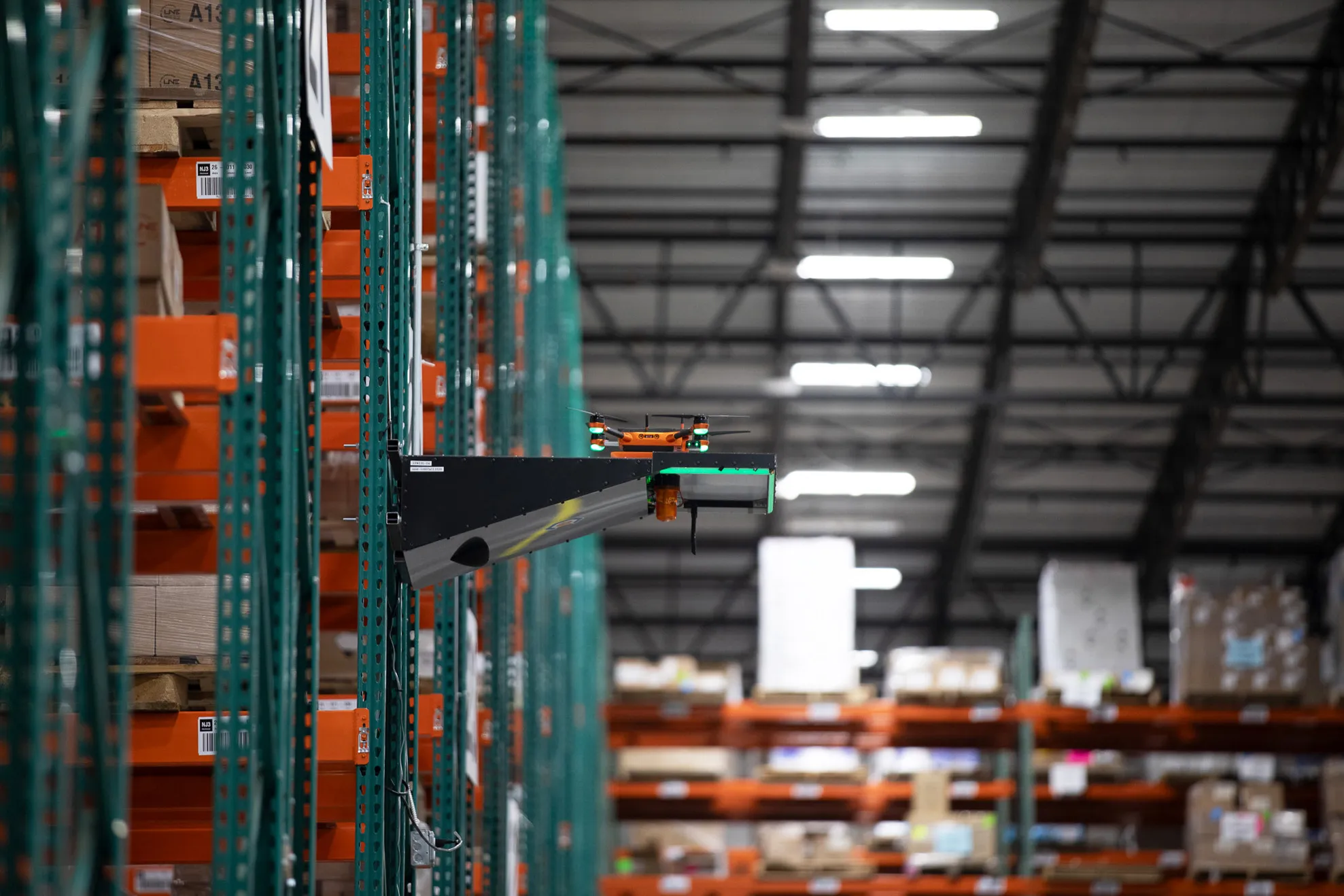
Autonomous inventory drones attack the cost problem from both directions at once — they cut the labor and the equipment diversion, and they raise counting frequency high enough to keep discrepancies from ever accumulating. Actel Robotics deploys Corvus One, an autonomous inventory drone that flies pallet aisles on its own and counts locations roughly 20 times faster than a manual crew while sustaining 99%-plus inventory accuracy.
Two design choices matter most for the cost case:
- No infrastructure changes. Corvus One navigates by onboard computer vision — no new Wi-Fi, no GPS, no floor markers or facility retrofit. That keeps deployment fast and avoids a hidden capital line of its own.
- Ambient and cold-chain. The same drone flies ambient warehouses and freezer or cold-storage environments, where manual counting is slowest, coldest, and most expensive to staff.
- WMS-native output. Discrepancy reports sync straight to your warehouse management system, so the count turns into corrected records and actionable exceptions rather than a spreadsheet someone has to reconcile by hand.
Because the drone reaches high-bay positions on its own, the scissor lifts stay parked and the associates who used to count go back to fulfillment and replenishment. For sites that pair counting with picking, the same operation often extends into Locus fulfillment AMRs, which lift picking productivity two to three times on existing racking. Both fall under our warehouse inventory practice. If you want the mechanics of the flight and vision system, our explainer on how inventory drones work walks through it.
Buyer Considerations and the ROI Frame
The right way to evaluate autonomous counting is against the full cost stack above, not the wages alone. When a facility is spending on direct count labor, diverted equipment, elevated-access gear, and the shrinkage and failed picks that flow from infrequent counting, the comparison shifts decisively.
A few points to weigh as you build the case:
- OpEx, not CapEx. Corvus One is available on a Robotics-as-a-Service model, so counting becomes a predictable operating expense rather than a capital purchase — easier to approve and to scale with the operation. Our primer on how RaaS works covers the structure.
- Payback window. Across typical deployments, facilities reach payback in roughly 10 to 22 months once the full cost of the manual program is counted.
- Time to value. A facility can move from signed proposal to a live, flying system in about three months.
- Standards and integration. As a systems integrator, Actel handles the WMS integration, operator training, and ongoing optimization — not just the hardware drop, and with attention to AMR safety standards such as ANSI/RIA R15.08.
To size this for your own operation, use our ROI calculators as a directional planning tool, and see how autonomous counting stacks up against other platforms on our compare robots page. Actel manages the full lifecycle — assessment, solution design, deployment, integration, training, and optimization — described across our services.
The Takeaway
Manual cycle counting is rarely as cheap as its budget line suggests. The wages are only the part you can see; the diverted equipment, the lifts, the safety exposure, and the shrinkage and failed picks that grow between counts are the part that actually moves the number. Once you total the real cost, autonomous drone counting stops looking like an expense and starts looking like the cheaper way to run the same operation more accurately.
If your inventory operation spans Texas, Louisiana, or Oklahoma and manual counting is eating labor, equipment, and accuracy, contact Actel Robotics for a no-commitment facility assessment and a deployment-specific ROI projection built on your actual numbers.