
The conversation about warehouse labor availability has shifted in the past three years from "when will the shortage end" to "is it structural." Most workforce analysts, logistics operators, and DC managers who have been tracking the numbers have reached the same conclusion: it's structural. The combination of demographics, competing wage pressures from e-commerce fulfillment growth, and a generation of workers that has better-paying alternatives to warehouse associate roles means the labor availability assumptions that distribution-center capacity planning relied on for decades no longer hold. For operators across Texas, Louisiana, and Oklahoma, this is not an abstract macro trend — it's the reason a shift goes uncovered, a cycle-count program falls behind, or a peak season gets staffed with untrained temporary labor.
What "Structural" Means for Operations Planning
A cyclical labor shortage normalizes on its own. A structural one requires operational redesign. The distribution centers that are winning on cost and throughput in this environment are not the ones waiting for the labor market to correct — they're the ones that have reoriented their operations around what humans are genuinely better at than machines, and have automated the rest. That reorientation starts with an honest task-by-task audit: which roles depend on human judgment, dexterity, and problem-solving, and which are repetitive, measurable, and fatigue-sensitive.
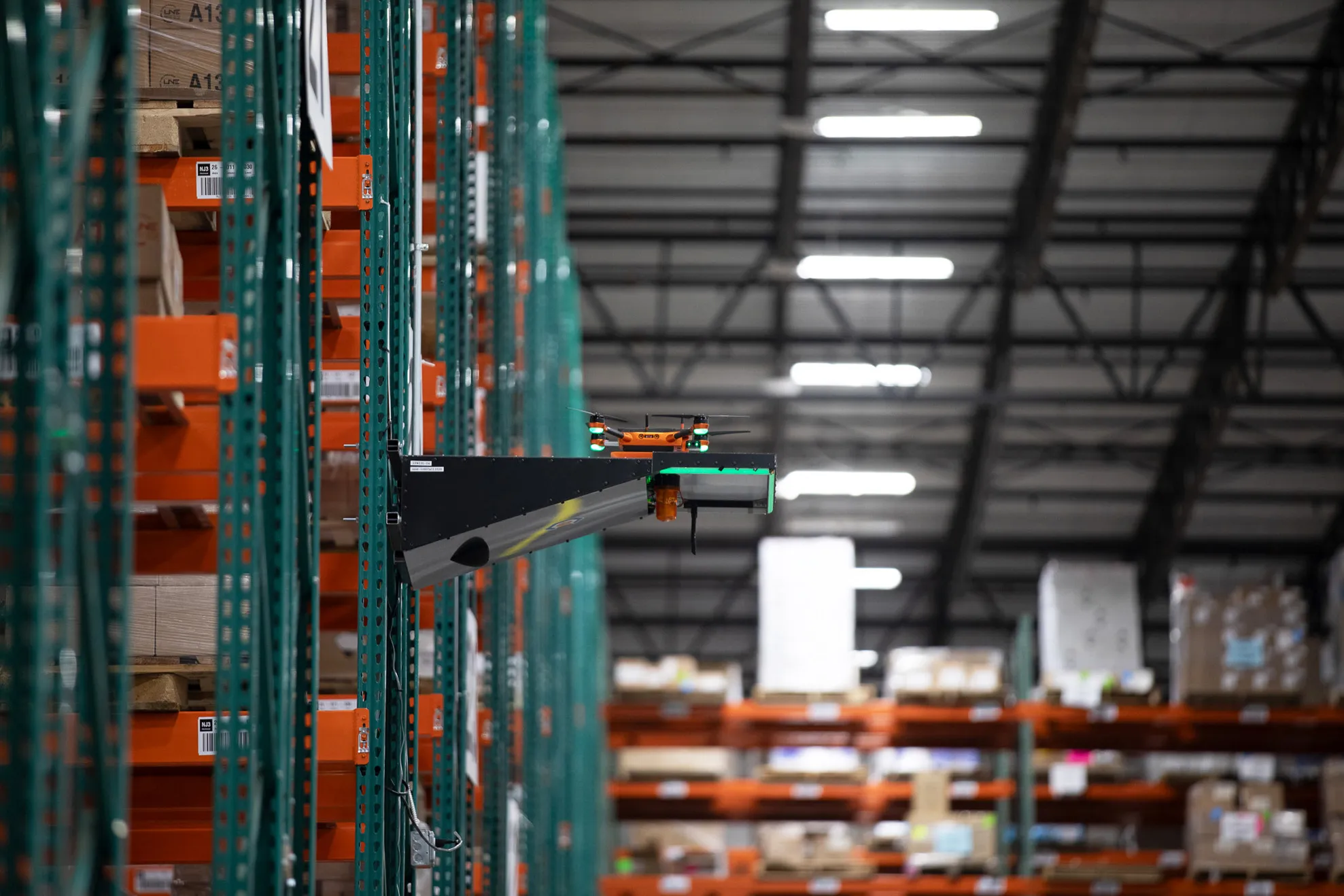
Cycle counting is the textbook example of the second category. Walking aisles with a scanner, reading barcodes, logging locations, and uploading data to a warehouse management system is not a task that benefits from human judgment. It's a task that benefits from precision, consistency, and the ability to run seven days a week without fatigue, without benefits, and without turnover. That's exactly what the Corvus One inventory drone delivers — flying pallet aisles autonomously with onboard computer vision, requiring no Wi-Fi, no GPS, and no infrastructure changes to the building.
Why the drone approach fits a labor-constrained facility
The value of an autonomous inventory drone in a tight labor market comes down to a few concrete operating characteristics:
- Roughly 20x faster than manual cycle counting, so a counting program that used to trail demand can finally stay current.
- Sustained 99%+ inventory accuracy, which reduces the mis-picks, phantom stock, and emergency recounts that quietly consume labor elsewhere.
- Works in ambient and freezer/cold-chain environments, where staffing counting labor is hardest and most expensive.
- Syncs discrepancy reports directly to your WMS, so the data lands where planners already work instead of in a spreadsheet.
Industry sources generally put a manual cycle-counting program at two to four full-time employees for a mid-to-large facility. In a market where those roles are hard to fill and harder to retain, moving that recurring requirement onto an autonomous system is not a luxury — it's how you keep the inventory program running at all.
Redeployment, Not Replacement
The narrative about warehouse automation displacing workers is both technically accurate and operationally misleading. Technically accurate: the drone does eliminate the need for dedicated cycle-count labor. Operationally misleading: in a tight labor market, those associates don't get laid off — they get redeployed to picking, packing, value-added services, and customer-facing operations where their judgment actually matters.
That same logic extends across the platforms we integrate. On the fulfillment side, Locus Robotics AMRs lift picking productivity two to three times on your existing racking and existing staff — the associate walks less and picks more, so throughput rises without adding headcount. It's the difference between hiring your way out of a labor gap and engineering your way out of it. Explore how these pieces fit together in warehouse fulfillment and warehouse inventory operations.
Safety is part of the labor math
Warehousing carries injury rates above the private-sector average, according to the Bureau of Labor Statistics, and every recordable injury is also a labor problem: lost time, light-duty reassignment, and the cost of covering the role. Autonomous systems take on the repetitive, ergonomically taxing, and cold-environment work that drives a share of those incidents. Purpose-built platforms are designed to operate safely alongside people, and the relevant standards — ANSI/RIA R15.08 for autonomous mobile robots and ISO 3691-4 for automated industrial trucks — give integrators a clear framework for deploying them in occupied buildings.
How Deployment Actually Works
Adopting robotics is less about buying a machine and more about integrating a capability. As a full-lifecycle systems integrator, Actel Robotics runs the sequence that turns a platform into a working part of your operation: facility assessment, solution design, deployment, WMS and systems integration, operator training, and ongoing optimization. The integration step is where most of the value is created and where most do-it-yourself efforts stall — a drone that counts perfectly but doesn't reconcile cleanly against your WMS hasn't solved the problem.
The timeline is shorter than most operators expect. A facility can go from signed proposal to a live system in roughly three months. Because the Corvus One relies on onboard computer vision rather than fixed infrastructure, there's no need to rewire the building, install beacons, or take aisles offline for a lengthy retrofit.
The ROI Framing: OpEx, Not a Capital Gamble
The biggest objection to automation has traditionally been the capital outlay. That objection is largely gone. Robotics-as-a-Service (RaaS) lets a facility deploy autonomous systems as an operating expense rather than a capital project — you pay for the capability month to month instead of financing a large up-front purchase, and the cost lands in the same budget line as the labor it offsets. Typical payback across our deployments runs in the range of 10 to 22 months, depending on facility size, SKU count, and how labor-constrained the operation is.
The most compelling argument for deploying today, though, isn't the current-year ROI — it's the five-year trajectory. Labor costs continue to rise. Robotic system costs continue to fall. The ROI calculation improves every year you wait, but so does the competitive gap between facilities that have made the transition and those that haven't. The operator who deploys now is compounding an advantage; the one who waits is compounding a disadvantage. Read our analysis of the true cost of manual cycle counting for the underlying economics, and see how the platforms line up side by side on our compare robots page.
Beyond Inventory: A Broader Autonomy Roadmap
The labor shortage doesn't stop at the four walls of the pick-and-count operation, and neither does automation. Many of the same facilities using drones for inventory extend autonomy into inspection and security — functions that are chronically understaffed and often filled by overnight labor that's especially hard to retain. The Boston Dynamics Spot quadruped runs repeatable visual, thermal, and acoustic inspection routes day or night, including lights-out. For outdoor perimeter security, the rugged Ghost Robotics Vision 60 handles mud, gravel, ice, and Gulf Coast heat, while Asylon combines ground and aerial robots with 24/7 human monitoring. Viewed together, these platforms let an operator convert the hardest-to-staff roles in the building — counting, inspecting, patrolling — into a coordinated autonomy program.
The Takeaway
The warehouse labor shortage is structural, and structural problems reward operators who redesign rather than wait. The playbook is straightforward: automate the repetitive, measurable, fatigue-sensitive work; redeploy your people to the judgment-driven work that actually differentiates your operation; and treat robotics as an operating capability funded out of the labor budget it offsets. Facilities that adopt this approach don't just survive the labor market — they widen the gap on the ones that don't.
If you operate a distribution center in Texas, Louisiana, or Oklahoma, contact Actel Robotics for a facility assessment, or use our ROI calculator to model your five-year savings projection. We'll help you identify which tasks to automate first and build the deployment plan around your existing operation.