
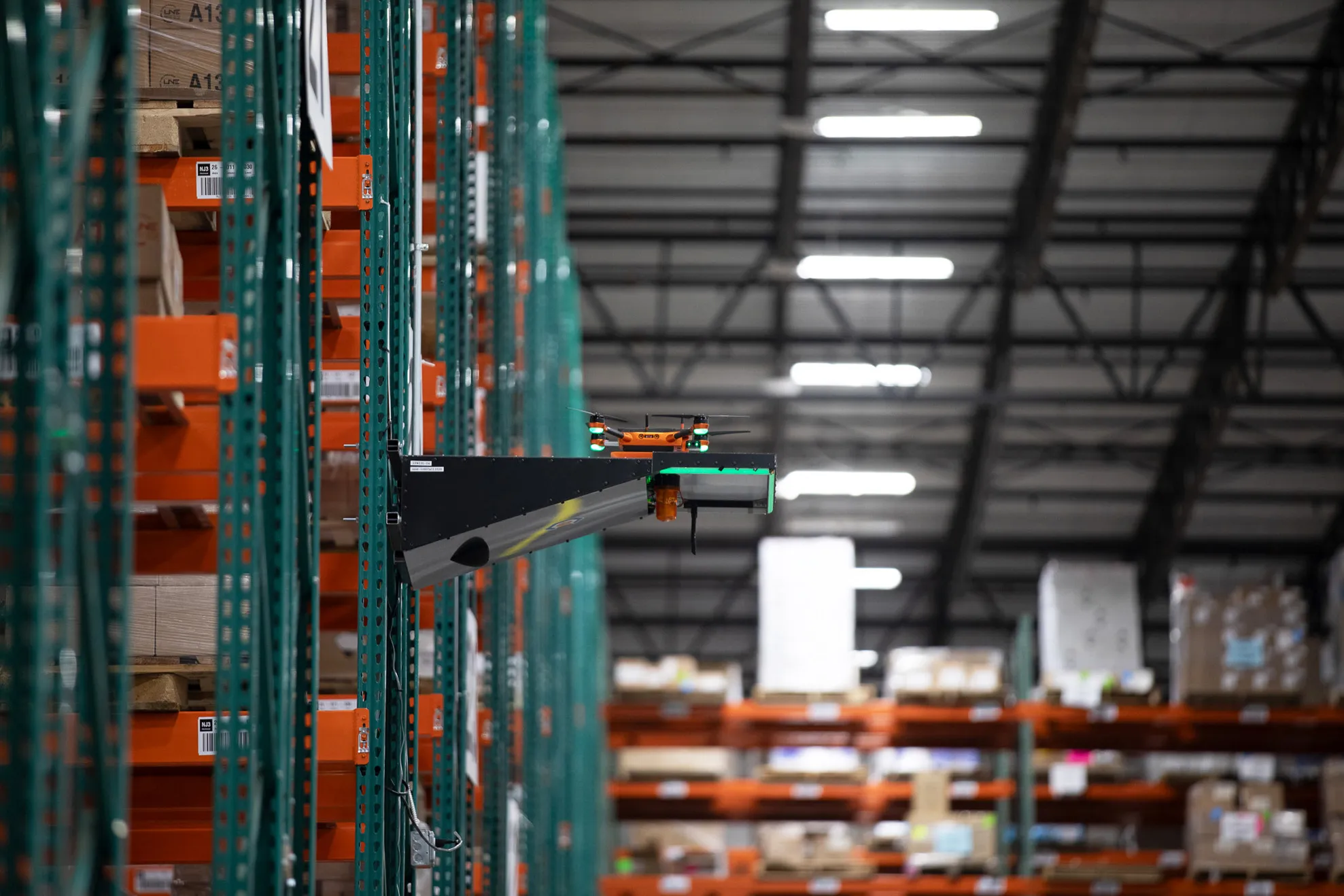
Autonomous inventory drones have moved from novelty to a proven line item on the warehouse automation roadmap. But the technology isn't equally valuable in every building. The question a distribution center leader should ask isn't "is this cool?" — it's "does my operation show the specific pain that drone-based cycle counting is built to remove?" The Corvus One autonomous inventory drone that Actel Robotics deploys flies pallet aisles on its own, using onboard computer vision with no Wi-Fi, GPS, or infrastructure changes, and counts roughly 20 times faster than a person with a scanner. That capability solves a real problem — but only in facilities that have that problem.
Below are five operational signals that reliably separate a strong candidate from a facility that should wait. When several of these show up together, the business case usually writes itself. If you recognize your building in three or more of them, it is worth a serious conversation.
1. Cycle Counting Ties Up Multiple Full-Time People
Manual cycle counting typically absorbs two to four full-time associates in a mid-to-large distribution center — people walking aisles, climbing to upper racks with lifts, and keying counts by hand. That labor is not just expensive; it competes directly with the material-handling equipment and floor space you would rather be using to move product.
If counting is a dedicated job for more than one person in your building, you have enough volume to justify automation. The honest comparison is not "a drone versus one associate." It is the drone against the full cost of manual inventory work: the labor itself, the lift hours that support it, the throughput those lifts could have generated, and the shrinkage that slow, infrequent counts allow to accumulate. When you frame it that way — the way our breakdown of the true cost of manual cycle counting lays it out — the math changes considerably.
2. Your Annual Physical Inventory Is a Multi-Day Shutdown
A facility that has to slow or halt throughput for a wall-to-wall physical inventory is paying a large, poorly tracked cost every year. Between overtime, temporary counters, external auditors, lost shipping days, and the reconciliation cleanup that follows, the PI event usually costs far more than the line item most teams write down for it.
Drones attack this at the root. Because the Corvus One can fly aisles continuously — days, nights, and during lights-out windows — it turns inventory from an annual fire drill into a background process. Instead of a once-a-year snapshot that is stale the moment it is finished, you get a rolling, near-continuous count that keeps the system honest all year. The annual event shrinks from an all-hands shutdown to a short exception-resolution exercise.
3. Failed Picks and Accuracy Gaps Are a Measurable Problem
Every operation has a first-pass fulfillment rate, and every point below the high-90s tells you the same thing: your warehouse management system and physical reality have drifted apart. That gap surfaces as failed picks, short shipments, emergency replenishment, and the exception-handling labor that quietly eats supervisor time.
This is exactly where a daily, autonomous count earns its keep. Corvus One deployments sustain 99%+ inventory accuracy, and every discrepancy the drone finds syncs straight into the WMS as a report your team can act on — no manual data entry, no waiting for the next scheduled count. The value shows up across the operation:
- Fewer failed picks because on-hand quantities and locations match what pickers actually find.
- Smarter replenishment because reorder decisions run on trustworthy numbers instead of padded buffers.
- Cleaner slotting and putaway because misplaced pallets get flagged instead of disappearing into the rack.
If you want to size the opportunity for your own volumes, our ROI calculators let you model what closing an accuracy gap is worth at your order count and error rate. It pairs naturally with the goals of a modern warehouse inventory operation and the downstream fulfillment throughput it feeds.
4. You Run Frozen, Refrigerated, or Otherwise Difficult Zones
Cold-chain and freezer environments compound the manual inventory problem. Sub-zero aisles are physically punishing, counting is slower, and safety rules rightly limit how long associates can work in the cold. The predictable result is that frozen zones get counted less often than ambient ones — so their accuracy is worse and their discrepancies grow faster.
The Corvus One flies in both ambient and freezer/cold-chain conditions without the labor and safety constraints a human count carries. It does not slow down, need a break, or require someone to bundle up and climb into a -10°F aisle. That matters beyond productivity: warehousing already carries injury rates above the private-sector average (per BLS data), and taking people out of the coldest, highest-reach counting tasks removes a genuine safety exposure. For operators managing tough zones, the case for automation is often stronger than in the general warehouse.
5. Nobody Fully Trusts the WMS
The clearest sign of all is cultural. When supervisors mentally add a cushion to on-hand numbers because they assume the system is a little wrong, or when replenishment and picking decisions get double-checked by hand because the WMS shows stock that may not physically be there, you have a data-quality problem that a daily count is built to fix.
An autonomous drone counting the building every day rebuilds that trust methodically. Over a few weeks the WMS stops being a rough estimate and becomes the source of truth your team plans against — which is the entire point of investing in warehouse automation in the first place.
How Deployment and ROI Actually Work
Recognizing the signs is step one; the deployment itself is more approachable than most operators expect. As a full-lifecycle systems integrator, Actel Robotics runs the whole path — facility assessment, solution design, installation, WMS and systems integration, operator training, and ongoing optimization. Because the Corvus One needs no Wi-Fi, GPS, or infrastructure changes, a typical facility can go from signed proposal to live flying in about three months.
The commercial model is built to lower the barrier as well. Robotics-as-a-Service (RaaS) is available, which turns the system into an operating expense rather than a capital project and moves it out of the CapEx approval queue. Across inventory deployments, payback typically lands in the range of roughly 10 to 22 months depending on facility size, count frequency, and current accuracy. Everything Actel deploys is designed to modern safety standards, including ANSI/RIA R15.08 for autonomous mobile robots and ISO 3691-4 for automated industrial vehicles, so the automation fits into your existing safety program rather than fighting it.
Inventory drones are also frequently a first step. Facilities that solve counting often move next to Locus Robotics fulfillment AMRs to lift picking productivity, or to autonomous inspection and security platforms — and you can weigh those options side by side on our compare robots page.
The Takeaway
If your building shows two or three of these signs, autonomous inventory drones are worth evaluating now. If it shows four or five, you are almost certainly leaving measurable money and accuracy on the floor every quarter you wait. The strongest candidates are not the most futuristic warehouses — they are the ordinary, hard-working ones where counting is expensive, PI is painful, accuracy is slipping, and nobody quite trusts the numbers. Contact Actel Robotics to schedule a free facility assessment, or explore our full integration services to see how a drone deployment would fit your operation across Texas, Louisiana, and Oklahoma.