
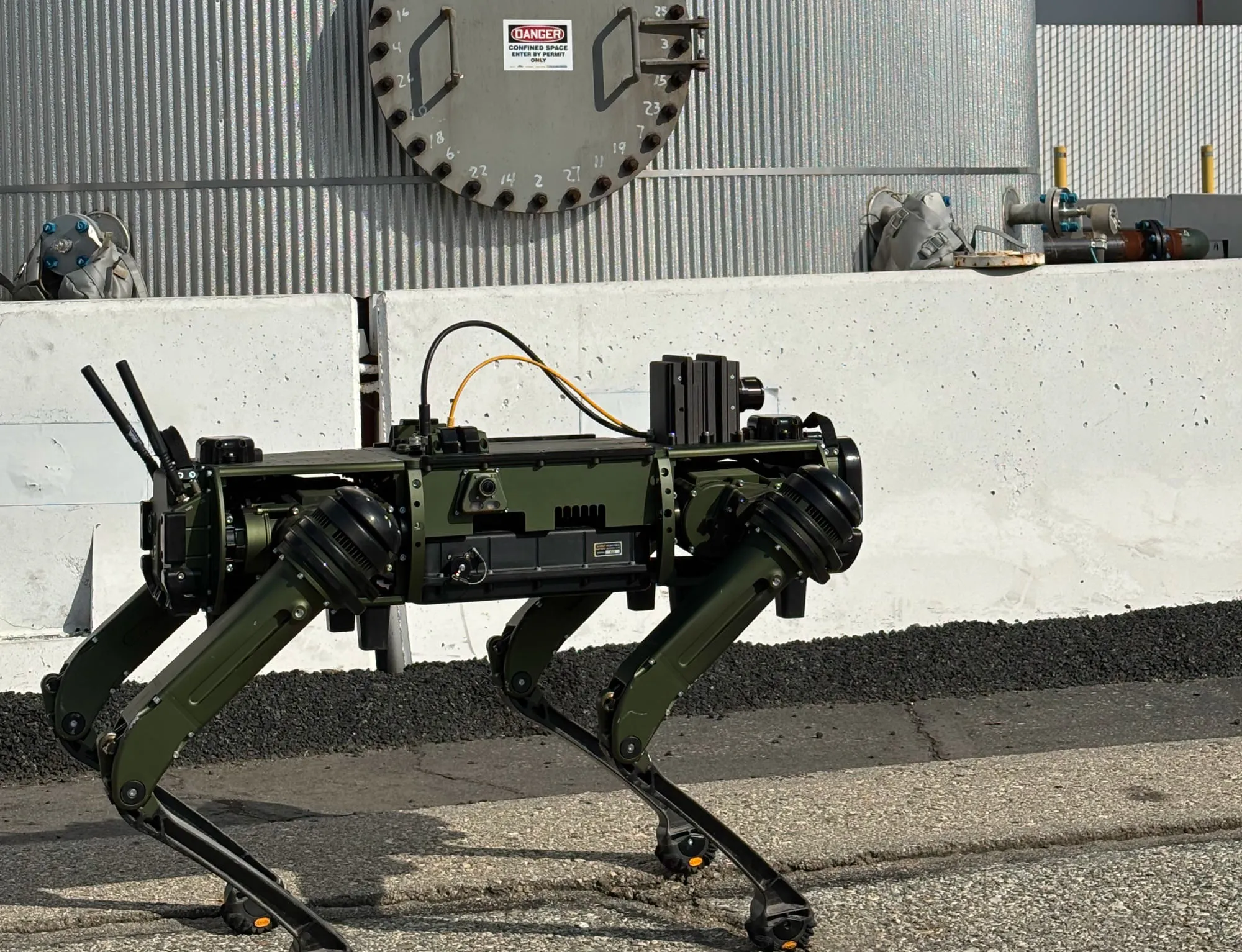
Ghost Robotics Vision 60 and Boston Dynamics Spot are the two leading quadruped robot platforms deployed at industrial facilities today. Both walk on four legs, both carry configurable sensor payloads, and both run autonomous, repeatable missions with minimal human oversight. Yet they are engineered for fundamentally different primary applications, and the differences in durability, sensing, mobility, and commercial model are significant enough that choosing the wrong one wastes budget and leaves gaps in coverage. This guide walks through how the two platforms actually differ, where each one earns its keep, and how to frame the decision around your facility's real risk and workload rather than the spec sheet alone.
Two Robots, Two Jobs: Security vs. Inspection
The single most useful way to think about these platforms is by their primary mission. The Ghost Robotics Vision 60 is a rugged, all-terrain unmanned ground vehicle (UGV) built for outdoor perimeter security. The Boston Dynamics Spot is an agile quadruped built for autonomous, repeatable inspection — visual, thermal, and acoustic — inside plants, warehouses, and other structured environments. Both can technically do a little of the other's job, but each was designed around a different set of constraints, and that shows up everywhere from the chassis to the software.
Vision 60 is meant to live outside, cover long distances along a fence line, and keep moving through mud, gravel, ice, and Gulf Coast heat without babysitting. Spot is meant to walk a fixed route through a facility, climb stairs, thread through equipment, hold a camera steady on the same gauge or bearing every single time, and feed that data back into an inspection program. When you frame the choice as "what is the recurring task I need done," the platform usually selects itself.
Ghost Robotics Vision 60: Outdoor Perimeter Security
The Vision 60 is engineered for the perimeter — the fence line, the tank farm, the yard, the substation, the storage lot. Its ruggedized construction and all-weather operation are core design requirements, not marketing add-ons. That matters on the Gulf Coast, where summer heat, humidity, sudden downpours, standing water, and uneven outdoor terrain routinely defeat wheeled robots and fixed camera coverage alike. A legged platform steps over curbs, drainage, cabling, and debris that would strand a wheeled unit.
In a security role, Vision 60 typically carries a pan-tilt-zoom camera and thermal imaging so it can patrol day, night, and in low visibility. It runs the same patrol route on a schedule, streams what it sees, and flags anomalies for human review — extending the reach of a small security team without adding headcount to walk cold, dark, or hazardous ground. For facilities weighing this against traditional manned patrols, our breakdown of guard costs vs. autonomous patrol ROI lays out where the math tends to favor automation, and our look at autonomous security for Texas oil and gas sites covers the outdoor-industrial use case in more depth.
Where Vision 60 is usually the right call:
- Outdoor perimeter and yard patrol across large, unstructured footprints.
- Harsh or wet environments — rain, mud, ice, dust, and extreme heat.
- Deterrence and situational awareness at the fence line, tank farms, and remote assets.
- Sites where fixed cameras leave blind spots that a mobile patrol can close.
Boston Dynamics Spot: Indoor and Industrial Inspection
Spot's home turf is the structured industrial interior. It shines on complex, repeatable inspection routes where consistency is the whole point: the same thermal read on the same motor, the same acoustic signature on the same pump, the same visual check on the same gauge, captured identically every shift so that trends — a bearing heating up, a leak forming, a reading drifting — become visible over time. That repeatability is what turns raw sensor data into predictive maintenance instead of a pile of one-off photos.
Spot's mobility is tuned for the built environment. It climbs stairs, navigates catwalks and confined aisles, and operates day, night, or fully lights-out, which lets you inspect hazardous or hard-to-reach areas without putting a technician in harm's way. Warehousing and heavy industry carry above-average injury rates relative to the private-sector average (per BLS data), and moving routine inspection rounds onto a robot is a direct way to reduce human exposure. For a fuller treatment, see our guide to robotic inspection solutions and the comparison of Spot vs. traditional manual inspection.
Where Spot is usually the right call:
- Recurring indoor inspection rounds — thermal, visual, and acoustic — on fixed routes.
- Stairs, catwalks, and confined interior spaces that wheeled platforms can't reach.
- Predictive maintenance programs that depend on identical, repeatable data capture.
- Lights-out or hazardous areas where reducing human exposure is a priority.
How the Selection Decision Actually Gets Made
In practice, the platform choice comes down to four questions, in roughly this order. First, indoors or outdoors? Outdoor perimeter work points to Vision 60; indoor inspection points to Spot. Second, security or inspection? Deterrence and patrol favor the UGV; data-driven condition monitoring favors the inspection quadruped. Third, what's the terrain and weather? Wet, muddy, or extreme-heat outdoor ground rewards the more rugged platform, while stairs and tight interior geometry reward the more agile one. Fourth, what's the recurring task and how often does it run? The more repetitive and hazardous the round, the stronger the case for automating it.
A common and entirely valid answer is both. Many industrial sites have a real outdoor security need and a real indoor inspection need at the same time — Vision 60 walking the fence line while Spot walks the process units. It's also worth knowing where a fully managed security service fits: Asylon pairs ground (DroneDog) and aerial (Guardian) robots with 24/7 human monitoring from a remote security operations center, which suits sites that want outcomes and oversight rather than an in-house robotics team. Our security and surveillance overview maps these options side by side.
ROI, Deployment, and the RaaS Model
Robotic security and inspection don't have to be a capital project. Actel Robotics offers these platforms under a Robotics-as-a-Service (RaaS) model, which turns the investment into a predictable operating expense rather than up-front CapEx — no large purchase, and hardware, software, and support bundled into a recurring cost. For programs that displace continuous manned patrols or labor-intensive manual inspection rounds, typical payback lands in roughly the 10-to-22-month range, and a facility can go from a signed proposal to a live deployment in about three months. You can model your own numbers with our ROI calculators.
Getting there is a full-lifecycle effort, not a drop-shipped robot. As an authorized integrator, Actel handles assessment, solution design, deployment, systems integration, operator training, and ongoing optimization. Deployment specifics matter too: patrol and inspection routes have to be mapped, docking and charging located, sensor payloads matched to the task, and alert workflows tied into your existing security or maintenance operations so the data reaches the people who act on it. Safety standards are part of the design conversation as well — ANSI/RIA R15.08 governs mobile robots and ISO 3691-4 covers automated guided vehicles.
The Bottom Line
Vision 60 and Spot are not really competitors — they're specialists. If your problem is an outdoor perimeter in demanding conditions, Ghost Robotics Vision 60 is built for it. If your problem is consistent, data-rich inspection inside a facility, Boston Dynamics Spot is built for it. Many sites benefit from both, or from a managed service layered on top. The right answer depends on your terrain, your recurring tasks, and how you want to own the program — exactly the kind of call an experienced integrator should help you make.
See our full robot comparison table for side-by-side specs, explore our integration services, or contact Actel Robotics for a free facility assessment and a platform recommendation tailored to your site across Texas, Louisiana, and Oklahoma.