
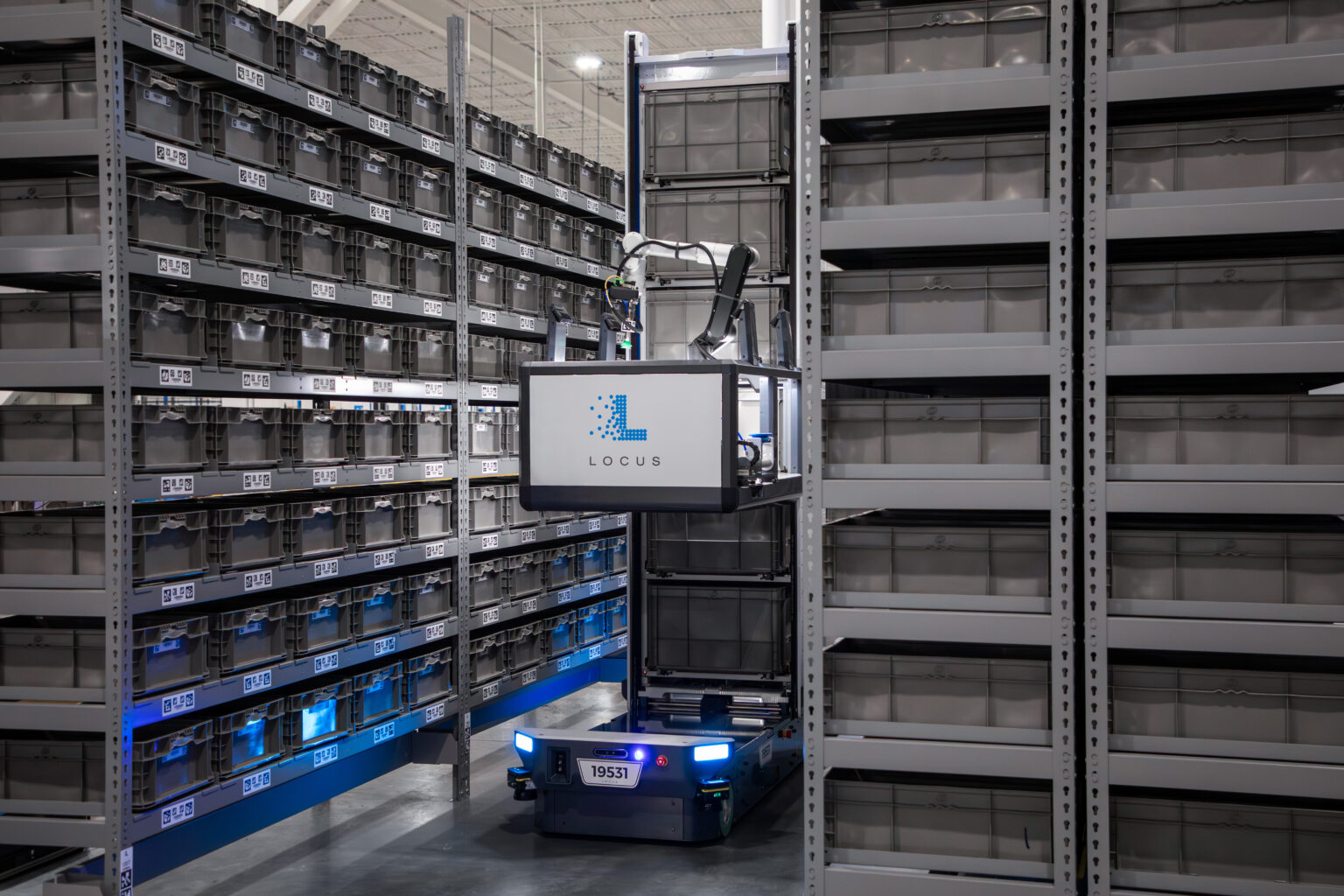
We're excited to announce that Actel Robotics is now a Locus Robotics implementation partner. With this partnership, Gulf Coast warehouses and distribution centers can deploy Locus autonomous mobile robots (AMRs) for order fulfillment — designed, integrated, trained, and supported locally by the Actel team from our base in Sugar Land, Texas. If you run a distribution or fulfillment center anywhere in Texas, Louisiana, or Oklahoma, you now have a single accountable partner to plan, deploy, and optimize AMR-assisted picking end to end.
Why Locus, and why now
Order volumes keep climbing while warehouse labor stays hard to find and harder to keep. Traditional fixed automation — conveyors, sortation, goods-to-person shuttles — can move the needle, but it's capital-intensive, slow to install, and inflexible once it's bolted to the floor. When your SKU mix or throughput changes, rework is expensive. Locus takes a different approach that fits how most warehouses actually operate today.
Instead of rebuilding your building around the machines, a fleet of autonomous robots travels your existing aisles and brings picks to your associates. Your team spends its time picking instead of walking — and walking is where a huge share of a picker's shift disappears in a conventional operation. The robots work with the racking, WMS, and people you already have, so you're improving the process rather than replacing the facility.
What changes on the floor
- Less unproductive travel. Associates work within a zone while robots handle transport between pick locations and pack-out.
- Higher picking productivity. Locus typically lifts units-per-hour 2–3x on your current racking and staff, without a facility redesign.
- Elastic capacity. Add robots for peak season and scale back afterward — a fit for the seasonal swings common across Gulf Coast retail, e-commerce, and 3PL operations.
- Faster onboarding. Guided, screen-directed picking shortens the learning curve for new and temporary associates during surge periods.
- Better ergonomics. Less walking and lifting-in-motion supports a safer floor. Warehousing carries injury rates above the private-sector average (BLS), so reducing miles walked matters.
What "implementation partner" means for you
Robots are only part of a successful deployment — the rest is workflow, data, and change management. As your implementation partner, Actel owns the whole rollout rather than dropping off hardware. Our full-lifecycle process covers every stage from first walk-through to steady-state operation:
- Assessment. We analyze your order profiles, SKU velocity, pick paths, and peak curves to confirm where AMRs deliver the strongest return.
- Solution design. Fleet sizing, zone and workflow design, and pack-out layout mapped to your actual demand — not a generic template.
- Deployment. A phased, low-disruption go-live so you keep shipping while the fleet comes online.
- WMS and systems integration. We connect Locus to your warehouse management and execution systems so orders, waves, and inventory stay in sync.
- Operator training. Hands-on training for associates and supervisors so the floor is confident on day one.
- Ongoing optimization. As volume, staffing, and SKU mix shift, we tune zones and fleet size to keep throughput high.
You get one local team accountable for the outcome, led by Dan Tarpey, whose background spans more than 30 years in supply-chain technology and automation. That's the difference between buying robots and adopting a working system. Deployments generally align to current AMR safety practice, including ANSI/RIA R15.08, so the fleet operates predictably alongside your people.
Deployment timeline and the RaaS model
Two questions come up in nearly every first conversation: how fast can we go live, and how do we pay for it? On timeline, a well-scoped facility can move from signed proposal to live in roughly three months, because Locus rides on your existing infrastructure instead of requiring a construction project.
On cost, Locus is available through a Robotics-as-a-Service (RaaS) model. Instead of a large upfront capital outlay, you subscribe to the fleet as an operating expense that scales with the robots actually on your floor. That keeps capital free for the rest of the business, matches spend to seasonal demand, and shortens the path to approval. Typical payback lands in the ~10–22 month range depending on labor rates, volume, and how much walking your current process carries. To pressure-test the numbers for your own operation, start with our ROI calculators and we'll refine the model together.
Part of a complete automation lineup
Locus fulfillment AMRs round out an automation portfolio that lets you address the whole warehouse with one integrator. Actel is an authorized integrator for five platforms, so counting and picking can share a single partner and a single set of accurate inventory data:
- Corvus autonomous inventory drones — cycle-count pallet aisles roughly 20x faster than manual counts, with no Wi-Fi, GPS, or infrastructure changes, sustaining 99%+ accuracy and syncing discrepancies back to your WMS. Manual cycle counting often ties up 2–4 full-time employees; those hours can move to fulfillment.
- Boston Dynamics Spot — a quadruped for repeatable visual, thermal, and acoustic facility inspection, day, night, or lights-out.
- Ghost Robotics Vision 60 and Asylon — rugged ground and aerial perimeter security built for Gulf Coast conditions, with 24/7 human monitoring.
The practical benefit is coordination. When your inventory counting and order fulfillment both run through Actel, your inventory data and order flow stay aligned — so pickers aren't sent to empty locations and your WMS reflects reality. You can weigh the platforms side by side on our compare robots page, and see how the full engagement works under our services.
Is your operation a good fit?
Locus tends to pay off fastest in operations with high pick volumes, a large active SKU count, meaningful associate travel between locations, and pronounced seasonal peaks — the profile of most e-commerce, retail distribution, and third-party logistics warehouses across our region. If your team is walking miles per shift or you're hiring aggressively just to keep pace with orders, AMR-assisted picking is worth modeling. For deeper background on how mobile robots reshape the pick line, see our related coverage on the Actel blog.
Let's model your operation
Becoming a Locus implementation partner is about giving Gulf Coast operators a local, accountable path to modern fulfillment — assessment through optimization, backed by a RaaS model that keeps the decision financially sensible. If you run a distribution or fulfillment center in Texas, Louisiana, or Oklahoma and want to ship more orders without simply adding headcount, request a free consultation and we'll model what Locus AMRs could do for your operation.