
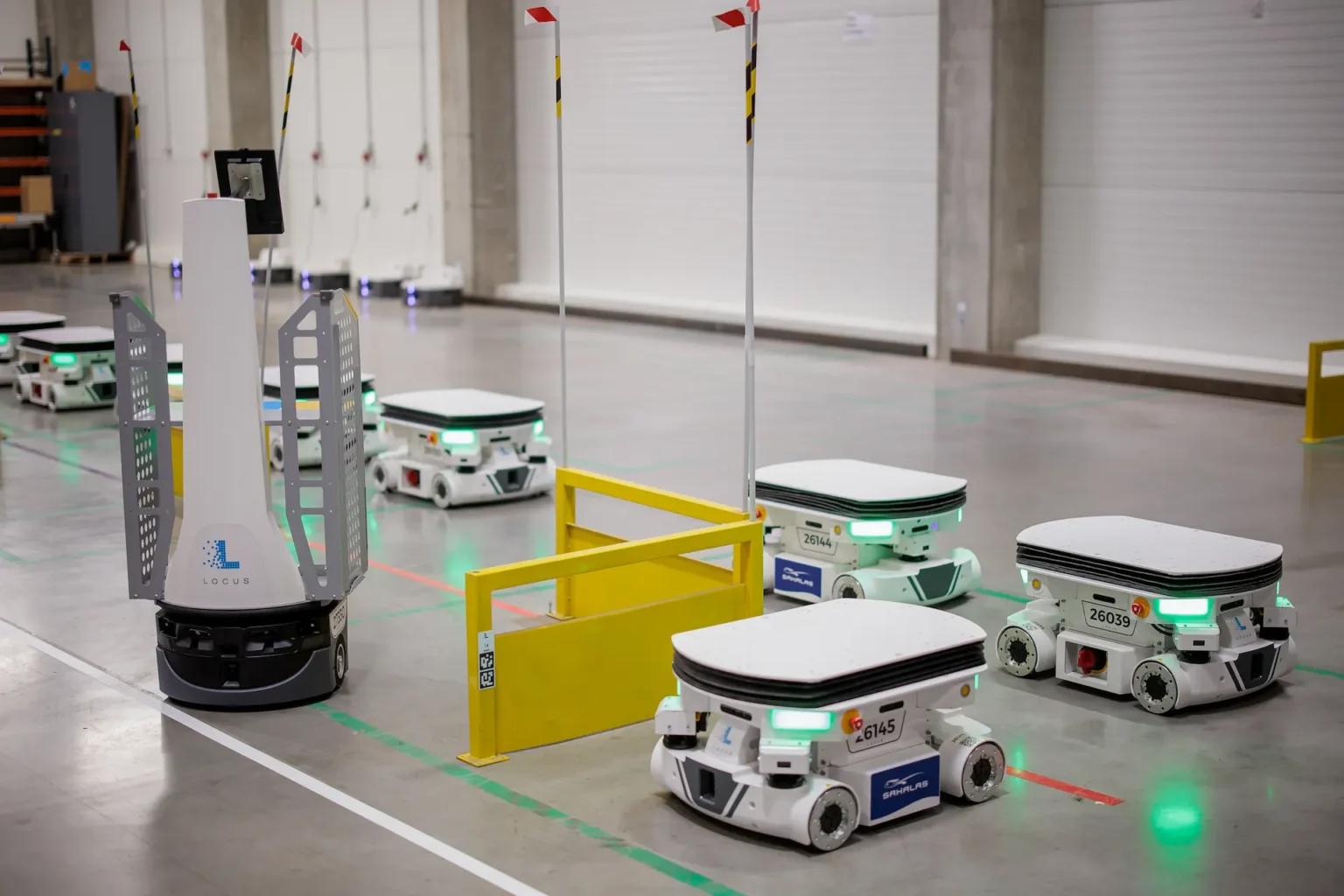
If you've heard that autonomous mobile robots can double or triple picking productivity, it sounds too good to be true. It isn't — and the reason is simpler than most people expect. The single biggest source of wasted time in a manual pick operation isn't picking. It's walking. AMRs like Locus attack that lost time head-on, and they do it without ripping out your racking or replacing your team. This is why fulfillment AMRs have become the most widely adopted form of warehouse automation over the past several years, and why they're often the first robotics investment a distribution operation makes.
The walking problem behind flat productivity
In a traditional cart-pick workflow, associates can spend well over half of every shift simply traveling between locations. That walking produces nothing shippable. It wears people out, it drives up labor cost per unit, and it puts a hard ceiling on how many orders you can move through the building — a ceiling that turns into a genuine crisis when peak season hits and volume spikes faster than you can hire.
The traditional answers all have downsides. Throwing more temporary labor at the problem raises cost and compounds a training burden right when error rates matter most. Warehousing already carries injury rates above the private-sector average according to BLS data, and long travel distances on hard floors contribute to fatigue and turnover. AMRs don't just add throughput; they take the highest-strain, lowest-value part of the job off your associates' plates.
How Locus AMRs actually work
With a Locus deployment, a fleet of robots receives orders from your warehouse system and drives itself to each pick location. The associate stays in an assigned zone, and the bots come to them: the worker scans, picks, and places the item into the robot's tote — guided by clear on-screen prompts, quantity, and visual cues on the robot's display — then the loaded bot drives itself off to packing while the next one is already rolling up. The result is less walking, less fatigue, fewer mis-picks, and far more picks per labor hour.
Two things make this practical rather than theoretical:
- No infrastructure teardown. The robots navigate your existing aisles and work alongside your current racking, floor, and people. There's no fixed track to lay and no wholesale relayout.
- Elastic capacity. Because Locus offers Robotics-as-a-Service, you can add bots for the holidays and scale back afterward, matching robot count to real demand instead of your worst week of the year.
Modern fulfillment AMRs are also built to a recognized safety standard — ANSI/RIA R15.08 for industrial mobile robots — so they detect and route around people, forklifts, and obstacles rather than depending on caged-off zones the way older ISO 3691-4 automated guided vehicles did.
Why not just install a conveyor or goods-to-person system?
Fixed goods-to-person systems, conveyors, and shuttle systems can deliver enormous throughput, and for the right SKU profile they're the right answer. But they are capital-heavy, take many months to design and install, and lock your layout in place for a decade. If your product mix, order profile, or lease changes, that concrete-and-steel investment can't follow you.
AMRs sit at the opposite end of the flexibility spectrum. They drop into the building you already have, ship measurable gains in weeks rather than years, and flex with your business. For most growing e-commerce, 3PL, and multichannel operations, that adaptability is exactly why AMRs are the first automation step — and often the one that funds the next.
The ROI case: OpEx, payback, and peak
The financial argument is as important as the operational one. Under a RaaS model the robots are an operating expense, not a capital project, which means no large up-front outlay and no multi-year depreciation schedule to defend. You pay for capacity as you use it, and you can turn that capacity up and down.
The savings come from three places at once: more units picked per labor hour, fewer costly mis-picks and returns, and reduced reliance on hard-to-hire seasonal labor. Across the AMR deployments Actel supports, typical payback lands in roughly the 10-to-22-month range, depending on volume, SKU velocity, and how the workflow is designed. If you want to sanity-check the math against your own numbers before you talk to anyone, our ROI calculators are a good starting point, and our compare robots tool helps frame AMRs against other options.
What it actually takes to hit the 2–3×
Here's the part vendors gloss over: the robots are necessary but not sufficient. The 2–3× gain comes from designing the operation around the fleet, not from the fleet alone. That's where an experienced Locus implementation partner earns its keep.
Where the design work lives
- Zoning and slotting. Fast-moving SKUs are placed to minimize associate travel and balance work across zones so no picker or bot sits idle.
- WMS/WES integration. The fleet has to speak fluently to your warehouse management or execution system so orders, priorities, and inventory stay in sync in real time.
- Operator training and change management. Associates who trust the system and understand the on-screen prompts hit target rates in days, not weeks.
- Ongoing optimization. As volume and SKU mix shift, the workflow gets re-tuned so the productivity gain holds instead of eroding.
As a warehouse-robotics systems integrator based in Sugar Land, Texas, Actel Robotics handles that full lifecycle — assessment, solution design, deployment, systems integration, training, and ongoing optimization — across Texas, Louisiana, and Oklahoma. A facility can typically go from signed proposal to live in about three months, and our services cover every step in between.
Where AMRs fit in a broader automation roadmap
Fulfillment is usually the front door, not the whole house. The same integrator relationship that stands up your picking fleet can extend to autonomous inventory management with the Corvus One inventory drone, to facility robotic inspection with Boston Dynamics Spot, and to security and surveillance with Ghost Robotics Vision 60 and Asylon. Starting with fulfillment AMRs gives you the operational and financial proof point that makes those next steps far easier to justify. For a deeper look at the inventory side, our post on the Actel blog covers how autonomous cycle counting complements a picking deployment.
The takeaway: AMRs deliver 2–3× picking productivity by eliminating wasted travel, they install without tearing up your building, and under RaaS they behave like an operating cost that scales with demand — but only when the workflow around them is engineered properly. Curious what that looks like in your facility? Talk to our team for a free consultation, or run the numbers and see the payback for yourself.