
Here’s a truth that surprises a lot of first-time buyers: the robot you choose matters less than the partner who deploys it. The same fleet of autonomous mobile robots or drones can deliver a transformative return or a disappointing one depending entirely on the design, integration, and support wrapped around the hardware. A warehouse robot is not an appliance you plug in — it is a system that has to understand your racking, your order profile, your software, and your people. That system is built by the integrator, not the manufacturer. So before you evaluate hardware, evaluate integrators. This checklist covers what actually separates a great partner from a risky one, and how to pressure-test each claim during your evaluation.
1. Vendor coverage — agnostic or single-line?
A partner tied to a single manufacturer will recommend that manufacturer’s robot for every problem, whether or not it’s the best fit. A multi-vendor integrator can match the right platform to the right job and tell you honestly when a robot isn’t the answer at all. Different jobs call for genuinely different machines, and no single line covers them all:
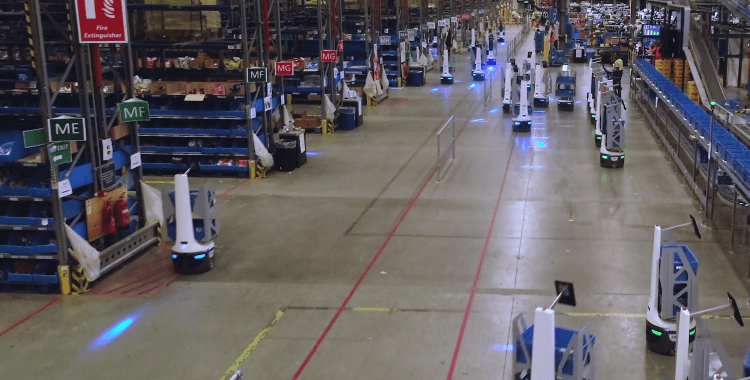
- Fulfillment and picking — collaborative AMRs like Locus Robotics lift picking productivity two to three times on your existing racking and staff, and scale up or down with demand.
- Inventory and cycle counting — the Corvus One autonomous drone flies your pallet aisles with no Wi-Fi, GPS, or infrastructure changes, counting roughly twenty times faster than a manual team while sustaining 99%+ accuracy.
- Inspection — the Boston Dynamics Spot quadruped runs repeatable visual, thermal, and acoustic inspection routes day or night, including lights-out.
- Security and perimeter — the rugged Ghost Robotics Vision 60 UGV patrols outdoor terrain, while Asylon combines ground and aerial robots with 24/7 human monitoring.
Ask which platforms a partner is authorized to deploy, and weight the answer heavily. You can see how the major platforms line up on our compare robots page.
2. Integration depth
The robots only pay off when they’re wired into the software that runs your building. Ask a prospective partner to walk you through exactly how they’ll integrate with your specific warehouse management or execution system, how order and inventory data flows to and from the fleet, and how they’ve handled that handoff before. For fulfillment, that means orders dropping cleanly to the AMRs and pick confirmations flowing back in real time. For inventory, it means drone count discrepancies syncing straight into the WMS so your team acts on exceptions instead of re-keying spreadsheets. Vague answers here are the single biggest red flag — integration is where deployments quietly stall. A strong integrator treats this as the core of the project, not an afterthought bolted on at the end.
3. Local service and response time
When a deployment needs hands on-site, distance matters. A partner with people in your region can respond in hours, not days, and that responsiveness shows up directly in uptime — the metric that actually determines your return. Ask where their service team is based and what their response commitment looks like in writing. Actel Robotics operates from Sugar Land, Texas, serving Texas, Louisiana, and Oklahoma — close enough to show up quickly, and structured to support multi-site rollouts across the region. Local presence also means a partner who understands the conditions your equipment actually works in, from Gulf Coast heat on outdoor security robots to freezer and cold-chain environments where inventory drones still have to fly.
4. References and relevant experience
Ask for references — ideally operations that resemble yours in size, SKU profile, and industry. A partner who has solved your specific kind of problem before will move faster and surprise you less. Just as important is the depth of the team leading the work. Actel is led by President Dan Tarpey, who brings 30+ years in supply-chain technology and automation to every engagement. If a prospective partner can’t point to comparable deployments or explain the reasoning behind their design choices, factor that into your risk assessment.
5. Pricing transparency and the RaaS option
Get clarity on how the partner is compensated and what’s included before you commit. Insist on a clear, itemized picture of hardware, integration, operator training, and ongoing costs — not a single number that hides where the money goes. Ask specifically about Robotics-as-a-Service (RaaS), a subscription model that turns automation into an operating expense rather than a capital purchase.
Why the financing model matters
RaaS lowers the barrier to entry, keeps the fleet current, and ties cost to usage instead of a large up-front outlay. Across the platforms Actel deploys, typical payback lands in the range of roughly 10 to 22 months, and a facility can move from signed proposal to live operation in about three months. Model the numbers for your own building with our ROI calculators, then have your partner walk through the assumptions with you line by line.
6. Support after go-live
Deployment isn’t the finish line. SKUs change, volumes grow, peak season arrives, and the workflow needs tuning. Ask what support looks like in month six and year two — software updates, fleet scaling, optimization reviews, and who answers the phone when something stops. This is where full-lifecycle integrators separate themselves. Actel’s service model runs the entire arc: assessment, solution design, deployment, systems integration, operator training, and ongoing optimization. A partner invested in your long-term outcome behaves very differently from one who disappears after install.
Don’t forget safety and compliance
Warehousing carries above-average injury rates for the private sector, according to the Bureau of Labor Statistics, and well-designed automation is one way to take people out of repetitive or hazardous tasks. A credible integrator will speak fluently to the relevant safety standards — ANSI/RIA R15.08 for autonomous mobile robots and ISO 3691-4 for automated guided vehicles — and design your deployment to work safely alongside your team. If safety only comes up because you raised it, treat that as a warning sign.
Run the checklist on us
The right partner is the one who can answer every question above without flinching. Actel Robotics is an authorized integrator for Corvus Robotics, Locus Robotics, Boston Dynamics, Ghost Robotics, and Asylon, with deep WMS integration, regional service across Texas, Louisiana, and Oklahoma, transparent RaaS pricing, and support that continues long after go-live. Put us against this list — and if you’re weighing where automation fits, our guide to robotic security and surveillance and the rest of our blog go deeper on individual use cases. Request a free consultation and ask the hard questions. We’d rather earn the work than oversell it.