
Warehouse automation usually gets framed as a single decision — drones or robots, counting or picking. In practice, the highest-performing distribution centers do both, because accuracy and throughput are two different problems that reinforce each other. Knowing exactly what you have on the shelf and moving it out the door quickly are complementary capabilities, and the facilities pulling ahead treat them as one connected system rather than two isolated projects. This post lays out how autonomous inventory drones and fulfillment AMRs work together, what to weigh before you buy, and how to sequence a rollout for the fastest return.
Two jobs, two robots
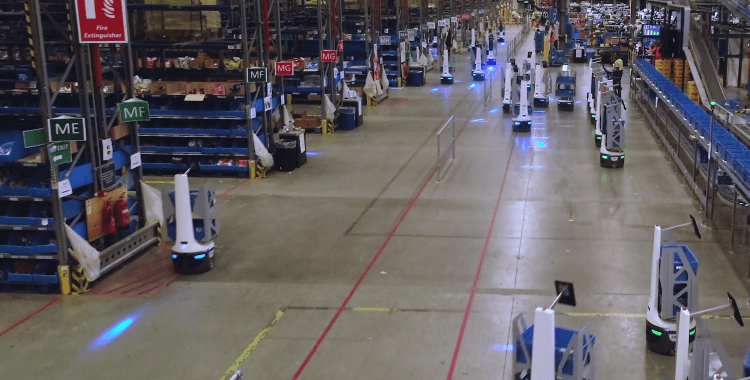
Corvus One inventory drones solve accuracy. The drone flies your pallet aisles and cycle-counts locations automatically, keeping recorded inventory matched to physical reality without sending people up order-pickers or reach trucks. Locus fulfillment AMRs solve throughput. The robots travel the floor and bring picks to associates so orders ship faster with the same headcount, on the racking and staff you already have. One keeps the data honest; the other moves the goods. Neither replaces your team — they redirect people away from repetitive travel and error-prone manual counting toward higher-value work.
How the inventory drone actually works
The most common objection to drones in a warehouse is infrastructure: operators assume they need Wi-Fi upgrades, GPS, floor markers, or ceiling anchors. Corvus One does not. It navigates using onboard computer vision, which means it flies in existing racking with no changes to your building — a meaningful difference when you are weighing disruption and install time. It runs roughly 20 times faster than manual cycle counting, sustains 99%-plus inventory accuracy, and operates in both ambient and freezer or cold-chain environments where you least want people spending hours on a lift. Each pass syncs discrepancy reports straight to the WMS, so a mismatch becomes a work order instead of a surprise at ship time.
How fulfillment AMRs change the pick
Traditional picking sends associates walking miles per shift between locations. Locus AMRs collapse that travel: the robot meets the picker at the right spot, and the picker stays productive in a zone instead of pushing a cart across the building. Because the fleet works on your current layout, you avoid the rip-and-replace cost of fixed conveyor or goods-to-person megastructures, and you can scale robots up for peak and down afterward instead of hiring and training a seasonal surge. For a deeper look at the fulfillment side, see our warehouse fulfillment solutions.
Why they're better together
Fast picking on top of bad inventory data just means shipping the wrong things faster. When drones keep counts accurate, the orders flowing to your Locus fleet are based on stock that actually exists — fewer short-picks, fewer mis-ships, fewer frustrated customers, and fewer emergency counts that pull the floor to a stop. Accurate inventory makes autonomous fulfillment trustworthy, and autonomous fulfillment makes accurate inventory pay off. The two capabilities close a loop:
- Counting feeds picking. Reliable location-level accuracy means the WMS routes AMRs to slots that are truly stocked, cutting wasted trips and pick exceptions.
- Picking exposes drift. High-velocity fulfillment surfaces discrepancies quickly, and the drone's next pass verifies and corrects them before they compound.
- Fewer manual interruptions. Manual cycle counting typically ties up two to four full-time employees; automating it frees those people and removes the stop-the-line counts that break fulfillment rhythm.
- Safer floors. Warehousing carries injury rates above the private-sector average per BLS data. Taking people off high lifts and out of constant cart travel reduces exposure to the tasks that drive many of those incidents.
One WMS, one partner
Both systems plug into your warehouse management system, which acts as the brain: it knows what is on the shelf thanks to the drones and routes orders to the floor picked by the AMRs. The catch is integration — two robotics platforms, one set of systems, one workflow. That is the case for using a single implementation partner for both, so the counting and the picking are designed to operate as one process rather than two science projects that each need their own data mapping, exception handling, and support path.
Actel Robotics is a warehouse-robotics systems integrator based in Sugar Land, Texas, serving Texas, Louisiana, and Oklahoma. We handle the full lifecycle — assessment, solution design, deployment, WMS and systems integration, operator training, and ongoing optimization — under one accountable relationship. Because we are an authorized integrator for both Corvus Robotics and Locus Robotics, the drone counts and the AMR picks are engineered to share the same source of truth. Modern autonomous systems are also built to recognized safety standards, including ANSI/RIA R15.08 for mobile robots, which matters when robots and people share aisles.
Buyer considerations before you commit
A combined deployment is a real capital and operational decision, so pressure-test it against your own facility rather than a generic pitch. A few questions worth answering early:
- Where does your accuracy actually break? If phantom inventory and short-picks are your pain, lead with the drone. If associate travel and peak throughput are the constraint, lead with AMRs.
- What is your WMS's integration maturity? The tighter your system of record, the more value both platforms return — and the more important a single integrator becomes.
- How disruptive can the install be? Infrastructure-free navigation and work-with-your-racking AMRs keep downtime low, but you still need to plan around live operations.
- CapEx or OpEx? Robotics-as-a-Service turns automation into an operating expense instead of a capital project, which changes both the approval path and the risk profile.
To compare platforms side by side before you narrow the field, use our robot comparison tool, and if inventory accuracy is the first problem to solve, start with warehouse inventory automation.
ROI, RaaS, and deployment timeline
The financial case rests on redeployed labor, reduced errors, and faster order flow rather than on any single headline number. Because a Robotics-as-a-Service model is available, you can treat both the drones and the AMRs as an operating expense instead of a large up-front purchase, which lowers the barrier to starting and lets the savings offset the subscription as they accrue. Typical payback lands in roughly the ten-to-twenty-two-month range depending on volume, SKU mix, and how count- and travel-heavy your current process is. On the timeline side, a facility can go from signed proposal to live in about three months — fast enough to capture a peak season if you plan the sequence now. Model the numbers for your own operation with our ROI calculators, and see the full scope of what we deliver on our services page.
Inventory drones and fulfillment AMRs are the clearest pairing, but they are also a foundation. Once autonomous systems and clean data are running inside the four walls, the same integration discipline extends to robotic inspection with platforms like Boston Dynamics Spot and to security and surveillance with Ghost Robotics and Asylon. For more on the accuracy side of this story, read our related post on autonomous inventory drones.
The takeaway
Accuracy without throughput leaves orders stuck; throughput without accuracy ships mistakes at speed. Pairing Corvus inventory drones with Locus fulfillment AMRs — integrated through one WMS and one partner — gives you both, and a RaaS model lets you get there without a capital fight. Actel Robotics deploys and supports both platforms across Texas, Louisiana, and Oklahoma, from assessment through training and long-term optimization. If you are mapping a multi-year automation roadmap, contact us for a free consultation and let's sequence accuracy and throughput for the biggest return on your floor.