
Here is the contradiction sitting at the center of the warehousing industry in 2026. Survey after survey says the same thing: roughly three-quarters of supply-chain and logistics operations report notable workforce shortages, and more than half of warehouse operators name unfilled headcount as their single biggest reason to automate. And yet, by the same research, only about one in ten companies is using automation effectively, while roughly a third are still in a "wait-and-see" posture. The demand is overwhelming and the technology is proven. So why is there still a gap — and, more usefully, how does a Gulf Coast operator actually close it? After three decades in supply-chain technology, I can tell you the honest answer, and it is not the one most vendors lead with.
The Gap Is Real — and Growing
The market numbers are not subtle. Warehouse automation was valued in the low thirties of billions of dollars in 2025 and is climbing toward the mid-thirties in 2026, on its way to roughly triple that within the decade. Millions of warehouse robots are now installed across tens of thousands of facilities, and mobile-robot shipments have been growing 20 to 30 percent a year. The operators who have committed report the kind of results that make the case for themselves — commonly cited figures put labor-cost reductions in the 25-to-30-percent range and inventory accuracy approaching 99 percent. (We keep the market, adoption, payback, and platform numbers in one sourced place — our Warehouse Automation ROI Benchmark 2026.)
Meanwhile the labor problem it is meant to solve keeps getting harder: warehousing runs high turnover, peak season forces expensive overtime and temp hiring, and the upper-rack, cold-storage, and night-shift work that is hardest to staff is also the most hazardous. So the puzzle is not whether automation pays. It is why so many operators who need it most are still standing on the sidelines.
Why Good Operators Stay on the Sidelines
In my experience the hesitation almost never comes down to doubting that a drone can count pallets or that an AMR can move goods. It comes down to three very rational fears:
- Integration risk. The horror story every operator has heard is the six-figure system that arrived, didn't talk to the WMS, and became expensive shelf art. The worry is not the robot — it is whether it will actually fit into the operation.
- Not knowing where to start. "Automate the warehouse" is a paralyzing mandate. Faced with inventory, fulfillment, inspection, and security all at once, the safe move feels like doing nothing until the picture is clearer.
- Capital exposure. A large up-front purchase for an unproven fit is a hard thing to defend to a CFO, especially when the last capital project underdelivered.
None of those are technology problems. They are deployment and commercial-model problems — which is good news, because those are the ones you can design around.
How to Actually Close It
The operators who cross the gap successfully tend to do the same three things. None of them involve betting the building.
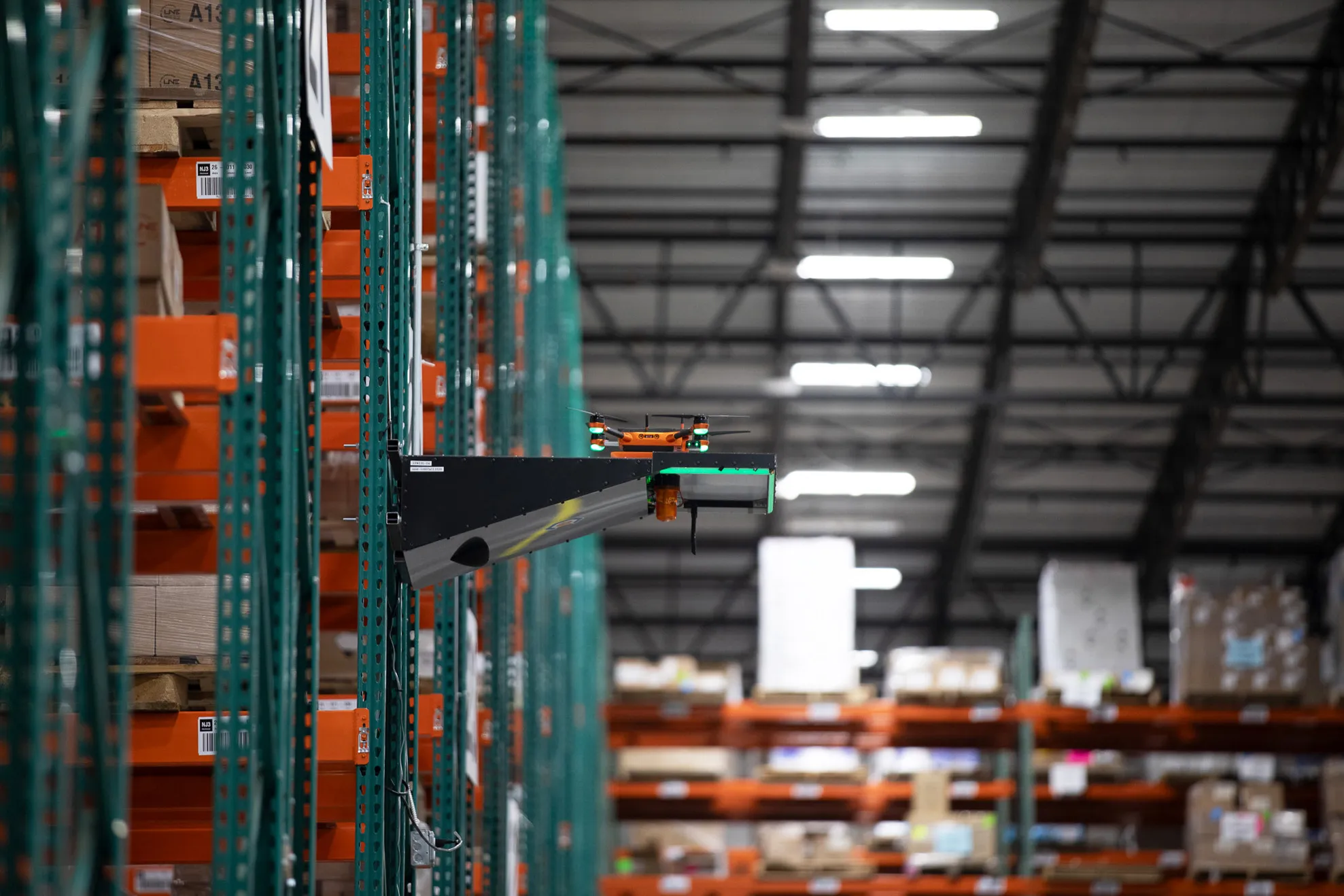
Start with one high-ROI application, not the whole warehouse. Pick the single job with the clearest before-and-after number and the most painful labor exposure. For most facilities that is autonomous inventory counting — cycle counting is slow, hazardous on the upper racks, and chronically understaffed, and the accuracy improvement is easy to measure. Prove the model in one building on one problem, then extend from a position of evidence rather than faith. We walk through the sequencing in our warehouse inventory automation roadmap.
Use one integrator who owns the whole lifecycle. Integration risk shrinks dramatically when a single accountable partner runs the assessment, solution design, WMS integration, training, and ongoing optimization — instead of a manufacturer shipping a box and a system that has to be married to your operation by someone else. That single-throat-to-choke model is the whole point of working with an integrator, and it is why we handle every deployment end to end through our full-lifecycle services. It also future-proofs you: the same relationship that stands up inventory can later add fulfillment AMRs, inspection, and security without four new vendors — the connected picture we describe in the all-in-one robotic warehouse.
Make it an operating expense, not a capital project. A Robotics-as-a-Service model turns automation into a predictable monthly cost tied to results, which sidesteps the capital-exposure fear entirely and lets you start without a large up-front outlay. It also aligns incentives — the partner is paid to keep the system working, not just to sell it. You can pressure-test the economics for your own building with our ROI calculators before anyone signs anything.
Why This Matters on the Gulf Coast
Texas, Louisiana, and Oklahoma sit at the center of the country's freight and industrial economy — the Houston distribution corridor, the I-35 lane between San Antonio and Austin, ports and petrochemical logistics, and the 3PLs that serve them. Those operators feel the labor squeeze acutely and run exactly the high-volume, multi-shift buildings where automation pays back fastest. Being a regional integrator rather than a distant vendor matters here: an assessment is a walkthrough, not a webinar, and support is people who can be on your floor. That is the model Actel is built on, and it is why the "wait-and-see" posture is the most expensive choice a labor-short Gulf Coast operator can make right now.
The Takeaway
The 2026 automation gap is not a technology gap — it is a gap between proven capability and the confidence to deploy it. You close it not with a moonshot but with a first, well-chosen, well-integrated step: one high-ROI application, one accountable integrator, and a commercial model that keeps risk in check. Actel Robotics runs that entire lifecycle as an authorized integrator for Corvus, Locus, Boston Dynamics, Ghost Robotics, and Asylon across Texas, Louisiana, and Oklahoma. Compare the platforms on our compare robots page, model the numbers with our ROI calculators, and when you want to see what a sensible first step looks like in your building, request a free facility assessment.