
Most warehouses automate one task at a time — a fulfillment project this year, maybe an inventory pilot next year. That’s a reasonable way to start, but it’s worth seeing the whole picture, because the four big jobs in a modern warehouse each have a robot class purpose-built for them, and those classes are far more powerful working together than in isolation. This is what the all-in-one robotic warehouse actually looks like when the pieces are planned as one system rather than acquired one emergency at a time.
Four jobs, four robot classes
Step back from the day-to-day and the warehouse breaks down into four recurring problems: knowing what stock you have and exactly where it sits, getting orders picked and out the door, keeping equipment and the building inspected, and keeping the site secure around the clock. Each of these maps to a different kind of robot, and each has matured to the point where autonomous systems now outperform manual methods on cost, speed, and safety. A coordinated operation runs all four without piling the work onto people — and without piling four disconnected data silos onto your operations team.
The reason to think about all four at once is not that you should buy all four at once. It’s that the labor, safety, and data problems they solve overlap. The warehouse that struggles to count its top racks by hand is usually the same one walking its pickers all shift and stretching two night guards across a sprawling yard. Solving them on one roadmap, with one partner, is how you avoid four vendors and four support lines that never talk to each other.
Inventory: autonomous drones
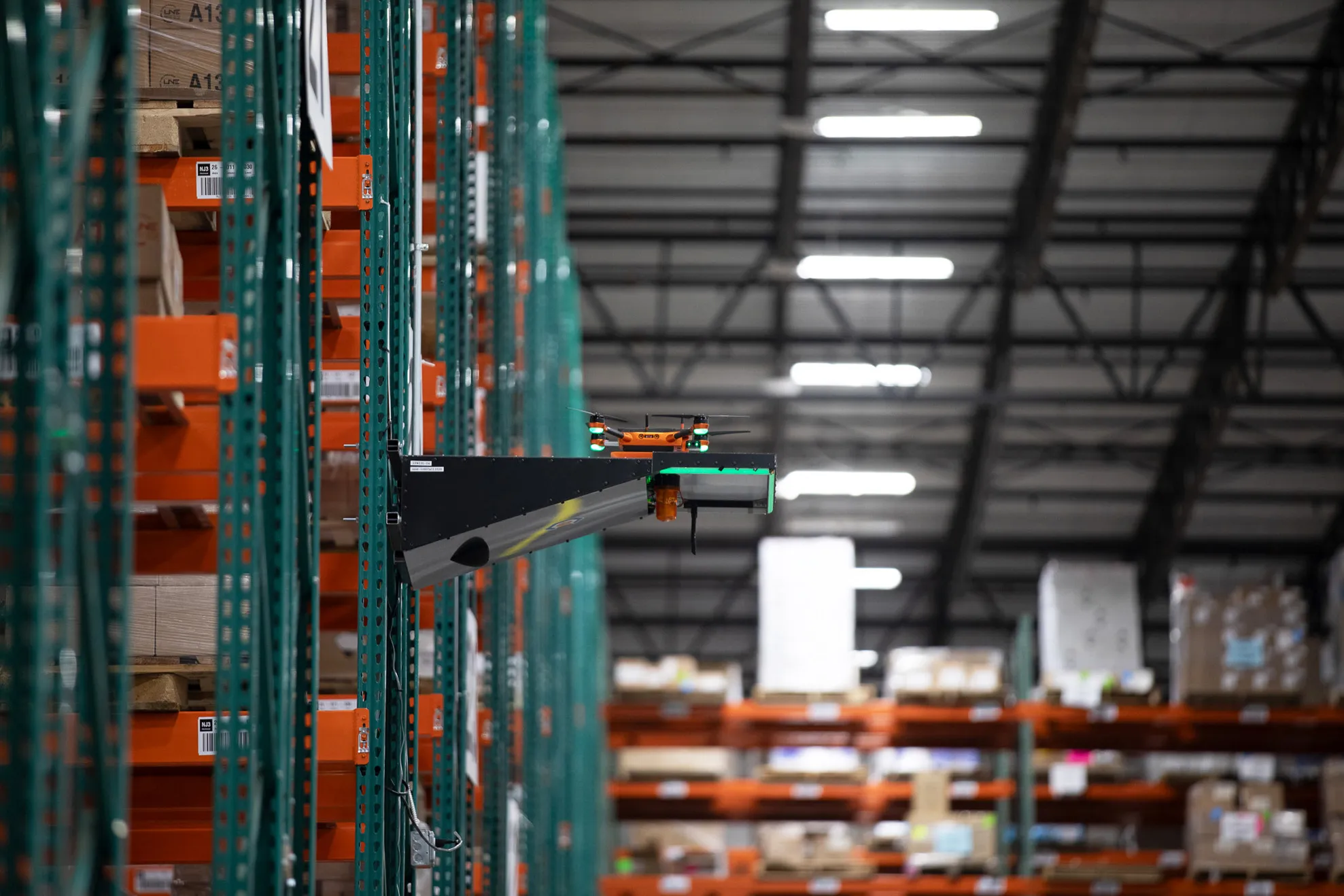
Cycle counting by hand is slow, error-prone, and sends people up order-pickers to scan top beams. Industry practice typically ties up two to four full-time employees on counting alone, and it still leaves large gaps between counts where the record and the reality drift apart. Autonomous inventory drones flip that math. The Corvus One drone flies pallet aisles using onboard computer vision — no Wi-Fi, GPS, or infrastructure changes required — and counts stock at every height, including the top positions no one wants to reach.
Corvus is roughly twenty times faster than manual cycle counting and sustains 99%-plus inventory accuracy, syncing discrepancy reports straight into your WMS so the count becomes a live data feed rather than a quarterly fire drill. It works in ambient warehouses and in freezer and cold-chain environments alike. The payoff is not just cleaner numbers — it’s freeing those two to four employees for higher-value work and eliminating the fall risk of riding a lift to read a label.
Fulfillment: autonomous mobile robots
On the outbound side, the bottleneck is almost always walking. In a conventional pick operation, associates spend the majority of their shift traveling between locations rather than actually picking. Locus Robotics AMRs attack that directly by bringing work to the associate: the robot travels the building, the person stays in a zone and picks. That single change lifts picking productivity two to three times on your existing racking and existing staff — no rip-and-replace, no new mezzanine.
Because AMRs are modular, a high-throughput fulfillment fleet scales up for peak and back down afterward, so you’re matching robot count to demand instead of over-hiring for the holidays and carrying idle labor in the off-season. AMR deployments in the U.S. are governed by the ANSI/RIA R15.08 safety standard (with ISO 3691-4 covering AGVs), and a good integrator designs the fleet, the traffic patterns, and the human work zones to that standard from day one rather than bolting safety on afterward.
Inspection: legged robots
Facilities and equipment need regular eyes on them — thermal scans of electrical gear, gauge and meter reads, walkthroughs of areas that are hot, dark, elevated, or otherwise awkward to reach. Warehousing already carries injury rates above the private-sector average according to BLS data, and manual inspection routes send people into exactly the spots that drive those numbers. Legged inspection robots such as the Boston Dynamics Spot run those routes autonomously and repeatably, handling stairs and rough terrain that wheeled robots can’t.
Spot captures visual, thermal, and acoustic data on a fixed schedule — day, night, or lights-out — so a missing reading or a hot bearing gets flagged before it becomes a failure. The value of repeatability is easy to underrate: because the robot walks the identical route and shoots the identical angles every time, trend detection becomes reliable in a way human rounds never are. That turns inspection from a compliance checkbox into genuine predictive maintenance, and it keeps your people out of the areas most likely to hurt them.
Security: autonomous patrol
After hours, large sites are hard and expensive to guard, and standing guard posts don’t scale to a sprawling Gulf Coast yard. Autonomous patrol closes the gap. The Ghost Robotics Vision 60 is a rugged all-terrain quadruped built to patrol outdoor perimeters through mud, gravel, ice, and Texas summer heat — conditions that stop wheeled platforms cold. For a fuller program, Asylon combines ground robots (DroneDog) and aerial drones (Guardian) with 24/7 human monitoring from a remote security operations center, so an alert is a trained responder’s decision, not just a recorded clip.
The point of autonomous security is not to replace your guards but to extend their reach: cover the perimeter and yard on a schedule and flag anomalies without adding standing posts. That’s how a lean team covers acreage that would otherwise require a platoon.
One integrator, one roadmap — and the economics
Here’s the part that’s easy to miss. Buying these four capabilities from four different manufacturers means four contracts, four integrations, and four support lines that don’t coordinate. A single integration partner ties them into one system and one roadmap, so inventory data, fulfillment, inspection, and security operate as a coordinated whole. Actel Robotics is an authorized integrator for all six platforms — Dexory, Locus, Boston Dynamics, Ghost Robotics, Corvus, and Asylon — and delivers the full lifecycle: assessment, solution design, deployment, WMS and systems integration, operator training, and ongoing optimization. That single-throat-to-choke model is exactly why an all-in-one approach is realistic rather than a juggling act. Weigh the platforms side by side on our compare robots page and see the full delivery process under our services.
What the numbers tend to look like
The economics matter as much as the capability. A few factors shape most decisions:
- OpEx, not CapEx. Robotics-as-a-Service (RaaS) is available across the fleet, so automation lands as an operating expense you can right-size rather than a large capital outlay.
- Payback in months, not years. Typical payback runs roughly ten to twenty-two months once labor reallocation, accuracy gains, and safety savings are counted together.
- Fast to live. A facility can move from a signed proposal to a live deployment in about three months.
- Phased by design. You start with the job that hurts most and expand, with each phase building toward one coherent system.
Run your own scenario with our ROI calculators to see how these ranges apply to your building and volumes before you commit to anything.
Build your roadmap
You don’t have to deploy everything at once — nearly every operation starts with the single job that hurts most and grows from there. If cycle counts are the pain, start with inventory drones; if peak season breaks your pick line, start with AMRs. Planning the full picture early means each phase snaps into a coherent system instead of a pile of one-off pilots that never integrate. For deeper reading, see our posts on pairing inventory drones with fulfillment AMRs and on the Robotics-as-a-Service model. When you’re ready, request a free consultation and we’ll help you sequence a roadmap that fits your building, budget, and timeline.