
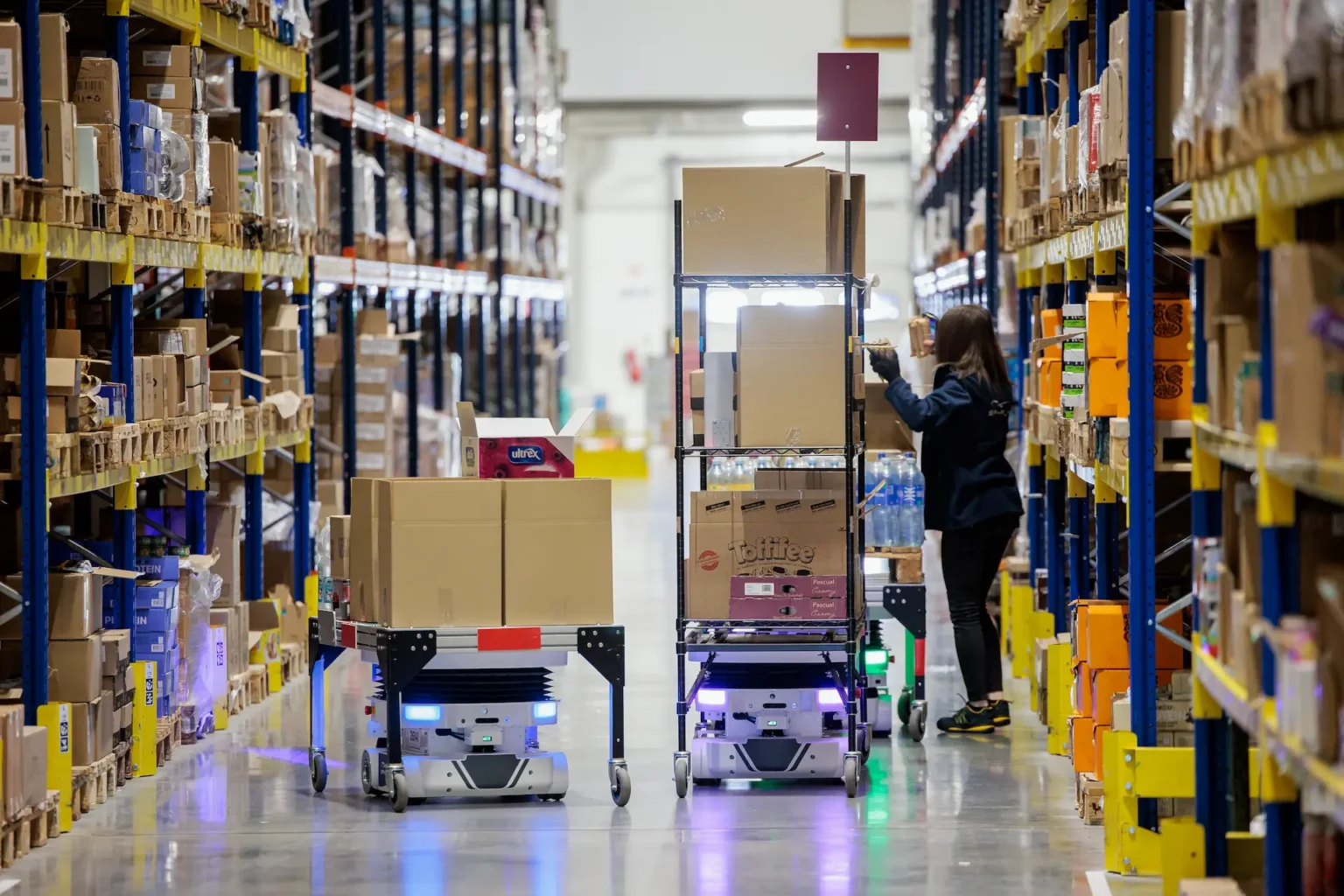
Warehousing and storage consistently rank among the most injury-prone industries in the United States — the Bureau of Labor Statistics puts the sector’s injury rate well above the private-industry average. The reasons are no mystery: long shifts of walking on concrete, repetitive lifting, reaching, bending, climbing, and shared aisles full of forklifts and foot traffic. Every one of those injuries carries a cost — a workers’ comp claim, lost productivity, overtime to cover the gap, and the slow erosion of morale that follows a serious accident. Warehouse robotics attack that problem at the source by removing the tasks most likely to hurt people, rather than simply adding another safety poster to the break room.
Where warehouse injuries actually come from
The expensive claims cluster around a handful of predictable activities. Manual material handling — lifting, lowering, and carrying — drives a large share of the sprains and strains that dominate warehouse loss runs. Repetitive walking and standing produce slower-burning musculoskeletal damage that shows up as overuse claims months later. And the most severe, highest-severity incidents tend to involve powered equipment: forklifts and order pickers moving through the same space as people on foot, or workers riding lifts to reach top racks. If you reduce how much walking, lifting, climbing, and forklift traffic your operation requires, you reduce your exposure on all of those fronts at once.
It helps to sort the risk into categories, because each one maps to a different class of robot:
- Ergonomic strain — miles walked, weight carried, and repetitive reaching that accumulate into musculoskeletal claims.
- Struck-by and pedestrian conflicts — collisions between people and powered equipment in shared aisles.
- Falls from height — associates on lifts, ladders, or order pickers scanning and counting inventory in the upper racks.
- Confined-space and environmental hazards — freezers, dim mezzanines, and tight or elevated areas that are simply hard on the body to enter.
How AMRs remove the riskiest tasks
Autonomous mobile robots change the physical pattern of the work instead of just speeding it up. In a Locus Robotics deployment, the bots travel the aisles and bring each order to the associate, who stays in a compact zone. That single change cuts the miles a worker covers in a shift — less walking means less fatigue, fewer slip-and-fall opportunities, and less of the cumulative strain that turns into a claim. Because the robots carry the totes, associates aren’t pushing heavy carts up and down the building either. The job shifts from “walk all day and haul weight” to “pick efficiently from a station,” which is far easier on the body and can lift picking productivity two to three times on your existing racking and staff.
Modern AMRs are also engineered to share space with people safely. They are built to standards such as ANSI/RIA R15.08, the safety framework written specifically for industrial mobile robots, and they navigate with onboard sensors that slow and stop for pedestrians rather than relying on painted floor lanes. That is a meaningful difference from older AGV traffic governed by ISO 3691-4 — the robot is actively watching for your team, not the other way around.
Beyond fulfillment: taking people out of harm’s way
The same logic extends across the building. Autonomous inventory counting with the Corvus One drone eliminates one of the more dangerous routines in the warehouse: sending a worker up a lift to scan top racks. The drone flies the pallet aisles on its own — no Wi-Fi, GPS, or infrastructure changes — using onboard computer vision, counts stock roughly twenty times faster than manual cycle counting, sustains 99%-plus accuracy, and works in ambient and freezer/cold-chain environments alike, then syncs discrepancy reports straight to your WMS. Manual cycle counting typically ties up two to four full-time employees; moving that work to a drone removes both the labor drag and the fall-from-height exposure.
For inspection and security, the pattern repeats. Robotic inspection with Boston Dynamics Spot sends an agile quadruped into the dark, hot, elevated, or confined spots people would otherwise have to enter, capturing visual, thermal, and acoustic readings day, night, or lights-out. Outdoors, Ghost Robotics Vision 60 handles rugged perimeter patrol across mud, gravel, ice, and Gulf Coast heat, and Asylon pairs ground and aerial security with 24/7 human monitoring — so a person isn’t walking a fence line alone at 2 a.m.
The workers’ comp math
Fewer high-risk tasks means fewer claims, and claims are expensive in ways that compound. There’s the direct medical and indemnity cost, but also the indirect cost: covering the absent worker, overtime, retraining, investigation time, and — over enough claims — a rising experience modifier that quietly raises every future premium. A single lost-time back injury can carry indirect costs that dwarf the medical bill. Even a modest reduction in incident frequency can move that modifier in your favor and keep it there for years.
When you model the return on a robotics deployment, the labor-productivity gain usually gets all the attention, but the avoided-injury savings belong in the same spreadsheet. So does the way you pay for the system. Actel offers Robotics-as-a-Service (RaaS), which turns automation into a predictable operating expense instead of a capital project — no large up-front outlay, and the cost scales with the fleet you actually use. Typical payback lands in the ten-to-twenty-two-month range once labor, throughput, and reduced claim exposure are counted together. Our ROI calculators are a good place to start putting numbers to your own facility, and comparing platforms side by side helps you match the right robot to your biggest risk.
Safety that helps retention, too
There’s a second-order benefit that’s harder to put on a balance sheet but just as real. Warehouses with high injury rates also tend to have high turnover — the work is punishing, and people leave. When robots absorb the walking, lifting, and climbing, the job becomes more sustainable: associates stay longer, new hires ramp faster, and you spend less recruiting and training a constantly churning workforce. Fewer injuries also means fewer experienced people sidelined at any given moment, which keeps throughput steady during peak. Safety, retention, and productivity turn out to be the same investment viewed from three angles.
What a deployment actually looks like
Cutting injuries isn’t about replacing your team — it’s about taking the parts of the job most likely to hurt them and handing those to a machine. As an authorized integrator for all six platforms above, Actel Robotics runs the full lifecycle so you’re not left to stitch it together yourself:
- Assessment — we walk your floor, review your loss history and workflows, and identify where injury risk and labor cost concentrate.
- Solution design — we map the right robots to those hot spots and model the throughput and safety impact before anything is ordered.
- Deployment and WMS integration — we install the fleet and connect it to your warehouse management and inventory systems so data flows automatically.
- Operator training and ongoing optimization — we train your staff to work alongside the robots and keep tuning the deployment as your volumes change.
Most facilities move from a signed proposal to a live system in about three months. Actel is based in Sugar Land, Texas, led by President Dan Tarpey, and serves operations across Texas, Louisiana, and Oklahoma. You can read more about our integration services or compare adjacent topics on the blog — including how autonomous drones sharpen inventory accuracy. When you’re ready, request a free consultation and we’ll walk the safety and ROI numbers for your building together.