
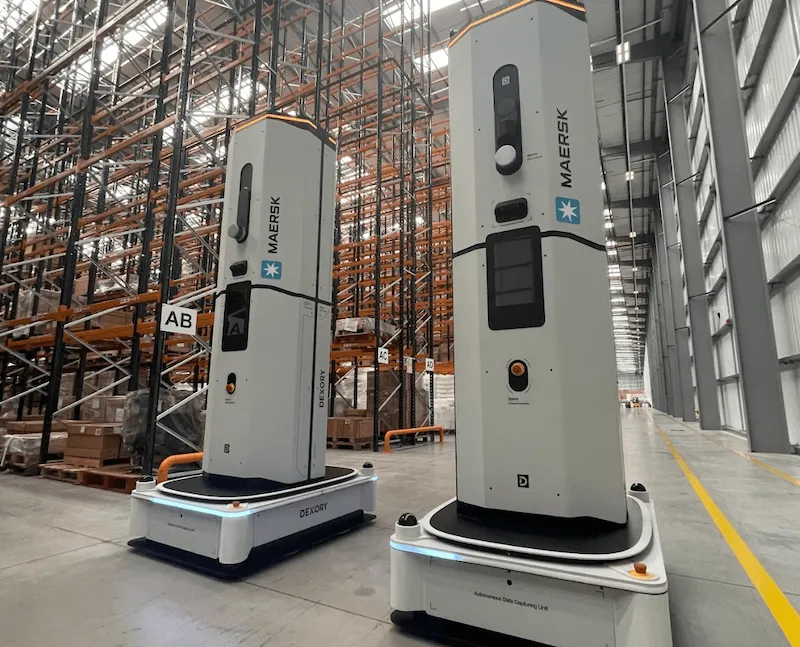
Most warehouses solved the "how often do we count" problem years ago. What a growing number of operators are running into now is a different problem: even a good cycle-counting program only tells you what was true the last time someone looked. Between counts, the warehouse management system is running on faith. Dexory's autonomous robots close that gap by scanning the entire facility on their own schedule and building a live digital twin of what is actually on the shelf — not a snapshot from last week.
Below are five signals that a facility has outgrown periodic counting, whether that counting is manual or drone-based, and is ready for continuous, real-time visibility instead.
1. You Operate More Than One Facility and Compare Them on Spreadsheets
A single-site operation can get by with one person who knows that building cold. Multi-site operators cannot. When inventory accuracy, space utilization, and discrepancy trends live in separate reports from separate systems at separate cadences, leadership ends up comparing facilities on stale, inconsistent data.
DexoryView runs every site through the same cloud console, so a multi-site operator sees inventory health, occupancy, and discrepancy trends across the whole network from one dashboard — not five spreadsheets updated on five different schedules.
2. Slotting Decisions Are Guesses, Not Data
Where to put fast-moving SKUs, how much space a category actually needs, which zones are chronically over- or under-utilized — most facilities answer these questions from institutional memory rather than measurement. That is a reasonable way to run a warehouse until the facility grows past the point where memory scales.
Because Dexory's robots scan the full facility, not just inventory locations, the DexoryView Optimise module surfaces actual space-utilization data: which zones are full, which are underused, and where a re-slot would pay off. Slotting stops being a periodic project and becomes something you can check any time.
3. You Cannot Answer "What Changed Since Yesterday?" Without a Fresh Count
A count that runs weekly, or even nightly by drone, is still a snapshot. If a discrepancy shows up today, you are working from data that is hours or days old by the time anyone looks at it. That lag is exactly where shrinkage, misplacement, and damaged stock go unnoticed the longest.
Dexory's robots complete a full-facility scan in a fraction of a shift — up to 15,000 pallets an hour, fast enough for daily or multiple-times-daily scanning — so the gap between "something changed" and "someone can see it" shrinks from days to hours.
4. Compliance and Safety Reviews Are a Separate Walk-Through
Damaged racking, blocked fire lanes, mislabeled locations — most facilities catch these on a dedicated safety walk, separate from inventory work, done by someone pulled off another task. That means two review cycles instead of one, and gaps between them where a real hazard can sit unnoticed.
Because Dexory's robots are already scanning every location for inventory, the Integrity module flags damage, safety, and compliance risks as part of the same pass — not a separate exercise that competes for someone's time.
5. You Want to Add Automation Without Adding Infrastructure Projects
A lot of warehouse technology comes with a construction project attached: RFID readers on every rack, fixed cameras wired through the ceiling, network drops at every dock door. For an operator who wants better visibility without a capital project, that overhead is often the real barrier, not the technology itself.
Dexory requires no racking sensors, RFID tags, or fixed cameras. The robot navigates on its own, and a typical facility goes from signed agreement to live scanning in one to two weeks — not months of site prep.
How Deployment and ROI Actually Work
As a full-lifecycle systems integrator, Actel Robotics runs the whole path for a Dexory deployment: facility assessment, WMS integration, deployment, and ongoing support across Texas, Louisiana, and Oklahoma. Because there is no fixed infrastructure to install, most facilities are live in one to two weeks from a signed agreement.
The commercial model is a straightforward monthly subscription that bundles the robot hardware, DexoryView software, monitoring, and support — no separate capital purchase. A Forrester Total Economic Impact study commissioned by Dexory found a 219% three-year ROI with payback in under six months, and named enterprise deployments at Maersk, GXO, DHL, and IKEA report accuracy at or above the platform's published 99.9%.
If your facility already runs an aerial inventory drone and is deciding between form factors, see our Dexory vs. Corvus One comparison, or weigh every platform side by side on our compare robots page.
The Takeaway
If your operation shows two or three of these signs, real-time inventory intelligence is worth a serious look. If it shows four or five, the cost of running on stale data is probably larger than you have measured. Contact Actel Robotics to schedule a free facility assessment, or explore our Dexory platform page for full details on deployment and pricing.