
The I-10 corridor west of Houston — from the Beltway through Katy, Brookshire, and toward Columbus — has transformed over the past decade from suburban residential expansion into one of the most active industrial real estate markets in the Sun Belt. National logistics operators have built or leased major distribution facilities across the Katy market, drawn by the convergence of I-10 access, available industrial land, and proximity to the Port of Houston's container terminals. As those buildings fill and order volumes climb, the operational question shifts from "how do we get space?" to "how do we run this space accurately at scale?" That is where autonomous inventory technology enters the conversation.
What's Driving the Katy Logistics Boom
Several structural factors have converged to make the Katy-to-Brookshire I-10 corridor a preferred location for new distribution-center construction. Land is available and relatively affordable compared with the Beltway interior. I-10 provides direct access to both the Port of Houston and the broader Texas consumer market. The Grand Parkway (SH-99) has opened north-south connections that further improve last-mile coverage. And the sustained population growth of Greater Houston keeps demand high for the e-commerce fulfillment and distribution operations that need large floorplates.
The tenants moving into these buildings are not running small stockrooms. They are high-throughput operations processing large daily order volumes against tight service-level agreements. In that setting, the warehouse's own data becomes the constraint. A world-class building with a fast conveyor system and a well-staffed pick team can still miss orders if the warehouse management system (WMS) believes product is in a slot where it isn't. Physical growth in the corridor has outpaced the counting methods most facilities still rely on.
Why Inventory Accuracy Is the Hidden Bottleneck
Most Katy-corridor DCs still count inventory the traditional way: teams walking aisles with scanners and lifts, sampling locations on a cycle-count schedule or shutting down for periodic wall-to-wall counts. It works, but it is slow, labor-intensive, and inherently partial. Manual cycle counting typically ties up two to four full-time employees who could otherwise be picking, receiving, or shipping. Because manual programs can only sample a fraction of locations on any given day, discrepancies can sit undetected for weeks — long enough to generate failed picks, emergency replenishments, and inaccurate promises to customers.
There is a safety dimension as well. Warehousing carries injury rates above the private-sector average according to the Bureau of Labor Statistics, and sending associates up on order pickers to count high pallet positions adds avoidable exposure at height. Automating the count removes people from that task and reallocates them to lower-risk, higher-value work on the floor.
How Autonomous Drone Inventory Fits the I-10 Corridor
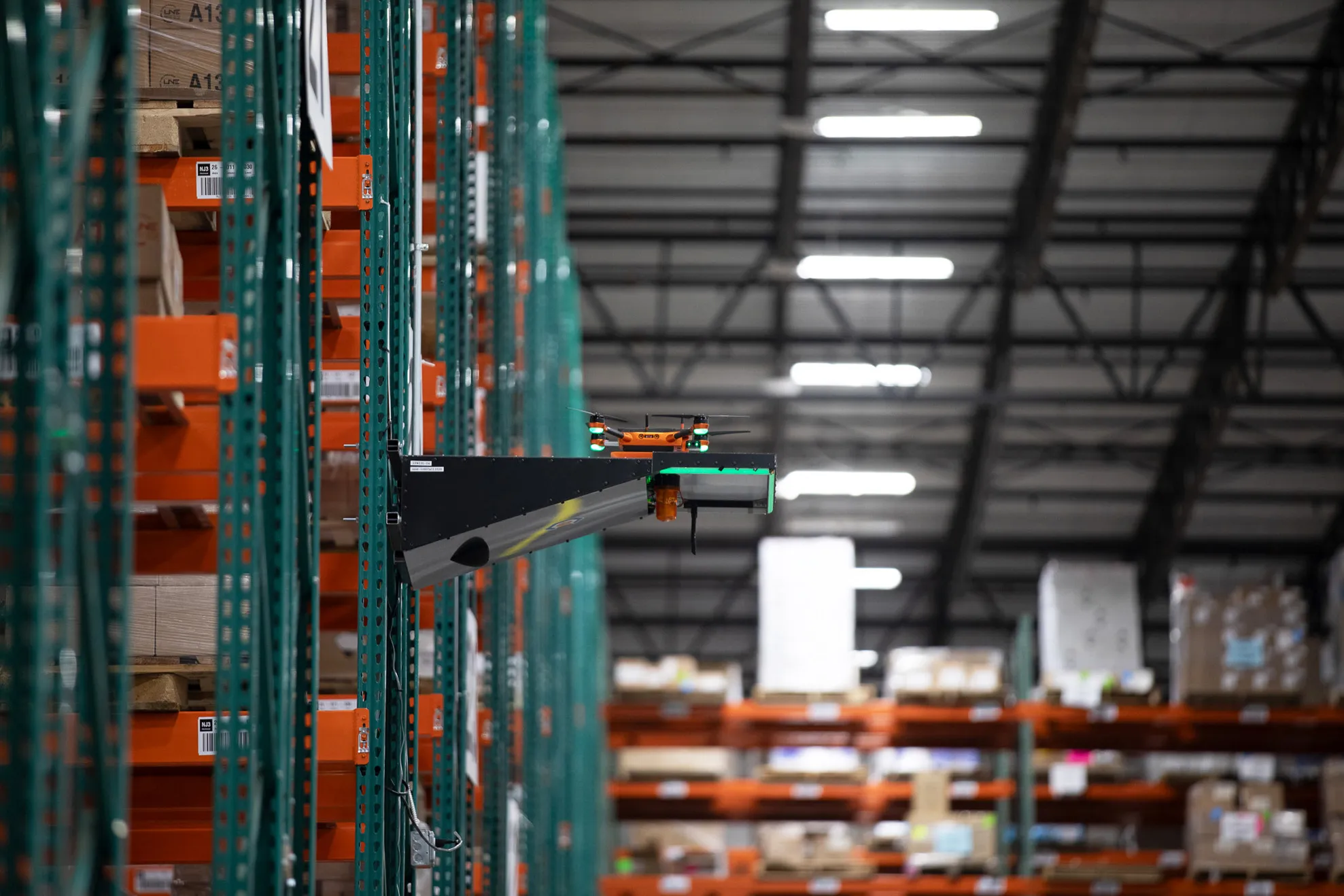
The Corvus One autonomous inventory drone is purpose-built for exactly this environment. It flies the pallet aisles that form the backbone of most I-10 corridor DCs and scans locations using onboard computer vision — no Wi-Fi upgrades, no GPS, no reflectors, beacons, or other infrastructure changes to the building. That matters in Katy, where many facilities are newly leased and operators are reluctant to modify a landlord's shell or interrupt a ramping operation.
The performance profile is what makes it compelling for high-volume tenants:
- Roughly 20x faster than manual cycle counting, so a facility can scan far more locations per shift with no added headcount.
- Sustained 99%+ inventory accuracy, which keeps the WMS trustworthy and drives down the failed-pick rate that erodes SLAs.
- Works in ambient and freezer/cold-chain environments — relevant for the food, beverage, and consumer-goods operators well represented along I-10.
- Discrepancy reports sync directly to the WMS, so exceptions surface as actionable data rather than a spreadsheet someone reconciles days later.
For operations that also need to move product faster, drone inventory pairs naturally with floor robotics. Locus Robotics fulfillment AMRs can lift picking productivity two to three times on a facility's existing racking and staff, and they scale up or down with seasonal demand — a common requirement for corridor tenants with pronounced peak seasons. Accurate inventory and faster picking reinforce each other: the robots are only as productive as the data they pick against. Explore both under our warehouse inventory and warehouse fulfillment solutions.
The Economics: RaaS, Payback, and Deployment Timeline
Capital committees rarely enjoy approving six-figure automation purchases, especially inside leased buildings. Actel Robotics offers a Robotics-as-a-Service (RaaS) model that turns automation into an operating expense rather than a capital expenditure — an easier fit for a tenant whose lease horizon may not match a traditional depreciation schedule. Typical payback lands in the range of about ten to twenty-two months, driven mainly by reclaimed labor, fewer failed picks, and reduced safety exposure.
Timeline is often the deciding factor for a fast-ramping corridor DC. A facility can move from a signed proposal to a live deployment in roughly three months, so a building filling up this quarter can be counting autonomously before its next peak. To model your own numbers before committing, run the figures through our ROI calculators, or line the platforms up side by side on our compare robots page.
What a Deployment Actually Involves
Actel Robotics is a full-lifecycle systems integrator, not a box reseller — a distinction that matters most when the technology has to work inside a live, high-throughput building. Every engagement follows the same disciplined path:
- Assessment of your facility, rack layout, SKU profile, and current counting process.
- Solution design matched to your aisles, ceiling heights, and WMS.
- Deployment and WMS integration so discrepancy data flows into the systems your team already uses.
- Operator training so your staff runs the program with confidence.
- Ongoing optimization as SKUs, volumes, and seasons change.
Deployments are engineered around recognized safety frameworks, including ANSI/RIA R15.08 for mobile robots and ISO 3691-4 for automated industrial vehicles, so autonomous equipment coexists safely with people and lift traffic. You can see the full scope of what we handle on our services page.
Beyond Inventory: One Integrator for the Whole Building
Inventory is often the entry point, but corridor facilities frequently have adjacent problems worth solving on the same relationship. For maintenance and compliance walks, Boston Dynamics Spot performs autonomous, repeatable robotic inspection — visual, thermal, and acoustic — across stairs and rough terrain, day, night, or lights-out. For the yard and perimeter, the all-terrain Ghost Robotics Vision 60 handles Gulf Coast heat, mud, gravel, and ice, while Asylon combines ground and aerial security and surveillance with 24/7 human monitoring. Working with a single integrator across inventory, inspection, and security keeps standards, safety practices, and support consistent across the site. For a closer look at how the aerial and ground platforms complement each other, see our post on choosing the right warehouse robot.
The Takeaway for Katy Operators
The I-10 West market has already won the real-estate race; the next competitive edge is operational precision inside those buildings. Facilities that keep their WMS accurate, move product faster, and pull people off risky manual counts will protect their SLAs while their neighbors fight exceptions. Autonomous drone inventory — deployed on a RaaS model, integrated into your WMS, and standing up in about three months — is one of the most direct ways to get there.
Actel Robotics serves the Katy and I-10 corridor from our Sugar Land headquarters, roughly twenty minutes away. Contact us for a free facility assessment, and we'll show you exactly how autonomous inventory would fit your building, your SKUs, and your numbers.