
Every fulfillment operation knows the peak-season squeeze. Order volume can double or triple for a few intense weeks around the holidays, and the traditional answer is to hire a temporary army to cover it. But overhiring is a blunt, expensive instrument — and there is now a better way to absorb demand spikes that does not depend on finding, training, and then letting go of hundreds of seasonal workers. Autonomous mobile robots let you scale throughput instead of scaling headcount, and they do it on your existing racking and floor plan. Here is how that works, what it costs, and how to get a fleet live before the wave hits.
The overhiring trap
Seasonal hiring looks simple on paper and is painful in practice. In a tight labor market the workers may not be there to hire at any price. The ones you do find need onboarding and training right when your operation is least able to spare a trainer, and a brand-new temp is far less productive — and more injury-prone — than a seasoned associate. Warehousing already carries injury rates above the private-sector average (per BLS data), and rushing untrained bodies onto the floor during your busiest, most fatigued weeks does not help. You pay overtime to bridge the gaps, eat the cost of higher pick-error rates and returns, and then unwind the whole workforce in January. It is a lot of money and risk spent to buy throughput you only needed for six weeks.
The deeper problem is that headcount is a lumpy, one-directional lever. You cannot hire half a picker, you cannot easily flex the crew down mid-week, and every incremental worker adds recruiting, badging, and supervision overhead. Peak demand is spiky; a human workforce is not. That mismatch is exactly where automation earns its keep.
How fulfillment AMRs flex with demand
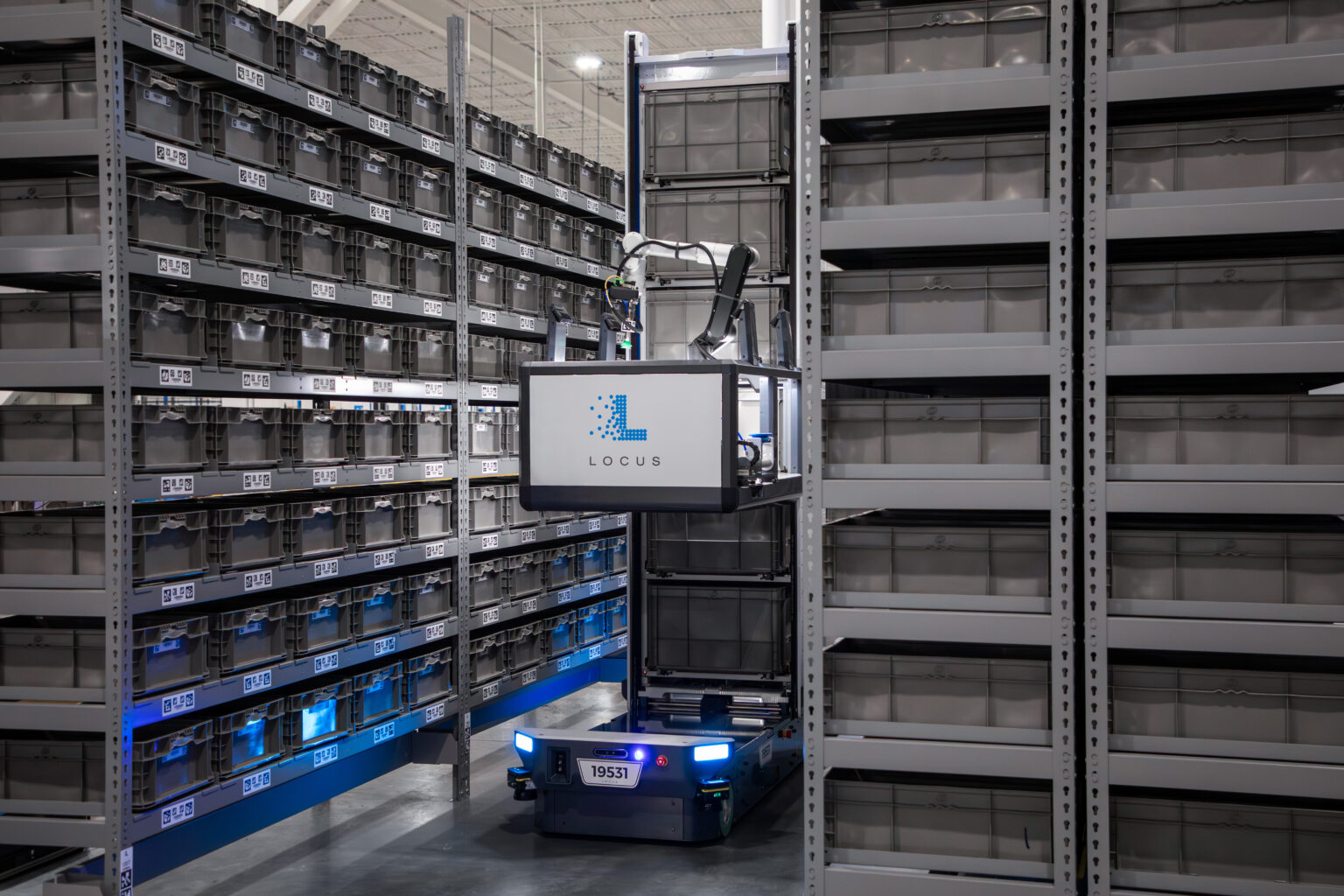
Autonomous mobile robots change the equation because they multiply the output of the workers you already have. With a Locus Robotics fleet, each associate stays in a compact zone and the bots bring work to them — a goods-to-person style workflow layered onto your current shelving. Because associates stop walking the miles that eat most of a manual picker's shift, picks per hour climb sharply, typically lifting productivity two to three times over a manual cart workflow. That means the same core team can ship dramatically more volume during peak without tripling headcount.
Why per-person productivity is the right lever
Scaling productivity per person, rather than the number of people, compounds in your favor:
- Fewer people to recruit and train for the same order volume, which shortens your peak hiring runway.
- Less floor congestion — bots optimize their own paths, so you are not cramming more foot traffic into the same aisles.
- Lower error rates from guided, screen-directed picking, which cuts the returns and re-picks that quietly balloon during peak.
- Safer flow under recognized robotics safety standards such as ANSI/RIA R15.08 for mobile robots, so throughput gains do not come at the cost of incidents.
AMRs are not limited to picking, either. The same discipline of letting robots absorb the repetitive, mileage-heavy work applies across the building — from autonomous inventory counting that keeps stock accurate through the chaos of peak, to robotic inspection and perimeter security when your facility is running longer hours and lights-out shifts.
Robotics-as-a-service: rent the surge, don't buy it
The real unlock for peak is that robot fleets can flex in size. Through robotics-as-a-service (RaaS), you can bring in additional bots for your busy weeks and return them when volume normalizes — paying for the capacity when you need it rather than buying a fleet sized for one month of the year. It is the same instinct as renting extra trailers for peak, applied to picking capacity.
RaaS also reframes the buying decision. Instead of a large capital outlay, robotics becomes an operating expense that scales with volume and, in principle, with the revenue that volume generates. There is no equipment to depreciate and no obsolescence risk sitting on your balance sheet. For most fulfillment deployments, the payback window lands in roughly the 10-to-22-month range once you account for reduced overtime, fewer temps, lower error and return costs, and higher throughput per square foot. Before committing, it is worth modeling your own numbers — our ROI calculators let you plug in your order volume, labor rates, and peak multiplier to see where the break-even falls for your operation.
Onboarding temps in minutes, not weeks
When you do add seasonal people, an AMR workflow makes them productive almost immediately. There is no need to memorize a cavernous building or learn an efficient walking path — the robot leads, and the associate follows on-screen prompts on the bot's display to pick the right item in the right quantity. New hires reach useful output in a fraction of the time a manual operation requires, and the guided workflow keeps error rates low even with an inexperienced crew. That takes enormous pressure off your peak staffing plan: you can staff to a realistic number, onboard fast, and trust the system to keep quality high while people are still climbing the learning curve.
What deployment actually involves
Standing up a fleet is a project, not a purchase, and it rewards planning. As a full-lifecycle systems integrator, Actel handles each stage so your team is not improvising during your busiest quarter:
- Assessment — we map your order profiles, SKU velocity, and peak multiplier to size the fleet and the workflow correctly.
- Solution design — zone layouts, pick paths, and staffing models are built around your existing racking, not a forklift of it.
- WMS and systems integration — the bots talk to your warehouse management system so orders, inventory, and productivity data flow without manual bridges.
- Operator training and go-live — associates and supervisors learn the workflow before peak, not during it.
- Ongoing optimization — we tune throughput and, with RaaS, scale the fleet up for the holidays and back down afterward.
Critically, a facility can go from a signed proposal to a live, producing fleet in about three months. That timeline is the reason peak planning is a summer decision, not an October scramble — and the best RaaS surge capacity for the holidays gets reserved early.
Beyond fulfillment: one integrator for the whole floor
Peak stresses more than picking. Longer hours mean more inventory drift, more wear to inspect, and more exposure at the perimeter after dark. Because Actel is an authorized integrator across five robotics platforms, the same partner that scales your Locus picking fleet can also stand up Corvus One inventory drones for continuous cycle counting, Boston Dynamics Spot for autonomous facility inspection, and Ghost Robotics or Asylon for outdoor security and 24/7 monitored surveillance. If you are weighing which platforms fit your building, our robot comparison guide lays out the trade-offs side by side, and our integration services page walks through how a phased rollout works.
Plan your peak now, not in October
The operations that sail through peak are the ones that designed for it months ahead. Overhiring will always be there as a fallback, but it is the most expensive, least reliable way to buy six weeks of throughput. A right-sized AMR fleet — scaled with robotics-as-a-service and integrated cleanly into your WMS — lets you ship the surge with a leaner, safer, more productive team, then flex back down without layoffs when the wave passes. As a Locus implementation partner and full-lifecycle integrator, Actel Robotics can get you there before the season starts. Talk to us about a peak plan for your facility, or run the numbers to see what AMRs would do to your throughput and your labor bill this holiday season.
Related reading: Overhiring is a symptom of a bigger pattern — see the 2026 automation gap: why labor-short warehouses still aren't automating, and how to close it.