
The stretch of I-35 between San Antonio and Austin has become one of the most dynamic logistics markets in Texas. Explosive population growth, a booming Central Texas manufacturing base, and the corridor’s role as a gateway for cross-border and regional distribution have filled the region with new distribution centers — and made warehouse labor harder to find and keep. That combination is why more Central Texas operators are turning to robotics. This post looks at what is driving demand along the corridor, where automation fits inside a working DC, how the ROI pencils out, and what a deployment looks like from proposal to go-live.
What’s Driving the I-35 Corridor Boom
Austin’s semiconductor and advanced-manufacturing surge, San Antonio’s established automotive and logistics base, and one of the fastest-growing consumer populations in the country have converged on the corridor. Developers are building large, high-throughput facilities along I-35 and SH-130 faster than the labor market can staff them, and the manual roles most exposed to that shortage — cycle counting and order picking — are exactly the ones robotics addresses.
The pressure is not only about headcount. As facilities scale toward hundreds of thousands of square feet and tens of thousands of pallet positions, the manual processes that worked in a smaller building start to break down. Cycle counting that once tied up a couple of associates now ties up a full team; a counting program that touches every location on a sensible cadence becomes impractical by hand. Warehousing also carries above-private-sector-average injury rates according to BLS data, and much of that exposure comes from the same manual tasks — climbing to scan high pallet locations, and the repetitive walking and lifting of manual picking. Automating those tasks removes both a labor bottleneck and a safety liability at the same time.
Where Robotics Fits in a Central Texas DC
Two problems dominate high-volume corridor facilities: keeping inventory accurate, and moving product to the pack station fast enough during peak. These are the highest-leverage places to start, and they map to two proven, complementary platforms.
Autonomous Inventory: Counting Without Slowing Down
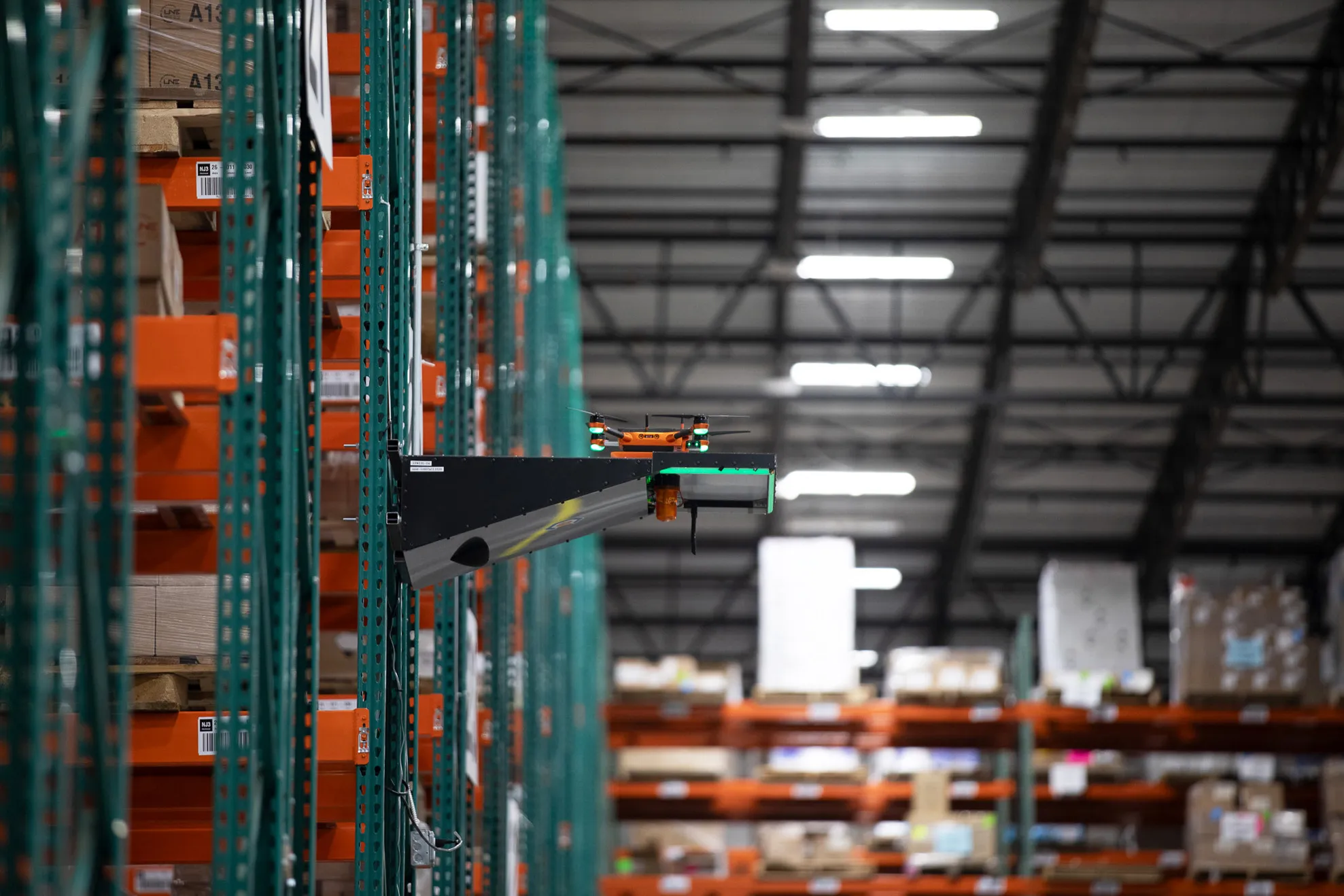
Autonomous inventory drones like the Corvus One fly the pallet aisles using onboard computer vision — no Wi-Fi, GPS, or facility infrastructure changes required. They read location and product labels at every level, including the high positions that are slow and unsafe to count manually, and sync discrepancy reports straight into your WMS. The result is roughly 20x faster counting than a manual program while sustaining 99%+ inventory accuracy, without ladders, aisle shutdowns, or pulling associates off the floor. Because the system runs on its own, a facility can count continuously rather than freezing operations for a periodic wall-to-wall. The same platform works in ambient and freezer or cold-chain environments, which matters for the food and beverage distributors well represented across the corridor. For a deeper look at how this replaces a traditional counting program, see our warehouse inventory solution.
Fulfillment Throughput: Picking Faster on the Racking You Have
On the fulfillment side, Locus Robotics AMRs lift picking productivity 2–3x on your existing racking and staff, which is what lets a DC absorb a demand spike without over-hiring. The robots handle the travel between pick locations while associates stay in their zones, cutting the walking that eats most of a picker’s shift. Just as important, the fleet scales up and down with demand — you add units for peak season and pull them back when volume normalizes, instead of hiring and laying off a seasonal workforce. That elasticity is a natural fit for a corridor where consumer demand is climbing fast but unevenly. Our warehouse fulfillment solution covers how AMRs slot into an existing pick process.
Corridor operators do not have to choose one or the other. Accurate inventory feeds faster fulfillment: an AMR pick wave built on trustworthy stock data generates far fewer exceptions than one built on numbers that drift between annual counts. Deploying both lets the two systems reinforce each other. For facilities with outdoor yards or high-value staging, the same integrator relationship extends to autonomous inspection and perimeter security — but for most corridor DCs, inventory and fulfillment are the right place to begin.
The ROI Math for the Corridor
The business case starts with the cost of the status quo. Manual cycle counting typically ties up two to four full-time associates whose labor produces no throughput — they exist only to correct a number that keeps drifting. When counting is slow, accuracy sits low between counts, and a persistent 1–2% accuracy gap produces failed picks, mis-ships, phantom stockouts, and emergency replenishment every day. Autonomous counting closes that gap, redeploys those associates to value-added work, and gives planning a stock picture it can actually trust.
Across our platforms, deployments typically reach payback in about 10 to 22 months. Two things make that math work for mid-market corridor operators rather than just national brands. First, AMRs and inventory drones layer onto the building you already run — no re-racking, no concrete, no forklift-guided AGV lanes to pour. Second, most deployments are available on a Robotics-as-a-Service (RaaS) model, so the entry point is an operating expense rather than a capital project. RaaS turns automation into a predictable monthly line item that scales with the fleet, which is why the technology is now within reach of regional 3PLs and manufacturers, not only the largest players. To put real numbers against your own volumes, labor rates, and error costs, run the figures through our ROI calculator or compare the platforms side by side.
What Deployment Looks Like
Buying a robot is not the same as running one. The gap between a promising pilot and a system your team relies on every shift is integration — and that is where a full-lifecycle integrator earns its keep. As the authorized integrator for all five platforms, Actel Robotics runs the whole arc rather than dropping off hardware:
- Assessment. We walk the facility, review your throughput and accuracy data, and identify where automation returns the most, before anything is quoted.
- Solution design. We size the fleet, map aisles and workflows, and define how the system meets standards such as ANSI/RIA R15.08 for AMRs and ISO 3691-4 for automated vehicles.
- Deployment and WMS integration. We stand up the platform and wire it into your warehouse management system so counts and pick tasks flow automatically — the step that most often determines success.
- Operator training and optimization. We train your team to run and trust the system, then tune it over time as volumes and SKUs change.
Because the platforms need no infrastructure overhaul, a facility can go from signed proposal to live in about three months — fast enough to have automation working before the next peak. Our full integration and support services keep it that way after go-live, and you can see how the approach applies beyond the corridor in our related look at how RaaS reshapes the automation buying decision.
The Takeaway for Central Texas Operators
The San Antonio–Austin corridor is growing faster than it can be staffed, and the manual tasks feeling that pressure first — counting and picking — are the ones robotics handles best today. Autonomous inventory drones and fulfillment AMRs deliver accuracy and throughput gains on the building and staff you already have, on an operating-expense model that fits a mid-market budget, with payback measured in months rather than years. The operators moving now are the ones who will have capacity in hand when the next demand spike arrives.
Actel Robotics designs, deploys, and services robotics across Texas, Louisiana, and Oklahoma from our Sugar Land base, and we are actively growing our presence along the San Antonio–Austin corridor. Contact us for a free facility assessment to see exactly where automation pays off in your operation — no commitment required.