
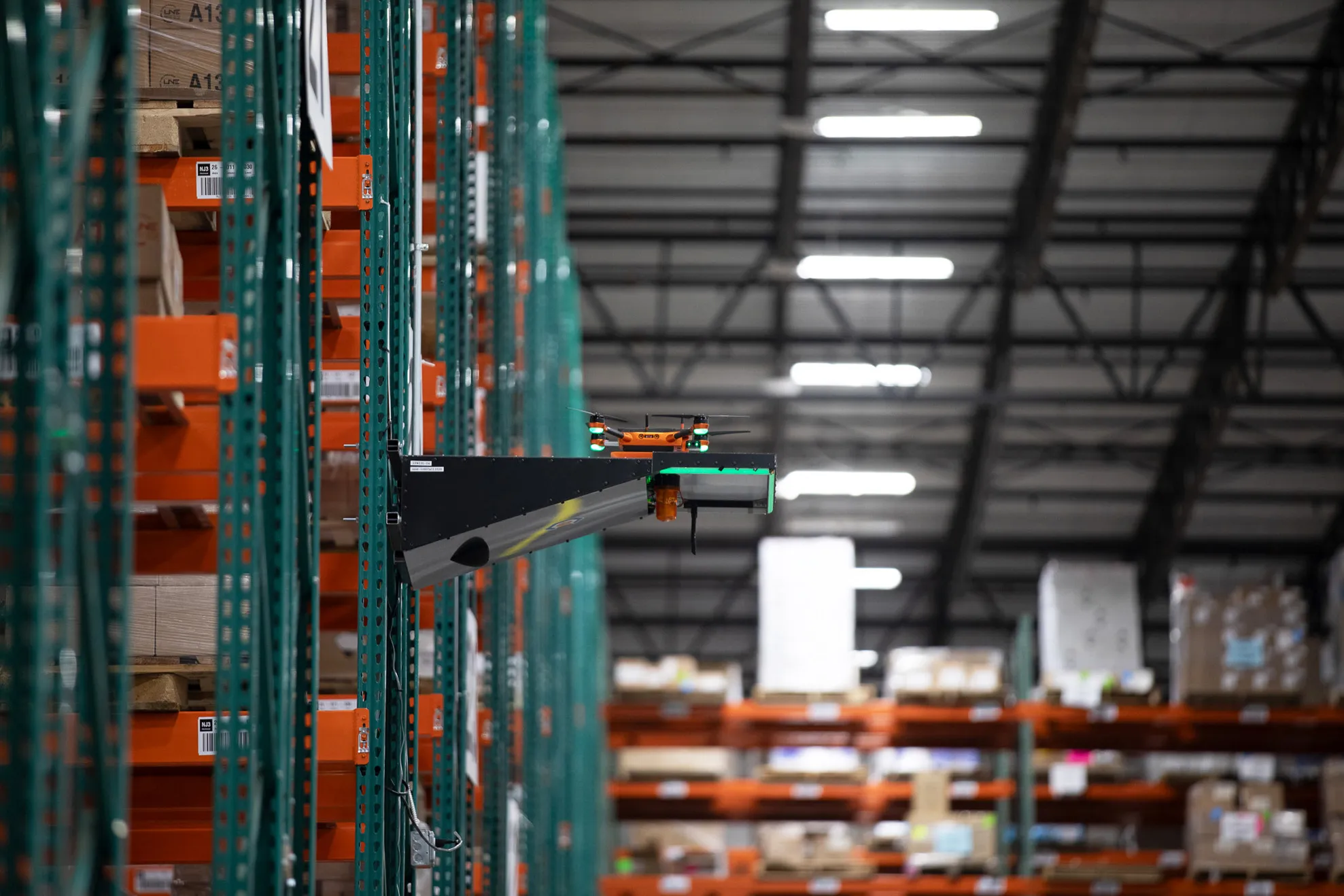
Third-party logistics (3PL) operators are disproportionately represented in early autonomous drone inventory deployments, and the reasons are structural rather than coincidental. The operational profile of a 3PL warehouse — multiple clients under one roof, contractual accuracy requirements, constantly shifting SKU bases, and margin pressure that makes every labor dollar a decision — creates a uniquely compelling use case for autonomous cycle counting. When a technology maps this cleanly onto a business model, adoption tends to lead the broader market rather than follow it. That is exactly what we see with 3PLs and inventory drones.
This post looks at why the 3PL model pulls automation forward, how autonomous drone counting actually works inside a busy multi-client facility, what the return-on-investment math looks like, and what a realistic deployment involves for an operator serving the Gulf Coast.
The Multi-Client Accuracy Problem
A dedicated distribution center has one client: its own supply chain. Inventory accuracy failures there are absorbed internally. A 3PL is different. It carries contractual accuracy obligations to multiple clients simultaneously, each with its own service-level agreement, reporting cadence, and financial penalty for missed accuracy targets. The risk of inaccuracy is effectively multiplied by client count, and it compounds because a single mislabeled or misplaced pallet can cascade into a failed pick, a mis-shipment, and a damaged client relationship all at once.
Daily cycle counts with the Corvus One autonomous inventory drone provide a defense against accuracy SLA breaches that manual programs cannot match. The drone flies pallet aisles on its own, using onboard computer vision to read location and pallet data — no Wi-Fi, no GPS, and no physical infrastructure changes to the building. It runs roughly twenty times faster than a manual counting crew and sustains 99%-plus inventory accuracy. Because every location can be counted every day, discrepancies surface the day they occur rather than during a quarterly audit, and the drone syncs its discrepancy reports directly to the WMS so the correction workflow starts immediately.
How Autonomous Drone Counting Works in a 3PL Setting
Operators are often surprised by how little the drone disrupts the floor. The Corvus One counts during off-shift windows or in cleared aisles, then returns to its dock to charge and upload. Because all localization is handled by onboard computer vision, the same platform works in ambient racking and in freezer or cold-chain environments — a meaningful point for 3PLs that hold mixed-temperature client inventory in one building.
A typical daily cycle looks like this:
- Autonomous flight: the drone navigates predefined aisles, capturing location barcodes and pallet presence at every level, including the high bays that are slow and unsafe to count manually.
- On-board processing: computer vision matches what it sees against expected inventory, flagging empties, misplaced pallets, and unexpected occupancy.
- WMS sync: discrepancy reports flow into your warehouse management system, so exceptions land in front of a supervisor as a work queue rather than a spreadsheet.
- Continuous coverage: the route repeats daily, turning cycle counting from a periodic project into a background process.
Because the drone reports by client, location, and SKU, a 3PL can hand each account a clean, defensible accuracy record instead of reconstructing one under audit pressure.
Onboarding New Clients Faster
When a 3PL onboards a new client, the transition period is the highest-risk window in the whole relationship. Inventory is arriving, being put away, and getting keyed into the WMS all at once, usually against a tight go-live date. Put-away errors made during that scramble are the ones that quietly poison accuracy for months. Continuous drone counting during onboarding catches those errors in real time — a pallet in the wrong slot is flagged the same day, not discovered weeks later when the client's first accuracy report comes back short.
That speed-to-confidence is also a sales asset. Being able to tell a prospective client that their inventory will be counted daily by an autonomous system, with per-account accuracy reporting from day one, is a differentiator in competitive 3PL bids. Automation stops being just a cost line and becomes part of the value proposition you take to market.
The Labor Flexibility Advantage
3PL labor demand is inherently spiky — peak seasons, promotional campaigns, and client volume swings all hit the same crew. Manual cycle counting typically ties up two to four full-time associates, and those are experienced people who know the protocol and are hard to backfill temporarily. When counting labor competes with picking and receiving during a surge, counting is what gets cut, and accuracy erodes exactly when volume is highest.
An autonomous drone program scales independently of the rest of the floor. It flies the same route whether the building is running one shift or three, with no training, no ramp-up, and no replacement coverage to arrange. That frees skilled associates for higher-value work and removes cycle counting from the list of things that break under peak pressure. There is a safety dimension too: warehousing carries above-average injury rates compared with the private sector overall (per BLS), and much of the manual counting exposure comes from operating lifts to reach high bays. Moving that task to a drone takes people out of one of the hazardous parts of the job.
The ROI and RaaS Case for 3PLs
For an asset-light business model, how automation is paid for matters as much as what it does. Actel offers the Corvus One under a Robotics-as-a-Service (RaaS) model, which turns the deployment into an operating expense rather than a capital purchase. For 3PLs that would rather not tie up capital or carry equipment on the balance sheet, that structure aligns cost with the client contracts the system supports. Typical payback lands in roughly the ten-to-twenty-two-month range depending on facility size, count frequency, and current labor cost.
The return comes from several directions at once: reclaimed labor hours, avoided SLA penalties, fewer mis-ships and the chargebacks that follow them, and the retention value of clients who trust your numbers. To pressure-test the math against your own operation, our analysis of the true cost of manual cycle counting lays out a framework you can apply directly, and the Actel ROI calculators let you model payback with your own labor rates and location counts.
Deploying Across a Multi-Site 3PL Network
Actel Robotics is a warehouse-robotics systems integrator based in Sugar Land, Texas, serving Texas, Louisiana, and Oklahoma. We handle the full lifecycle — facility assessment, solution design, deployment, WMS and systems integration, operator training, and ongoing optimization — so the technology arrives as a working program, not a box. A single facility can typically go from signed proposal to live operation in about three months, which makes a phased rollout across a multi-site 3PL network realistic rather than aspirational.
Inventory is also rarely the only automation opportunity in a 3PL building. Operators looking to lift throughput often pair drone counting with Locus Robotics fulfillment AMRs, which can raise picking productivity two to three times on existing racking and staff. Facilities with security or asset-protection needs across large yards can layer in perimeter security platforms such as Ghost Robotics Vision 60 or Asylon's integrated ground and aerial system, while Boston Dynamics Spot handles repeatable autonomous inspection routes. Our integration services tie whichever mix you choose into one coordinated program.
3PLs adopt inventory drones early because the technology fits the business — it protects multi-client SLAs, de-risks onboarding, decouples counting from labor volatility, and pays for itself on a predictable timeline. If you run a 3PL or dedicated warehouse operation in Texas, Louisiana, or Oklahoma, contact Actel Robotics for a 3PL-specific deployment assessment, or compare the platforms to see which combination fits your facility. There is no cost and no commitment to start the conversation.