
In a fulfillment operation, one number quietly determines whether you make money: lines per hour — how many order lines each associate picks in an hour of work. Every cost in the building is measured against it. Raise it, and your cost per order falls, your peak capacity grows, and the same team ships more. Autonomous mobile robots exist to raise that number, and it is worth understanding precisely how they do it, what the gain actually depends on, and how to model it against your own operation before you commit.
The walking tax
Start with where the time actually goes. In a conventional cart-pick workflow, associates routinely spend more than half of every shift walking between locations. That travel produces nothing — it is pure overhead between the moments that create value, which are the picks themselves. If walking eats 60% of a shift, then no matter how fast someone picks, their effective output is capped by their feet. This "walking tax" is the single biggest drag on picking productivity, and it is exactly what AMRs are built to eliminate.
The walking tax also carries a hidden cost that never shows up on a productivity report: fatigue and injury. Warehousing carries injury rates above the private-sector average according to BLS data, and miles of daily walking with a loaded cart contribute directly to that exposure. Removing the long-haul travel does not just raise throughput — it lowers the physical toll on your team and, with it, turnover and workers'-compensation risk.
How AMRs compress the pick cycle
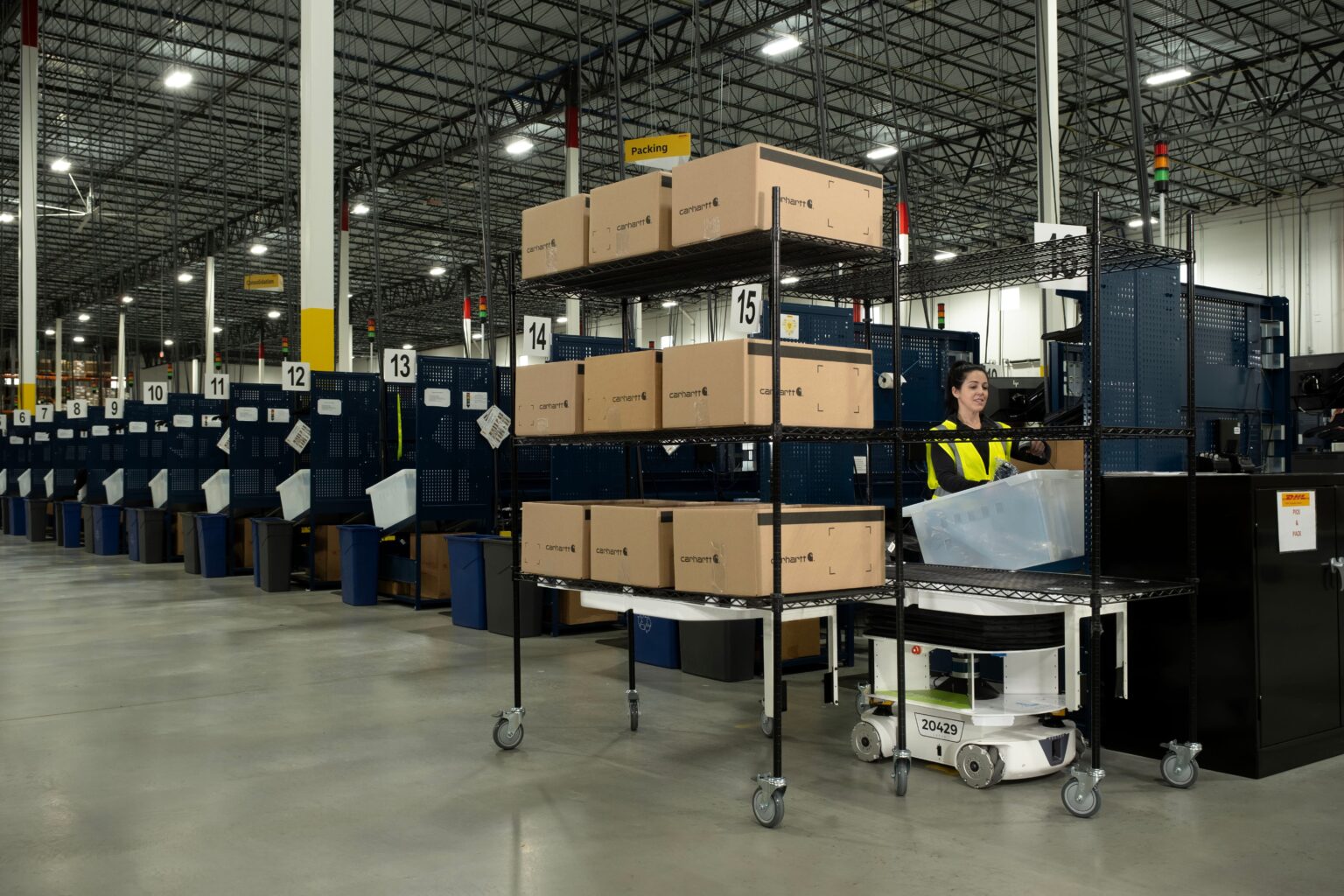
With a Locus Robotics deployment, the robots do the traveling. Orders flow from your warehouse system to the fleet, and each bot drives itself to the pick locations while associates stay within a compact zone. The worker scans, picks, and drops the item into the robot's tote — guided by clear on-screen prompts on the bot's display — and the full bot heads to packing while the next one rolls up. Because the associate is not walking the whole order, the time between picks collapses. That is where the widely cited 2–3× productivity improvement comes from: not from picking faster, but from removing the dead time between picks.
It is worth being precise about what changes and what does not. The physical act of reaching, scanning, and placing an item is roughly the same as it was before — that is deliberate. Associates keep the muscle memory they already have, so training is measured in hours rather than weeks, and there is no rip-and-replace of your racking. What changes is everything around the pick: the travel, the sequencing, and the handoff to pack. The robots absorb the parts of the job that were never productive in the first place.
Zone density and batching
The gain compounds when the workflow is designed well. Keeping associates in tight zones means short, quick reaches instead of long walks. The system batches and sequences work so each robot's route is efficient and each associate sees a steady stream of picks with minimal idle time. Done right, the worker is almost always either scanning or picking — the productive states — rather than walking or waiting. That density of value-adding activity is what turns a fleet of robots into a genuinely higher lines-per-hour operation.
A few design levers do most of the work here:
- Slotting. Placing fast-moving SKUs where they minimize robot travel and cluster into common orders directly raises hit density in each zone.
- Zone sizing. Zones that are too large reintroduce walking; zones that are too small starve associates of picks. The right size keeps hands busy without reintroducing travel.
- Batch and wave logic. Grouping compatible orders so each robot trip carries more productive picks is where a well-tuned system pulls away from a naive one.
- Fleet sizing. Too few robots and associates wait; too many and robots queue. The right ratio keeps both sides of the handoff flowing.
What the 2–3× actually depends on
The robots are necessary but not sufficient. The size of the gain depends on factors specific to your building: the spread of your SKUs, your average order profile (how many lines, how many units), your slotting, and how well the zones and batching are tuned. An operation with lots of small multi-line orders and good slotting can see the high end of the range; a poorly slotted layout will leave gains on the table. This is why the implementation matters as much as the hardware — the same robots can deliver a 1.5× or a 3× depending entirely on the design around them.
Integration with your warehouse management system is the other decisive factor. The fleet is only as smart as the order data feeding it. When the WMS hands off clean order, inventory, and location data in real time, the batching engine can build efficient trips and keep associates saturated with work. When that connection is brittle, the robots stall waiting for instructions and the productivity curve flattens. Getting the systems integration right — the WMS handshake, the slotting, the exception handling — is where a seasoned integrator earns its keep, and it is a core part of what Actel delivers on every deployment.
The ROI and deployment picture
Because AMRs run on your existing racking and staff, the capital story is different from traditional fixed automation. There is no conveyor to pour concrete for and no mezzanine to build. Actel also offers a Robotics-as-a-Service model, which turns the investment into an operating expense rather than a capital project — you scale the fleet up for peak and down afterward, and the cost tracks the value. For most fulfillment deployments, payback lands in the range of roughly 10 to 22 months, and a facility can go from a signed proposal to live operation in about three months.
That speed matters because picking productivity is rarely a standalone problem. Many operations that fix fulfillment also need to fix the count feeding it — which is why teams pair a Locus rollout with autonomous inventory using the Corvus One drone, keeping inventory accuracy at 99%+ so pickers are not sent to empty locations. If your questions run beyond the warehouse floor to inspection or perimeter security, the same integration discipline extends to platforms like Boston Dynamics Spot, Ghost Robotics Vision 60, and Asylon.
Measure your baseline first
Before you can improve lines per hour, you need to know yours. Pull your current picks-per-hour by shift and zone, and that becomes the baseline every projection is measured against. From there, modeling an AMR deployment is straightforward — our ROI calculators will turn your volumes into a throughput and payback estimate, and you can weigh options side by side on our compare robots page. For a deeper look at how the picking workflow itself works, our post on fulfillment AMRs explained walks through the mechanics, and peak-season fulfillment without overhiring shows how the same fleet flexes with demand.
As a Locus implementation partner led by President Dan Tarpey and his 30-plus years in supply-chain technology, Actel handles the assessment, slotting, zoning, WMS integration, operator training, and ongoing optimization that determine where in the 2–3× range you actually land. That is the difference between owning robots and getting the result. Request a free consultation and we will map the projection directly to your numbers.