
Once you’ve decided warehouse robots make sense for your operation, a quieter but consequential question follows: how do you actually buy them? Do you go straight to the manufacturer, or work through an integration partner? Both paths can put robots on your floor. They lead to very different projects — different timelines, different cost structures, and very different odds of hitting the productivity numbers you signed up for — so it’s worth understanding the trade-offs before you commit to anything.
What “buying direct” really means
Going direct sounds like cutting out the middleman, and for a simple, single-vendor deployment it can work. But a robotics manufacturer’s core business is building and shipping robots at scale, not redesigning your specific warehouse around them. Direct deals often leave the hard parts — physical integration, slotting and workflow design, change management, and ongoing support — either to your team or to a patchwork of third parties you have to coordinate yourself. You’re also negotiating, contracting, and troubleshooting with each manufacturer separately, which gets complicated the moment your operation needs more than one type of robot.
There’s a subtler cost, too. A manufacturer selling direct is incentivized to sell you their hardware, full stop. They aren’t positioned to tell you that a drone would solve your inventory problem better than more forklifts, or that your picking bottleneck is really a slotting issue that robots alone won’t fix. Vendor-neutral advice is hard to get from a company that only makes one thing.
What an integrator actually adds
An integration partner’s job is the part the manufacturer doesn’t do: assessing your operation, designing the workflow, integrating the robots with your warehouse management system, training your operators, and supporting the deployment long after go-live. The robot is one component of a working system, and the system is where the return on investment actually comes from. A good integrator has run this playbook across many buildings and brings the patterns that turn a pile of hardware into a measurable productivity gain — zone design, batching strategy, dock and staging flow, and the integration details that are easy to get wrong the first time.
At Actel Robotics, that lifecycle is the whole engagement. We run it in five stages:
- Assessment — walking your floor, reviewing throughput and labor data, and identifying where automation earns its keep.
- Solution design — matching the right platform (or combination) to the workflow, then modeling the expected impact.
- Deployment and WMS integration — installing the fleet and wiring it into your existing systems so data flows both ways.
- Operator training — getting your team confident and productive with the new equipment, not just certified on paper.
- Ongoing optimization — tuning the system as volumes, SKUs, and seasons change so performance holds over time.
That last stage is where direct-buy projects most often stall. Robots that were dialed in on day one drift out of tune as your catalog and order profile shift. Optimization is a relationship, not a shipment.
The pricing surprise
Buyers often assume going direct must be cheaper because there’s one fewer party in the deal. It frequently isn’t. Established integrators receive wholesale pricing from their vendor partners and can pass it through — so the hardware cost through a partner can match or beat what you’d negotiate on your own, while the integration, training, and support come bundled rather than billed back to you as change orders. At Actel, that wholesale relationship across our partner platforms means you’re not paying a premium for the help; you’re getting it as part of the deal.
The bigger financial lever, though, is how you pay. Many deployments can be structured as Robotics-as-a-Service (RaaS) — an operating expense rather than a capital purchase. That keeps a large upfront number off the balance sheet, aligns cost with usage, and lets you scale the fleet up or down as demand moves. Typical payback on a well-scoped deployment lands in the range of roughly 10 to 22 months, and a facility can go from a signed proposal to a live system in about three months. Our ROI calculators let you sketch those numbers for your own volumes before you ever get on a call, our services overview lays out exactly what each stage covers, and our guide to Robotics-as-a-Service breaks down the model in detail.
Multi-vendor, one point of contact
The strongest case for an integrator shows up when your warehouse needs more than one class of robot — and most serious operations eventually do. Consider a single Gulf Coast distribution center that wants all of the following working together:
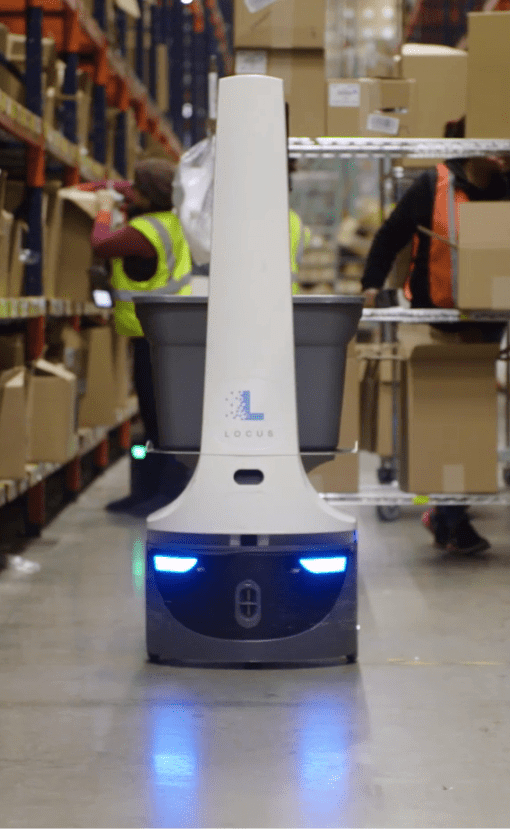
- Locus Robotics fulfillment AMRs to lift picking productivity two to three times on the racking and staff you already have.
- A Corvus One inventory drone that flies pallet aisles with no Wi-Fi, GPS, or infrastructure changes, counts up to twenty times faster than manual methods, and syncs discrepancy reports straight to the WMS — in ambient and freezer zones alike.
- Boston Dynamics Spot for autonomous, repeatable inspection — visual, thermal, and acoustic — including lights-out shifts.
- Ghost Robotics Vision 60 or an Asylon ground-and-aerial package for perimeter security, monitored 24/7.
Buying those four direct means four contracts, four integration efforts, and four support lines — with each vendor politely pointing at the others when something doesn’t line up. An integrator collapses that into one partner, one project plan, and one number to call. When you need multiple platforms working in concert, that single point of accountability is worth a great deal. You can also see how the options stack up on our compare robots page, or start with a single high-ROI use case like autonomous inventory and expand from there.
Risk, safety, and the cost of getting it wrong
Warehousing carries injury rates above the private-sector average, according to BLS data, and much of that risk clusters in exactly the repetitive, high-traffic tasks robots are built to absorb. But safe automation isn’t automatic — it depends on correct commissioning against standards like ANSI/RIA R15.08 for autonomous mobile robots and ISO 3691-4 for automated guided vehicles. Manual cycle counting alone typically ties up two to four full-time employees who could be redeployed to higher-value work. An integrator that installs these systems every week knows how to configure travel paths, safety fields, and human-robot interaction zones correctly the first time. Left to a direct buyer without that experience, safe integration becomes a self-taught project — and the cost of getting it wrong is measured in more than dollars.
When direct makes sense — and the bottom line
Direct buying isn’t always the wrong answer. If you’re a large operator with a mature in-house automation team, a single robot type, and the engineering depth to own integration and support, going straight to the manufacturer can be the right call. For nearly everyone else — especially operations adding robotics for the first time, or running multiple platforms across one or more buildings — a partner lowers risk, compresses the timeline, and usually matches the price thanks to wholesale terms and bundled services. If you want to go deeper on evaluating partners, our guide to choosing a warehouse robotics integration partner walks through the questions that matter.
The honest takeaway: the robot is the easy part. The system around it — design, integration, training, and the steady optimization that keeps performance from drifting — is what separates a deployment that pays for itself from one that becomes shelfware. Want to see which path fits your building? Request a free consultation and we’ll give you a straight answer, even if that answer is “go direct.”
Related reading: If integration risk is what's holding you back, you're not alone — see the 2026 automation gap and how to close it with one high-ROI application and a single accountable integrator.