
Dallas–Fort Worth has quietly become one of the most important logistics hubs in North America. A central location puts a two-day truck route within reach of most of the U.S. population, and the Metroplex now stores, sorts, and ships a growing share of the country's goods. That scale is exactly why more DFW operators are turning to warehouse robotics — not as a science project, but as a practical way to hold inventory accuracy, absorb demand spikes, and run safer facilities without over-hiring. This guide walks through what's driving the trend, where robots actually fit inside a distribution center, and how a Metroplex operator can move from interest to a live deployment.
What's Driving the DFW Logistics Boom
Several forces have converged on the Metroplex at the same time. An inland-port advantage anchored by AllianceTexas and the BNSF intermodal network makes DFW a natural consolidation point. Abundant developable land along the I-35 and I-45 corridors keeps new construction moving. And relentless e-commerce demand from one of the fastest-growing metros in the country keeps throughput requirements climbing. The result is a market building large, high-throughput distribution centers faster than it can reliably staff them.
Warehouse labor remains tight and expensive across the region, and turnover in manual roles like cycle counting and picking is chronic. Those same manual roles carry real safety exposure — the warehousing sector reports injury rates above the private-sector average (BLS), much of it tied to repetitive travel, lifting, and working at height. Robotics addresses all three pressures at once: it reduces dependence on hard-to-fill roles, it takes people out of the most repetitive and physically taxing tasks, and it makes throughput scalable without a proportional headcount increase.
Where Robotics Fits in a DFW Distribution Center
Two problems dominate high-volume DFW facilities: keeping inventory accurate, and moving product to the pack station fast enough during peak. Different platforms solve different halves of that equation, and a well-designed facility often runs more than one.
Inventory Accuracy Without the Manual Count
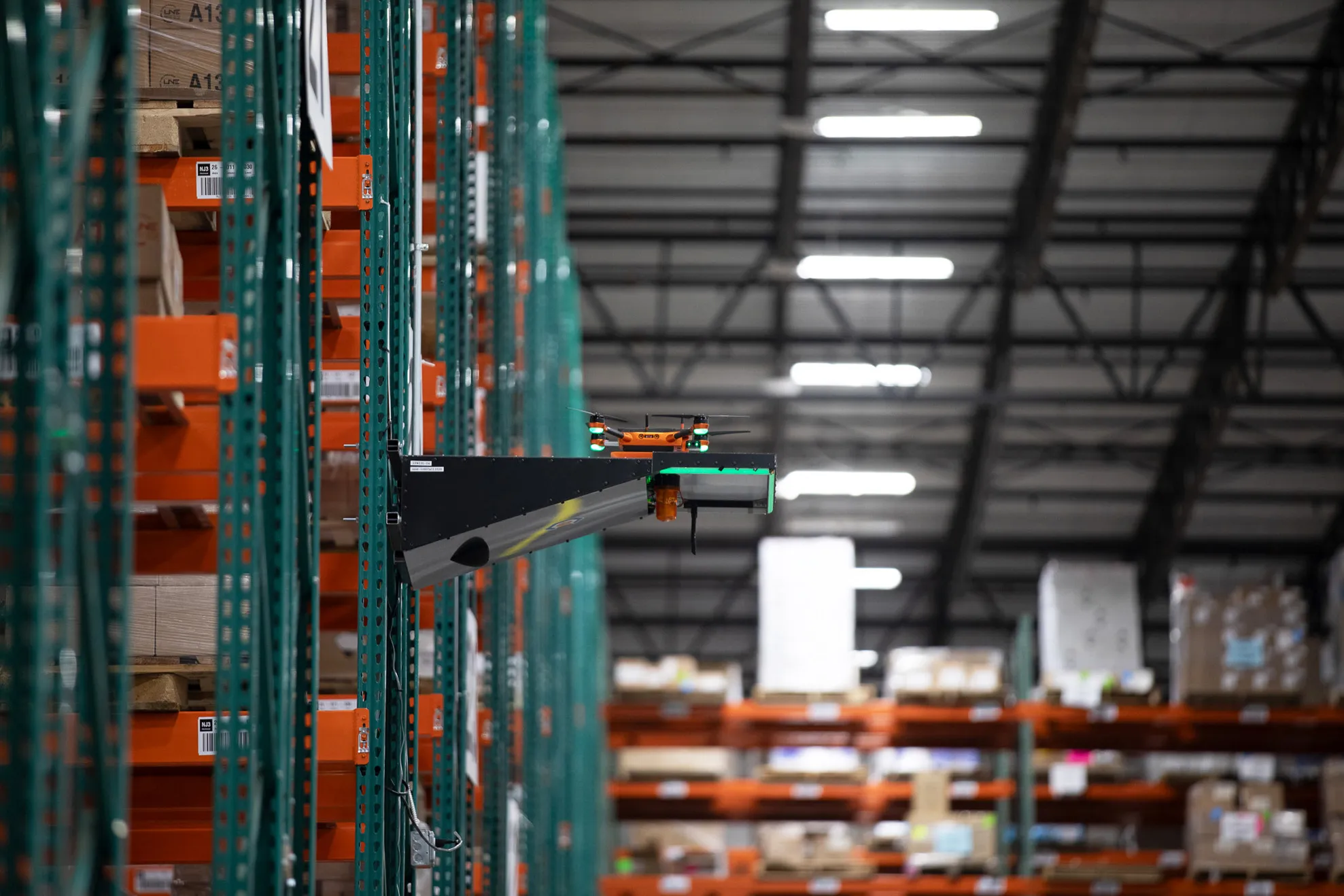
Manual cycle counting typically ties up two to four full-time associates and still leaves gaps between counts. An autonomous inventory drone like the Corvus One flies the pallet aisles on its own using onboard computer vision — no Wi-Fi, GPS, or infrastructure changes required — and counts roughly 20x faster than a manual team. It sustains 99%+ inventory accuracy, syncs discrepancy reports straight into your WMS, and works in ambient, freezer, and cold-chain environments, which matters for the food and grocery DCs concentrated around the Metroplex. No ladders, no aisle shutdowns, and no pulling associates off the floor to count.
Fulfillment Throughput That Scales With Demand
On the fulfillment side, Locus Robotics AMRs lift picking productivity two to three times on your existing racking and workforce. Because the fleet scales up or down with volume, a DC can absorb a holiday or promotional spike without over-hiring and then scale back when the wave passes. That elasticity is exactly what makes robotic fulfillment attractive to mid-market operators, not just national brands.
Inspection and Security for the Building Itself
The same facilities benefit from autonomous inspection and perimeter security. Boston Dynamics Spot runs repeatable visual, thermal, and acoustic inspection routes day or night, handling stairs and rough terrain in lights-out conditions. For outdoor coverage of large DFW yards and truck courts, the rugged Ghost Robotics Vision 60 patrols mud, gravel, and ice, while Asylon pairs ground and aerial robots with 24/7 human monitoring.
Buyer Considerations Before You Deploy
Choosing a platform is only part of the decision. The operators who get the most out of automation tend to weigh a consistent set of factors up front:
- WMS and systems integration. The value of a robot is in the data it feeds back. Confirm how discrepancy reports, pick tasks, and status updates flow into your existing warehouse management system.
- Environment. Ambient versus cold-chain, indoor versus outdoor yard, aisle width, and rack height all shape which platform fits.
- Safety standards. Autonomous mobile robots are governed by ANSI/RIA R15.08 and automated guided vehicles by ISO 3691-4; a serious integrator designs to these from day one.
- Change management. Operators and supervisors need training so the technology augments the team rather than sitting idle.
- Ownership model. Capital purchase versus Robotics-as-a-Service changes both the budget conversation and the payback timeline.
The ROI Math for the Metroplex
Inventory accuracy is where the numbers usually start. Every failed pick from a phantom stock position carries real exception-handling and customer-service cost, and those costs compound at DFW throughput volumes. Autonomous cycle counting closes that gap while freeing the two to four associates a manual program consumes. Across our deployments, typical payback lands in the range of roughly 10 to 22 months, depending on facility size, SKU count, and how the robots are used.
Because most of our work runs on a Robotics-as-a-Service model, the entry point is an operating line item rather than a capital project. That structure is a large part of why mid-market operators are adopting robotics as readily as the national brands — it removes the up-front CapEx hurdle and aligns cost with the value being delivered. You can pressure-test the economics for your own building with our ROI calculator or by comparing platforms side by side.
From Proposal to Live in About Three Months
As an authorized integrator for six platforms, Actel Robotics runs the full lifecycle rather than dropping off hardware: assessment, solution design, deployment, WMS and systems integration, operator training, and ongoing optimization. Led by President Dan Tarpey, who brings more than 30 years in supply-chain technology and automation, the team designs to your throughput and environment rather than a generic template. A typical DFW facility can go from signed proposal to live operation in about three months. You can see the full scope on our services page, and read how we think about deployment in our other field guides.
Dallas–Fort Worth is scaling faster than the labor market can keep up, and the operators who automate the right tasks now will hold the accuracy, throughput, and safety edge as volumes keep climbing. Actel Robotics designs, deploys, and services robotics across Texas, Louisiana, and Oklahoma — and we're actively growing our presence in the Metroplex. Contact us for a free facility assessment and we'll map exactly where automation pays off in your building.