
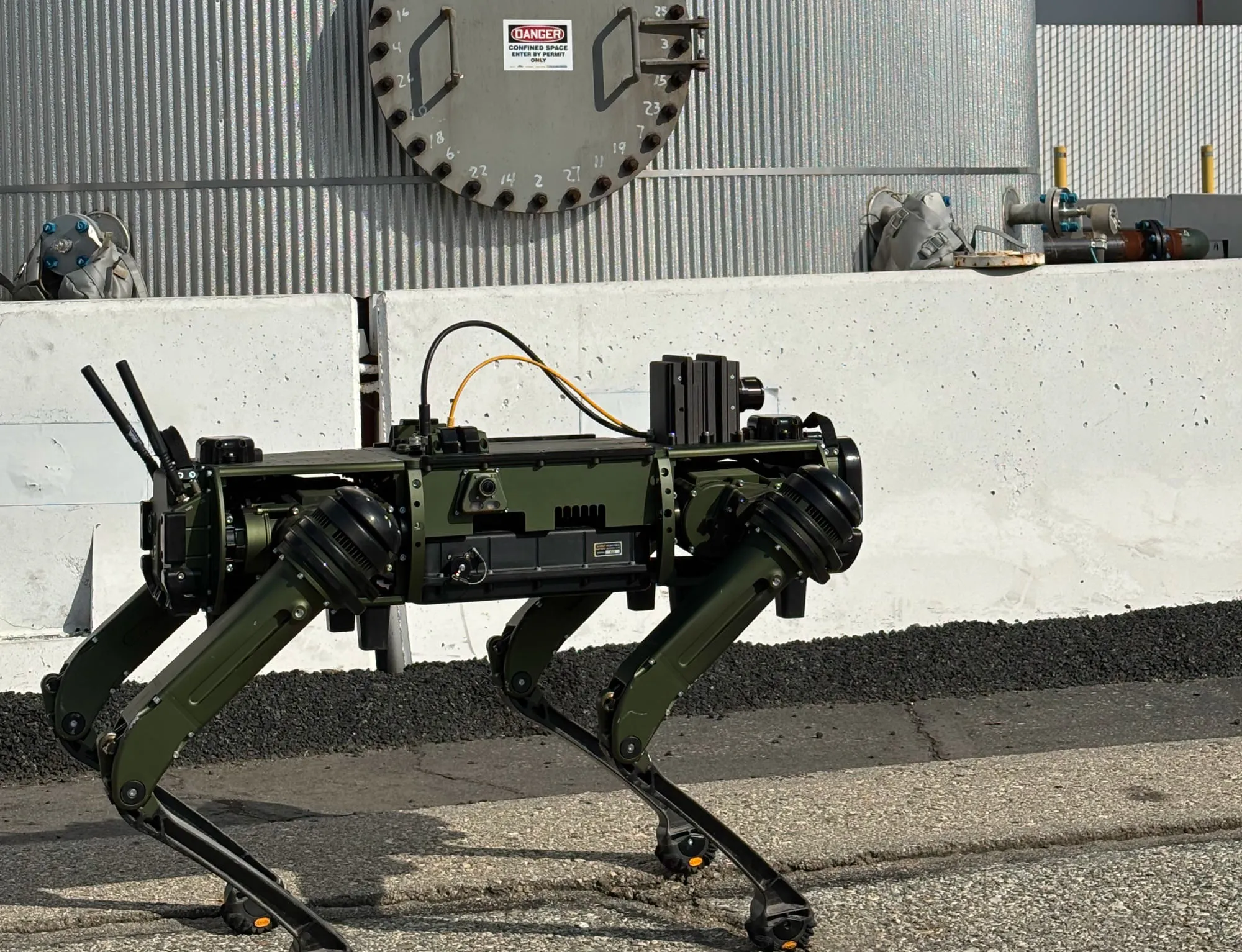
Data centers are a different kind of security problem than a typical industrial site. The value inside is enormous, the footprint is often a sprawling multi-building campus, and the tolerance for a missed patrol round is close to zero — a breach or even a documented near-miss can trigger client notifications, insurance scrutiny, and compliance findings that a warehouse break-in never would. That combination of high stakes and large, hard-to-staff perimeters is exactly why quadruped robots — commonly nicknamed "security dogs" — are showing up on data center campuses across Texas.
This post covers what a quadruped security robot actually does on a data center perimeter, how it fits into a layered security program, and what facility and security teams should weigh before deploying one.
Why Data Center Perimeters Are a Hard Problem for People Alone
A hyperscale or colocation campus can span dozens of acres, with fence lines, generator yards, substations, and cooling infrastructure spread across a footprint that takes real time to walk. A human guard force covering that ground on foot or in a vehicle faces the same structural problem every physical security program does: coverage is only as consistent as the person walking the route, and headcount doesn't scale cheaply to cover every corner around the clock. Add Texas heat, sudden storms, and construction zones from an actively expanding campus, and the gaps between patrol rounds are where risk concentrates.
A fixed camera network helps, but it has the same limitation everywhere: it watches specific points and records what crosses them. It doesn't move, and a determined intruder who has studied a site can often find the blind spot between cameras. A patrolling robot changes that math — it is mobile, its route can vary, and its presence signals active monitoring rather than passive recording.
What a Quadruped "Security Dog" Actually Does
The Ghost Robotics Vision 60 is a rugged, all-terrain quadruped robot, IP67-rated and trusted by the U.S. Air Force, built to walk perimeters that would stall a wheeled robot — gravel access roads, drainage ditches, mud after a storm, curbs, and stairs around mechanical yards. Deployed through Asylon as the DroneDog platform, it follows configured patrol routes on a set schedule or continuously, logging every round with timestamped video.
What a data center gets from a robotic patrol dog
- Consistent, documented rounds — every patrol timestamped and recorded, producing an audit trail that satisfies compliance and insurance reviewers without relying on a guard's paper log
- All-weather, all-terrain coverage — legged mobility across generator yards, substations, and unpaved construction zones that a wheeled robot or golf cart struggles with
- 24/7 patrol without proportional headcount — lights-out rounds through overnight hours that are hardest and most expensive to staff with people
- Active deterrence — a visible, moving robot changes the risk calculation for anyone surveilling the site ahead of an intrusion attempt
- Integration with existing access control and CCTV — the robot's alerts and video feed into the same security stack the facility already runs, rather than becoming a separate silo
Ground Plus Air: The Layered Model for Campus-Scale Sites
On a large data center campus, the strongest programs don't rely on the ground robot alone. When the Vision 60 flags something — motion near a substation fence, a gate that shouldn't be open — an aerial Asylon Guardian drone can launch from its dock and reach the location in seconds, giving an overhead view that a ground unit or a single guard cannot. A Robotic Security Operations Center (RSOC), staffed by human security professionals around the clock, reviews the combined ground-and-air picture and makes the actual call — escalate, dispatch, or stand down. The robots gather and confirm; a trained person still decides. For a campus with multiple buildings and a perimeter that would otherwise demand a large standing guard force, that ground-plus-air-plus-human model is what makes continuous coverage realistic.
What Robotic Patrol Does Not Replace
A quadruped robot is not a replacement for access control, badging, or human response to a confirmed incident — it replaces the most repetitive, lowest-consistency part of a security program: walking the same route and documenting it faithfully every time. The strongest data center security programs redeploy people from routine perimeter rounds toward the judgment-heavy work — incident response, credential audits, vendor escort — while the robot's logs become the backbone of the site's security reporting.
Deployment Considerations Specific to Data Centers
Campus phasing
Many Texas data center campuses are still under active construction while earlier phases are already live. Patrol routes and geofences need to be revisited as new buildings, fencing, and access points come online — a static route configured at initial go-live can go stale within months on a fast-growing campus.
Sensitive infrastructure zones
Substations, generator yards, and fuel storage areas typically carry their own access restrictions independent of the general perimeter. Patrol routes and alert thresholds should be configured with facility engineering, not just the security team, so the robot's proximity to high-voltage or fuel-handling equipment is accounted for from the start.
Coordination with facility inspection
Data centers already running autonomous thermal inspection on power and cooling equipment can often extend the same robotics relationship to perimeter security, giving one integrator accountability for both programs instead of two disconnected vendors.
Deployment Timeline and Economics
Actel Robotics offers Ghost Robotics and Asylon systems on a Robotics-as-a-Service basis, which turns the deployment into a predictable monthly cost rather than a large capital purchase — hardware, software, monitoring, and support are bundled into the subscription. Across the security platforms we deploy, typical payback lands in the 10-to-22-month range, driven by reduced overnight guard staffing, fewer loss and liability events, and the compliance value of a complete, timestamped patrol record. A facility can typically move from signed proposal to a live patrol program in about three months, including route planning, integration with existing access control and CCTV, and staff training.
See our security and surveillance solutions page for the full platform lineup, or read how the ground-and-air model comes together in our companion article on drone security for data centers.
If perimeter coverage gaps, rising guard costs, or compliance documentation are on your radar for a Texas, Louisiana, or Oklahoma data center, the fastest way to find out whether robotic patrol fits is a site assessment. Contact Actel Robotics to walk your perimeter with our team.