
"Automated warehouse systems" covers an enormous range — from a single inventory drone flying the aisles at night to a fully automated storage-and-retrieval building humming under lights-out operation. For most operations managers, the hard question isn't which individual technology is best. It's how the pieces fit together, which problem each one actually solves, and in what order to deploy them so that every dollar of automation builds on the last. This guide maps the modern warehouse automation stack, explains how each layer reinforces the others, and lays out a practical, ROI-first sequence for getting there without betting the whole operation on one giant project.
The Four Layers of the Automation Stack
A modern automated warehouse combines four complementary layers. Each attacks a different bottleneck, and each performs noticeably better when the others are in place. Understanding them as a stack — rather than a shopping list of competing gadgets — is the single most useful mental model for planning automation.
Inventory automation: the data foundation
Every downstream system assumes the inventory record is correct. If it isn't, automation simply moves the wrong product faster. Inventory automation keeps that record continuously accurate. Autonomous drones such as the Corvus One from Corvus Robotics fly pallet aisles and scan barcodes using onboard computer vision — no Wi-Fi, GPS, or infrastructure changes required. The system counts roughly 20x faster than manual cycle counting, sustains 99%+ inventory accuracy, and syncs discrepancy reports straight into the WMS. It runs in ambient warehouses and in freezer and cold-chain environments where sending people to count is slow, costly, and unpleasant. This is the layer that pays for everything above it, which is why our warehouse inventory automation solution is almost always the first recommendation.
Picking and fulfillment automation: the labor layer
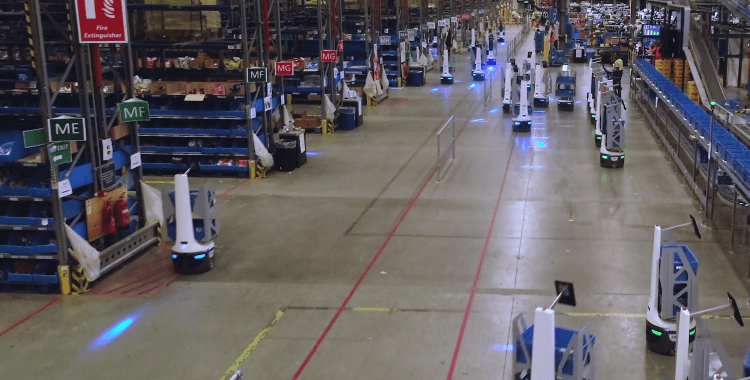
Order picking is where labor cost concentrates, and where pickers can spend more time walking than picking. Collaborative autonomous mobile robots (AMRs) like Locus Robotics meet pickers at the rack, carry totes, and optimize routes so each associate covers less ground and touches more units per hour. In practice this lifts picking productivity 2–3x on your existing racking and existing staff — no rip-and-replace of the building. Because the fleet scales up and down with demand, you add robots for peak season and pull them back afterward. Our warehouse fulfillment solution covers how these AMRs slot into an operation without halting it.
Material-handling automation: the throughput layer
Conveyance, sortation, and automated storage-and-retrieval systems (AS/RS) move and store goods at very high throughput. This layer delivers the most raw capacity, but it also demands the most capital, the longest installation, and the most fixed commitment to a given building layout. Standards such as ISO 3691-4 for automated guided vehicles govern how this equipment operates safely alongside people. Because it is expensive and hard to reverse, heavy material handling is rarely the right first move — it's the payoff you invest in once the accuracy and labor layers have proven the volume is there.
Inspection and security automation: the protection layer
The fourth layer protects the facility and the equipment the other three depend on. Agile quadrupeds like Boston Dynamics Spot run autonomous, repeatable inspection routes — visual, thermal, and acoustic — climbing stairs and crossing rough terrain day, night, or lights-out to catch failing equipment before it stops production. For perimeter and yard security, the rugged Ghost Robotics Vision 60 all-terrain UGV patrols mud, gravel, ice, and Gulf Coast heat, while Asylon pairs ground DroneDog and aerial Guardian units with 24/7 human monitoring from a remote security operations center. See our robotic inspection and security and surveillance pages for how these fit a warehouse campus.
Why Deployment Order Matters
The most common and most expensive mistake is automating throughput before automating accuracy. Picking AMRs and AS/RS both assume the system record reflects reality. When inventory is wrong, automated systems don't fix the error — they execute it at speed, generating mispicks, short shipments, and phantom stockouts faster than a manual operation ever could. Starting with inventory automation corrects the data foundation cheaply, then makes every later layer measurably more effective.
There's a workforce dimension too. Manual cycle counting typically ties up two to four full-time employees who could be redeployed to higher-value work, and warehousing carries injury rates above the private-sector average (per BLS). Automating the counting and inspection tasks first tends to improve both safety and morale before you ask the team to adapt to bigger changes on the pick line.
How the Layers Reinforce Each Other
The real value of automated warehouse systems isn't any single machine — it's the compounding effect of an accurate data layer driving automated physical work. Continuously verified inventory feeds the WMS. The WMS directs the picking AMRs to the right locations. The AMRs hand consolidated orders off to material-handling automation for sortation and shipping. Inspection robots keep the conveyors, chargers, and racking those systems rely on in good working order. Pull the accuracy layer out and everything above it degrades; put it in first and every subsequent investment starts from a stronger base.
Buyer Considerations and ROI Framing
When evaluating an automation program, weigh a few factors beyond sticker price:
- Capital vs. operating expense. Robotics-as-a-Service (RaaS) turns automation into a predictable monthly operating cost instead of a large CapEx outlay, which lowers the barrier to starting and makes it easy to scale a fleet with seasonal demand.
- Payback period. Well-scoped deployments typically reach payback in roughly 10 to 22 months, driven by recovered labor hours, fewer inventory errors, and avoided safety and shrink costs.
- Time to value. A facility can go from signed proposal to live operation in about three months, so the return clock starts quickly rather than after a multi-year build.
- Safety standards and compliance. Reputable AMR and AGV deployments follow ANSI/RIA R15.08 and ISO 3691-4 — worth confirming with any integrator.
- Vendor independence. Because no single manufacturer is best at every layer, an integrator that works across platforms can design the stack around your operation instead of forcing your operation to fit one product line.
Run your own numbers with our ROI calculators, and use compare robots to see how the platforms line up against your bottlenecks.
Building It as a Program, Not a Purchase
Because each layer is modular, you don't need a single mega-project — and you shouldn't attempt one. Many facilities begin with inventory automation on a RaaS subscription, prove the accuracy gains and the labor savings, then add fulfillment AMRs and, later, heavier material handling as volume justifies it. As a warehouse-robotics systems integrator, Actel Robotics manages the full lifecycle: facility assessment, solution design, deployment, WMS and systems integration, operator training, and ongoing optimization. Led by President Dan Tarpey, who brings 30+ years in supply-chain technology and automation, the team is an authorized integrator across Corvus, Locus, Boston Dynamics, Ghost Robotics, and Asylon. For a deeper look at the subscription model, see our explainer on Robotics-as-a-Service, and our inventory automation roadmap for the recommended first phase. You can also review our end-to-end integration services.
The takeaway is simple: treat automation as a sequenced program that starts with accurate data, and each layer will make the next one pay off faster. Actel Robotics serves distribution centers across Texas, Louisiana, and Oklahoma. Contact us to schedule a free facility assessment and map a phased automation plan built around your operation — not a vendor's catalog.