
Warehouse automation is no longer a single decision — it's a sequence. In 2026, a modern distribution center can automate inventory counting, order picking, put-away, inspection, and security independently, then layer them together over time. That flexibility is powerful, but it also makes the buying decision harder: it's easy to automate the wrong bottleneck first. This guide breaks down the major categories of warehouse automation systems, explains what each one is actually good at, and shows how to sequence them so the first investment funds the next.
The Four Layers of Warehouse Automation
Every warehouse automation program falls into one of four layers. Thinking in layers keeps you from over-buying — and from pouring capital into a system that solves a problem you don't actually have yet.
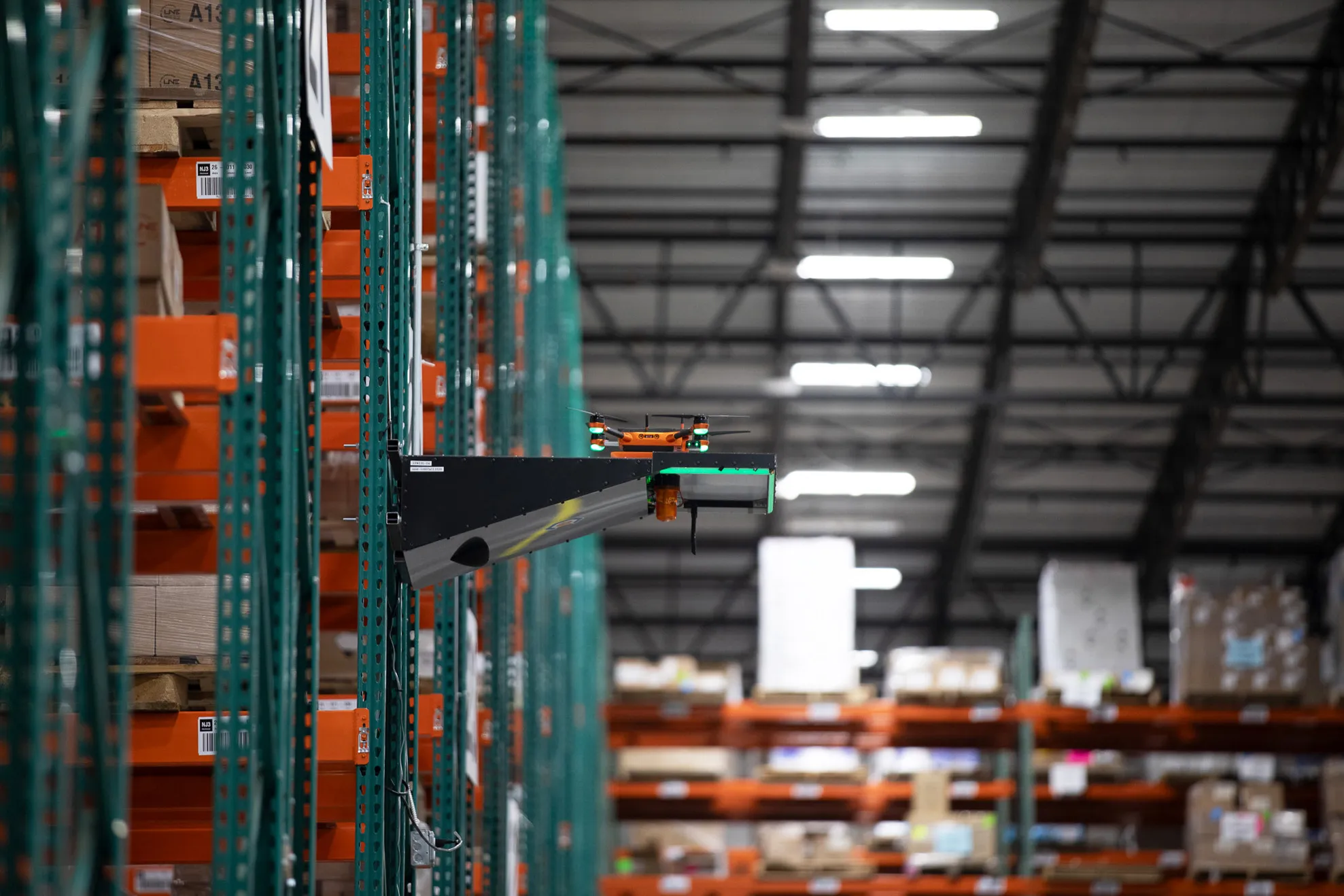
1. Inventory automation. This is the layer most facilities should automate first, because it has the shortest payback and the least operational disruption. Autonomous inventory drones like the Corvus One fly the pallet aisles after hours, read every barcode with onboard computer vision, and reconcile the count against your WMS — replacing weeks of manual cycle counting with a fully autonomous nightly pass that sustains 99%+ accuracy. Because it needs no Wi-Fi, GPS, or infrastructure changes, it drops into an existing building without a construction project.
2. Fulfillment automation. Autonomous mobile robots (AMRs) such as Locus Robotics collaborate with human pickers to cut walking time, lifting picks-per-hour by two to three times on the racking and staff you already have. This is the highest-labor-savings layer for e-commerce and high-throughput distribution centers, and it scales up or down as demand swings through peak season.
3. Fixed automation (AS/RS & conveyance). Automated storage and retrieval systems, sortation, and conveyor networks deliver enormous throughput but demand major capital and long installation windows. They earn their keep at very high, stable volumes — not as a first step, and rarely for a facility still working out where its real constraints are.
4. Inspection & security automation. Quadruped and drone platforms automate facility inspection and perimeter security, protecting the building, the people, and the equipment that the other three layers depend on. These systems often justify themselves on safety exposure and guard cost rather than throughput.
How Each System Actually Works on the Floor
The category names hide big differences in how these systems behave day to day.
An inventory drone operates on a schedule you set — typically overnight or during a shift gap. It follows the aisles autonomously, captures location-level barcode data, and pushes a discrepancy report straight into your inventory management workflow, flagging exactly which locations disagree with the system of record. Because the Corvus One runs on onboard computer vision, it works the same in an ambient facility or a freezer and cold-chain environment where staff shouldn't be spending hours counting.
Fulfillment AMRs work differently: they're collaborative. A robot meets the picker at the right location, the picker places items on the robot, and the robot handles the long walk to pack-out while the picker moves to the next pick. That division of labor is why fulfillment automation raises throughput without forcing a rip-and-replace of your racking or a wholesale change to how your team works.
Inspection and security platforms are built for repeatability and terrain. Boston Dynamics Spot is an agile quadruped that runs the same visual, thermal, and acoustic inspection route on a schedule, climbing stairs and crossing rough terrain in day, night, or lights-out conditions. For outdoor perimeters, the Ghost Robotics Vision 60 is a rugged all-terrain UGV built for mud, gravel, ice, and Gulf Coast heat, while Asylon combines ground DroneDog and aerial Guardian units with 24/7 human monitoring from a remote security operations center.
Why Inventory Automation Comes First
Inventory accuracy is the foundation every other automation layer stands on. Fulfillment AMRs, WMS-driven slotting, and AS/RS all assume the system record matches physical reality. When it doesn't, you get failed picks, phantom stockouts, and safety-stock bloat that quietly erodes margin. Automating an inaccurate inventory just lets you make the same mistakes faster.
Automating the count first fixes that foundation cheaply. Manual cycle counting typically ties up two to four full-time employees and still leaves gaps between counts; a drone-based system reads the barcodes already on your pallets — no re-racking, no per-SKU tagging cost, no infrastructure retrofit — and runs roughly 20 times faster than a manual count. That combination of low disruption and fast, repeatable accuracy is why we recommend it as the entry point to a broader roadmap. Our warehouse inventory automation roadmap covers the sequencing in detail.
Robotics-as-a-Service Changed the Math
The single biggest shift in warehouse automation over the last few years is the move from capital purchase to Robotics-as-a-Service (RaaS). Instead of a seven-figure capital outlay that has to clear a capital committee, facilities subscribe to an automation outcome — robots, software, maintenance, and support bundled together — as a predictable operating expense. That reframes the decision entirely.
Under a RaaS model, the questions that matter change:
- Payback, not purchase price. Most deployments reach payback in roughly 10 to 22 months, so the relevant comparison is monthly cost versus monthly labor and error savings — not a lump sum.
- Opex vs. capex. Treating automation as an operating line item removes the depreciation and up-front budget hurdle that has stalled many warehouse projects.
- Risk transfer. Maintenance, software updates, and support sit with the integrator, so obsolescence and uptime are our problem, not yours.
You can model these trade-offs for your own facility with our ROI calculators before committing to anything.
Deployment, Safety, and What to Expect
A common objection is that automation means months of downtime and disruption. In practice, the low-infrastructure layers deploy fast: a facility can go from signed proposal to a live system in about three months. The work that fills that window is integration and enablement, not construction.
Actel Robotics runs the full lifecycle: facility assessment, solution design, deployment, WMS and systems integration, operator training, and ongoing optimization. That last step matters because automation is not set-and-forget — count schedules, pick paths, and inspection routes all get tuned as your volumes and SKU mix change. Safety is engineered in from the start: warehousing carries above-average injury rates according to the BLS, and modern platforms are built to recognized standards including ANSI/RIA R15.08 for mobile robots and ISO 3691-4 for automated guided vehicles, so robots and people share the floor safely.
Because Actel is an authorized integrator for five platforms rather than a single-product vendor, we can recommend the system your bottleneck actually calls for — or tell you that you're not ready for a given layer yet. If you want to compare capabilities side by side, our robot comparison tool lays out the options.
Building Your Warehouse Automation Roadmap
A pragmatic 2026 roadmap for a mid-size Texas distribution center usually looks like this: automate inventory counting first for the fastest ROI and lowest disruption, add fulfillment AMRs where labor cost and pick volume justify them, then evaluate fixed automation only once volumes are high and stable enough to earn the capital. Inspection and security automation slot in wherever safety exposure or guard cost is highest. The point of sequencing is that each layer strengthens the business case for the next: accurate inventory makes fulfillment automation more effective.
Actel Robotics is an authorized integrator for Corvus Robotics, Locus Robotics, Boston Dynamics, Ghost Robotics, and Asylon, serving Texas, Louisiana, and Oklahoma from Sugar Land — so we can sequence the right systems for your facility rather than selling you a single platform. Explore our integration services, model the numbers with our ROI calculators, or contact us for a free facility assessment and we'll help you decide which layer to automate first.