
The stretch of the Mississippi River from Baton Rouge south to New Orleans is one of the densest concentrations of petrochemical, refining, and heavy-industrial capacity in the world. Add the Port of Greater Baton Rouge, sprawling tank farms, distribution centers, and the logistics operations that serve them, and you have a region where inspection and security are constant, high-stakes, and increasingly hard to staff with people alone. Skilled labor is tight, turnover on hazardous roles is high, and the cost of a missed leak or an unguarded perimeter is measured in millions, not hours. That combination is exactly where autonomous robots earn their keep — and why more South Louisiana operators are moving them from pilot to production.
The Inspection Challenge in South Louisiana
Refineries and chemical plants run thousands of inspection points — piping, valves, heat exchangers, pump seals, flare stacks, gauges, and confined spaces — that traditionally require people walking routes in hazardous or hard-to-reach locations, often several times a shift. Warehousing and industrial work already carry above-private-sector-average injury rates according to the Bureau of Labor Statistics, and the Gulf Coast adds heat, humidity, and classified areas on top of that baseline. Every manual round is a person exposed to an environment you would rather keep them out of.
The Boston Dynamics Spot quadruped runs those routes autonomously, day or night, in lights-out conditions, carrying thermal, acoustic, and visual payloads to catch a hot bearing, a gas leak, a failing steam trap, or a gauge reading that has drifted out of range before it becomes an incident. Because Spot handles stairs and rough terrain, it reaches the racks, catwalks, and pump rows that wheeled platforms cannot. Every pass is logged and repeatable, so instead of a clipboard reading you get a trended data record that turns reactive maintenance into predictive maintenance.
For the most dangerous work of all, robotic inspection lets you send a machine into a confined vessel, tank, or trench instead of a person. Removing that single task from the human column eliminates the highest-risk permit on many sites and often shortens the turnaround window that surrounds it.
Autonomous Perimeter Security for Plants and Terminals
Louisiana's industrial facilities are large, remote, and often subject to federal chemical-facility security and other regulatory requirements. Guard coverage of a sprawling tank farm, dock, or terminal is expensive, and overnight coverage is where staffing gaps and fatigue show up most. Robots do not skip a patrol, and they document every one.
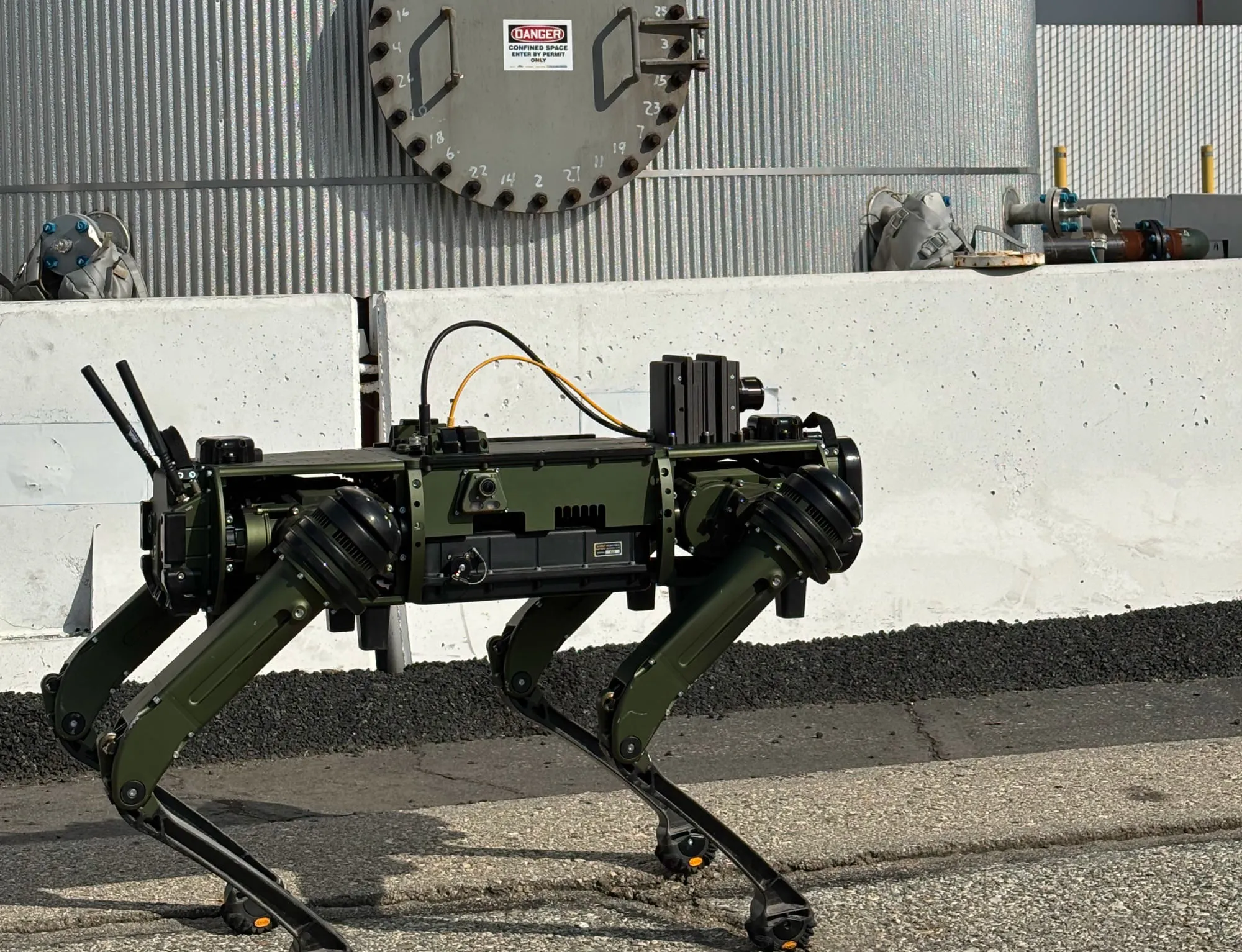
The Ghost Robotics Vision 60 is a rugged, all-terrain quadruped UGV built for outdoor perimeter security in exactly the conditions the Gulf Coast throws at it — mud, gravel, ice, standing water, and sustained heat. It patrols fence lines, laydown yards, and rail sidings that a wheeled robot would bog down in. For sites that need full ground-plus-air coverage, Asylon pairs an autonomous ground robot (DroneDog) with an aerial drone (Guardian) and backs both with 24/7 human monitoring from a remote security operations center. That combination turns a thin overnight guard roster into full-perimeter awareness with a live human in the loop to verify alarms and dispatch response.
What autonomous security actually delivers
- Consistent, documented coverage — every patrol is logged with time-stamped visual evidence, which supports audit and compliance reporting.
- Force multiplication — a small human team supervises robots covering ground it could never walk on foot each night.
- Faster, safer response — send a robot to investigate an alarm first, so people only enter when there is a confirmed reason to.
- All-weather reliability — platforms rated for heat, rain, and rough terrain keep working when conditions degrade guard performance.
Building the ROI Case
Autonomous inspection and security are not just safety plays — they carry a defensible financial case. The costs they offset are real and recurring: overtime on hazardous rounds, contract guard hours, unplanned downtime from failures caught too late, and the insurance and incident exposure that comes with people in dangerous environments. When you add trended condition data that pushes maintenance from reactive to predictive, avoided outages often become the largest line in the model.
Actel offers a Robotics-as-a-Service (RaaS) model so a deployment lands as an operating expense rather than a capital project — no large up-front purchase, no depreciation schedule, and a predictable monthly cost that scales with the work. Across our platforms, typical payback lands in roughly the 10-to-22-month range depending on scope and how many manual routes a system replaces. To sketch the numbers for your own site before you commit, our ROI calculators and platform comparison are a fast starting point, and a site assessment turns those estimates into a facility-specific proposal.
Why an Integration Partner Matters Here
No single robot solves a plant's inspection and security needs, and getting robots to work reliably in a classified, high-heat, high-vibration environment is its own discipline. Autonomy has to be mapped to real routes, payloads matched to what you actually need to detect, data pushed into the systems your teams already use, and the whole deployment brought in line with safety standards such as ANSI/RIA R15.08 for mobile robots. Buying a robot is easy; making it produce a dependable result on a live industrial site is not.
Actel Robotics is a warehouse and industrial robotics systems integrator based in Sugar Land, Texas, serving Texas, Louisiana, and Oklahoma. We are the authorized integrator for all six platforms referenced here, which means we recommend the right combination for your facility rather than pushing a single product line. Led by President Dan Tarpey, who brings more than 30 years in supply-chain technology and automation, our team handles the full lifecycle: assessment, solution design, deployment, integration with your existing systems, operator training, and ongoing optimization. You get one accountable partner standing behind the operating result instead of coordinating four separate vendors.
From proposal to live in about three months
A typical facility moves from signed proposal to a live, working deployment in roughly three months. That includes the on-site assessment, route and mission design, platform configuration, integration and testing, and hands-on training so your own people can run the system with confidence. Beyond inspection and security, the same integration discipline extends to fulfillment and inventory work with platforms like Locus Robotics and Corvus One for the distribution and logistics operations that support the corridor — so a single partner can grow with your automation roadmap.
The Takeaway for Baton Rouge Operators
South Louisiana's industrial corridor runs on assets that have to be inspected constantly and protected around the clock, and doing both with people alone is getting harder and more expensive every year. Autonomous inspection and security robots take the most hazardous, repetitive tasks off your team, deliver documented and audit-ready coverage, and build a payback case that a plant manager can defend — all without a capital outlay when deployed as a service. If you are running a plant, terminal, tank farm, or distribution center in the Baton Rouge region, the practical next step is a no-obligation site assessment to see which platforms fit your routes, risks, and budget. Contact Actel Robotics to book yours and start building a deployment plan tailored to your facility.