
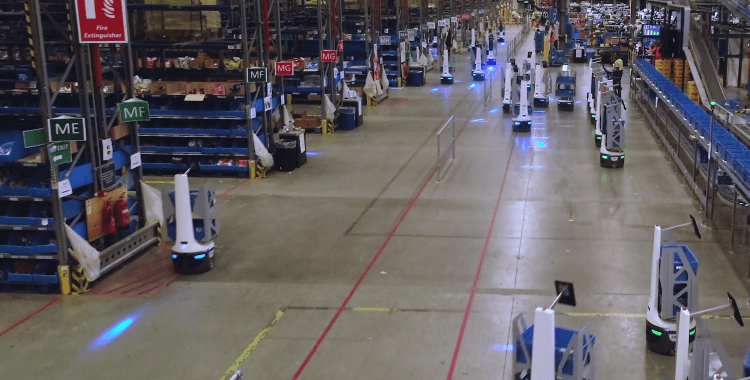
Whenever we scope a robotics project, the first question from the floor is the same: “Is it safe to run this around my people?” It is the right question — and in 2026 the answer is governed by a mature body of standards, not marketing claims. Warehousing already carries injury and illness rates above the private-sector average, according to the U.S. Bureau of Labor Statistics, so any technology added to the floor has to make that picture better, not worse. Here is what actually keeps autonomous systems and human workers safe in the same building, and what a responsible deployment looks like from assessment through daily operation.
The Standards That Govern Warehouse Robots
Modern warehouse automation is regulated by a specific, overlapping set of consensus standards. Knowing which one applies to which machine is the difference between a compliant deployment and a liability waiting to happen.
- ANSI/RIA R15.08 — the American National Standard for industrial mobile robot (AMR) safety, published by the Association for Advancing Automation (A3). It governs how autonomous mobile robots detect, slow for, and stop around people and obstacles.
- ISO 3691-4 — the international standard for driverless industrial trucks and automated guided vehicles (AGVs), covering guided material-handling equipment.
- ISO 10218 and the collaborative-operation technical specification ISO/TS 15066 — the framework for fixed and collaborative robot arms working near or with people.
Reputable manufacturers design and test their platforms against the relevant standard. But conformance is not a sticker on the robot — it is a property of the whole installed application: the robot, the space it runs in, the traffic patterns, and the people around it. That is why a competent systems integrator matters. Actel Robotics verifies that the deployed application, not just the machine in isolation, meets the standard for your building.
How AMRs Sense and Avoid People
The reason fulfillment AMRs can share aisles with pickers is layered, safety-rated sensing. Locus robots and comparable AMRs combine LiDAR scanners, 3D cameras, and sensor fusion to continuously map the space and everyone moving through it. The control logic manages what R15.08 calls speed and separation: the robot travels at full speed in clear zones, slows automatically as it approaches people or congestion, reroutes around obstacles, and comes to a protective stop if someone enters its safety field.
The design principle is important. Safety is engineered into the robot's behavior rather than delegated to your associates. Workers are not asked to memorize keep-out zones or stay out of the machine's way; the machine yields to them. That is what makes AMRs practical for high-throughput fulfillment operations where robots and staff share the same footprint all shift long, and it is why picking productivity can climb two to three times on existing racking without adding physical barriers between people and equipment.
Aerial Drones in an Occupied Warehouse
Autonomous inventory drones take a different but equally deliberate approach to safety. The Corvus One flies pallet aisles using onboard computer vision — no Wi-Fi, GPS, or facility infrastructure changes required — and geofenced flight paths keep the aircraft inside a defined envelope. Counts typically run during off-hours or lights-out windows, or in aisles separated from active work, so the drone is not sharing airspace with forklifts and foot traffic.
The safety payoff is twofold. First, the flight itself is contained and predictable. Second, and more significant, the drone eliminates the most dangerous version of the task it replaces. Manual high-bay cycle counting means people on ladders, order pickers, or reach trucks working at height for hours — exactly the fall and struck-by exposures that make inventory counting one of the riskier recurring jobs in a warehouse. Moving that work to an autonomous aircraft that sustains 99%+ inventory accuracy and counts roughly 20 times faster than a manual crew keeps your team on the ground. See how it fits a broader warehouse inventory program.
Ground and Perimeter Robots: Safety Beyond the Aisles
Safety standards and safe design extend past picking and counting. For inspection and security work, purpose-built robots take people out of environments that are hazardous by nature.
Autonomous inspection
Boston Dynamics Spot performs repeatable robotic inspection rounds — visual, thermal, and acoustic — climbing stairs and crossing rough terrain in day, night, or lights-out conditions. That means fewer people entering confined spaces, walking energized areas, or manually reading gauges in zones where a slip or a missed reading carries real consequences.
Perimeter and outdoor security
For the yard and the fence line, the Ghost Robotics Vision 60 is a rugged all-terrain quadruped built for mud, gravel, ice, and Gulf Coast heat, while Asylon pairs ground (DroneDog) and aerial (Guardian) patrols with 24/7 human monitoring from a remote security operations center. Both keep guards out of dark, remote, or weather-exposed patrol routes while extending coverage. Explore the full security and surveillance approach, or see Spot in detail.
Why Robots Often Improve Overall Facility Safety
Beyond their own engineered safeguards, robots improve safety by removing people from the tasks that hurt them. Manual cycle counting at height, repetitive long-distance walking and lifting in fulfillment, and inspection in confined or hazardous spaces are all associated with injuries and workers'-comp exposure. Manual counting alone typically ties up two to four full-time employees who are exposed to those risks shift after shift. Shifting that work to machines is a measurable safety win — a theme we cover in depth in how warehouse robots cut injuries and comp costs.
There is a financial dimension to that safety story as well. Fewer recordable incidents can mean lower workers'-compensation costs, less overtime backfilling injured staff, and reduced turnover. Those savings sit alongside the direct labor and accuracy gains that drive automation's return on investment. Across our deployments, Robotics-as-a-Service pricing turns the whole program into an operating expense rather than a capital outlay, and typical payback lands in roughly the 10-to-22-month range. You can model your own numbers with our ROI calculators.
What a Safe Deployment Plan Includes
A responsible rollout is far more than plugging in a robot. Actel Robotics is a full-lifecycle integrator, and safety is built into every stage:
- Application risk assessment — evaluating your specific traffic, racking, and workflows against the standard that applies.
- Solution design and verification — confirming the installed application, not just the robot, conforms to R15.08, ISO 3691-4, or the relevant spec.
- Zoning, signage, and WMS integration — clear shared-zone markings and clean data flow into your warehouse management system.
- Operator and maintenance training — so your team knows how the system behaves and how to work with it confidently.
- Emergency-stop and recovery procedures — defined, documented, and practiced before go-live.
- Ongoing optimization — because a safe deployment stays safe only if it is monitored and tuned.
Handled this way, a facility can move from a signed proposal to a live, safely operating system in about three months. The result is a floor where autonomous machines and people work side by side by design, not by luck.
Safety is not a feature you bolt on at the end — it is the foundation of every project we scope. If you are weighing automation and want a partner who treats standards compliance and worker safety as non-negotiable, talk to Actel Robotics about a safe path forward. You can also compare the platforms we deploy or review our full range of integration services to see where autonomous systems fit your operation.